📊 Experiments & Results
Evaluation Setup
Evaluation of reward model accuracy against human judgments and utility in downstream RL tasks.
Benchmarks:
- EditReward-Bench (Reward Model Evaluation) [New]
- GEdit-Bench (Image Editing Quality)
Metrics:
- Preference Prediction Accuracy (human alignment)
- Editing Success Rate (for RL policy)
- CLIP Score / LPIPS (traditional metrics)
- Statistical methodology: Two-annotator discussion protocol for ground truth creation to ensure high agreement.
Key Results
| Benchmark | Metric | Baseline | This Paper | Δ |
|---|---|---|---|---|
| EditScore outperforms both open-source and proprietary baselines on the newly proposed EditReward-Bench. | ||||
| EditReward-Bench | Accuracy | 84.41 | 86.36 | +1.95 |
| EditReward-Bench | Accuracy | 72.43 | 86.36 | +13.93 |
| Using EditScore for Reinforcement Learning significantly improves the editing capabilities of the OmniGen2 model. | ||||
| GEdit-Bench | Success Rate | Not explicitly reported in the paper | Not explicitly reported in the paper | +14.6 |
Experiment Figures
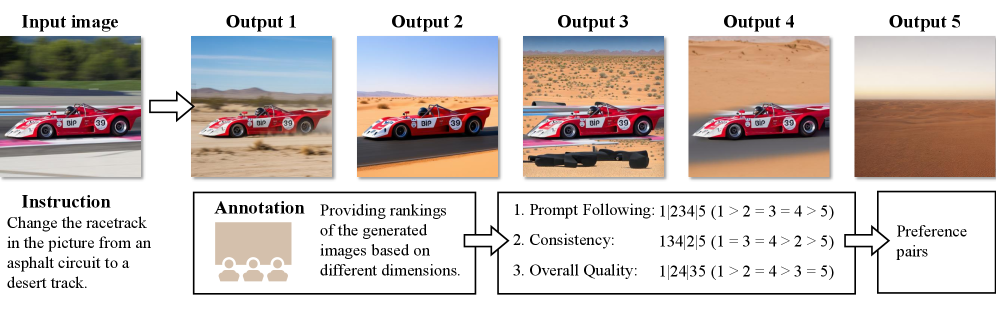
Comparison of EditScore accuracy vs. other VLMs (GPT-4o, Gemini, etc.) on EditReward-Bench.
Main Takeaways
- High-fidelity reward modeling is the unlock for RL in image editing; general VLMs are too noisy.
- Inference-time ensembling (Self-Ensemble) provides a consistent performance boost, allowing open-source models to beat proprietary giants like GPT-5.
- The proposed EditReward-Bench provides a much-needed standardized evaluation for this domain, covering diverse tasks from simple attribute changes to complex reasoning.
- RL training with EditScore improves not just prompt following but also the preservation of unedited regions (consistency).