📝 Paper Summary
Agentic RAG pipeline
Autonomous AI Agents
This survey conceptualizes and taxonomizes Agentic RAG, a paradigm shifting from static retrieval to autonomous agents that dynamically orchestrate reasoning, tool use, and iterative refinement for complex queries.
Core Problem
Traditional RAG systems rely on static, linear workflows that struggle with multi-step reasoning, dynamic query adaption, and seamless contextual integration.
Why it matters:
- Static RAG often yields fragmented or generic outputs because it cannot iteratively refine retrieval based on intermediate insights.
- Latency and scalability issues arise when traditional systems must query large datasets without intelligent routing or filtering.
- Complex real-world tasks (e.g., medical diagnosis, financial forecasting) require multi-hop reasoning that linear retrieve-read pipelines cannot support.
Concrete Example:
For a query like 'What lessons from renewable energy policies in Europe can be applied to developing nations?', a traditional RAG might retrieve disjointed policy documents without synthesis. An Agentic RAG would decompose the query, retrieve policy data, contextualize it for developing regions, and synthesize an economic analysis iteratively.
Key Novelty
Agentic RAG Taxonomy and Framework Integration
- Proposes a paradigm where the RAG pipeline is managed by autonomous agents rather than hard-coded logic.
- Integrates agentic patterns—Reflection (self-correction), Planning (sub-task decomposition), Tool Use (API calls), and Multi-Agent Collaboration—directly into the retrieval-generation loop.
- Classifies frameworks into single-agent, multi-agent, and graph-based architectures to handle varying levels of query complexity.
Architecture
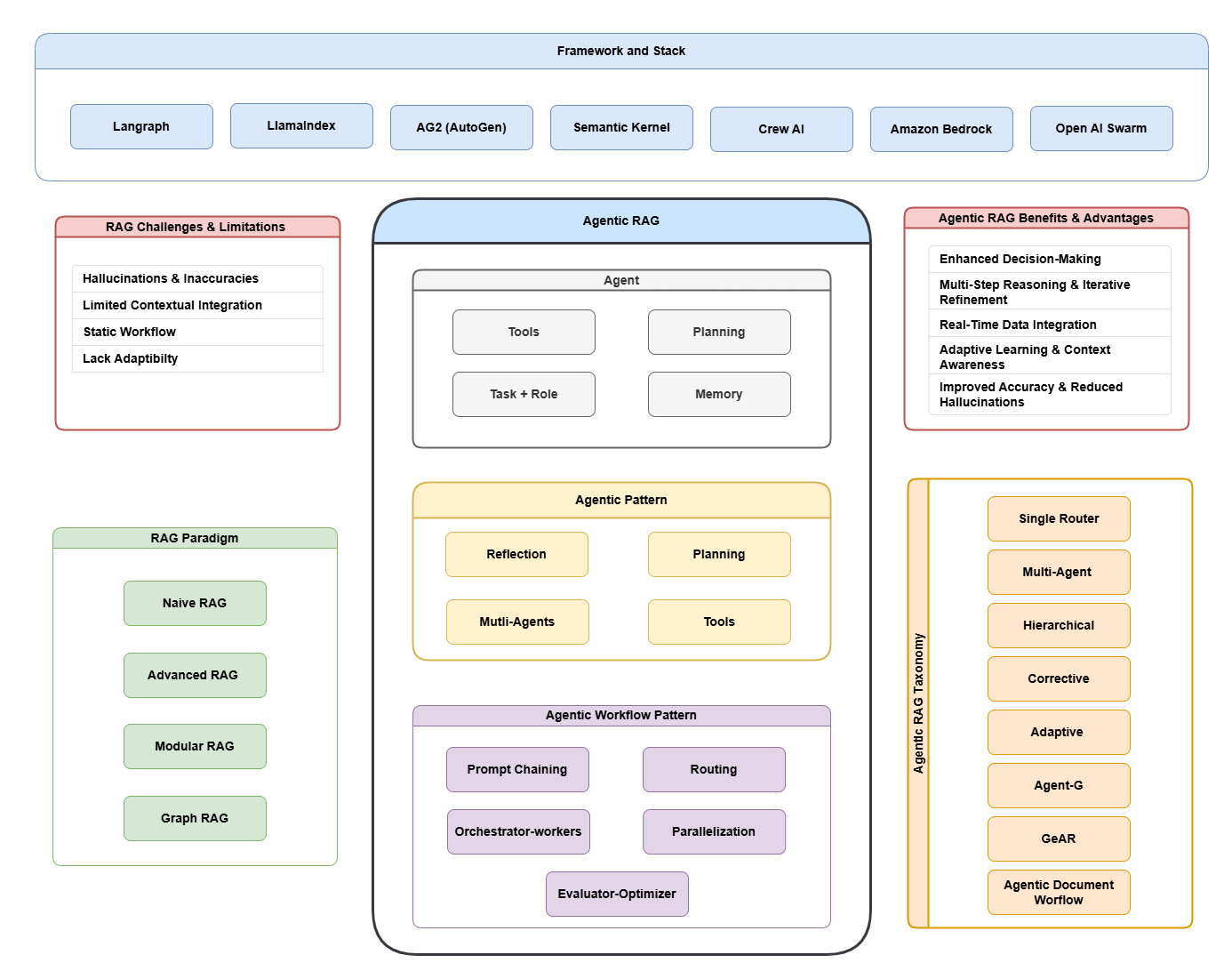
Overview of Agentic RAG, contrasting it with Traditional RAG.
Evaluation Highlights
- Not reported in the paper (Survey paper without empirical experiments)
- This is a survey paper reviewing existing methodologies rather than proposing a new model with benchmark results.
Breakthrough Assessment
7/10
Comprehensive survey that effectively defines the emerging field of Agentic RAG, providing a useful taxonomy and contrasting it with Naïve, Modular, and Graph RAG, though it lacks original experimental contributions.