TRPA improves LLM reasoning by converting rule-based evaluations into preference pairs and optimizing them via a trust-region constrained objective that guarantees monotonic improvement toward a target distribution.
Core Problem
Reward-based RL (like PPO) suffers from complexity and reward hacking, while current online preference-based methods (like Online DPO) lack theoretical guarantees for reasoning tasks, often leading to instability and inferior performance compared to rule-based baselines.
Why it matters:
Reasoning tasks require precise, stable optimization where standard alignment methods often fail to converge or generalize
Existing online DPO methods exhibit theoretical bias (not optimizing the true target distribution), preventing them from matching the performance of methods like GRPO
Designing explicit reward functions is difficult and prone to 'hacking', where models maximize the score without solving the problem
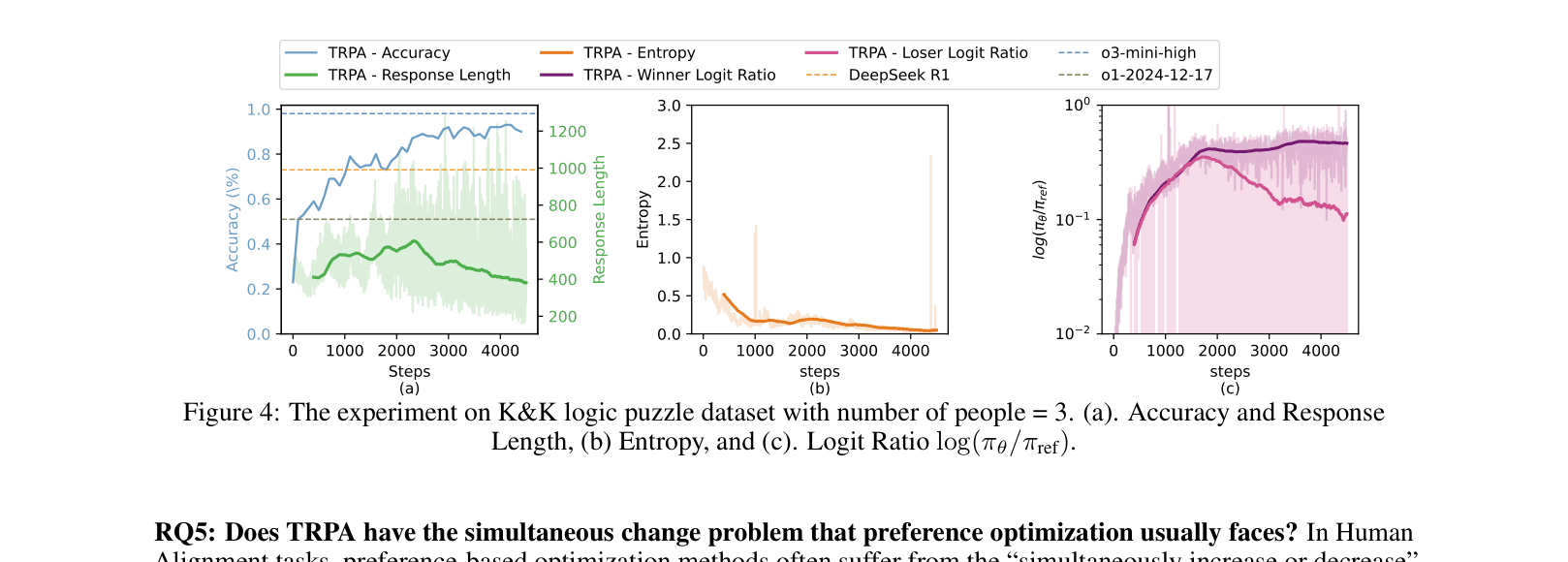
Concrete Example:In logic puzzles, standard Online DPO often causes the 'simultaneous change' problem where the probabilities of both correct (winner) and incorrect (loser) responses increase together. TRPA's update rule ensures the winner's logit ratio increases while the loser's decreases, as shown in the paper's analysis of logit trajectories.
Key Novelty
Trust Region Preference Approximation (TRPA)
Converts rule-based checks (format, accuracy) into discrete preference levels (Level 1 to 4) to construct training pairs dynamically during online rollouts
Introduces a KL-regularized preference loss that approximates the 'Posterior Boltzmann' target distribution, providing a theoretical monotonic improvement guarantee lacking in Online DPO
Applies 'Kahneman-Tversky Preference Optimization' (KTPO), using anisotropic hyperparameters to weigh high-quality responses differently, inspired by human sensitivity to gains/losses
Architecture
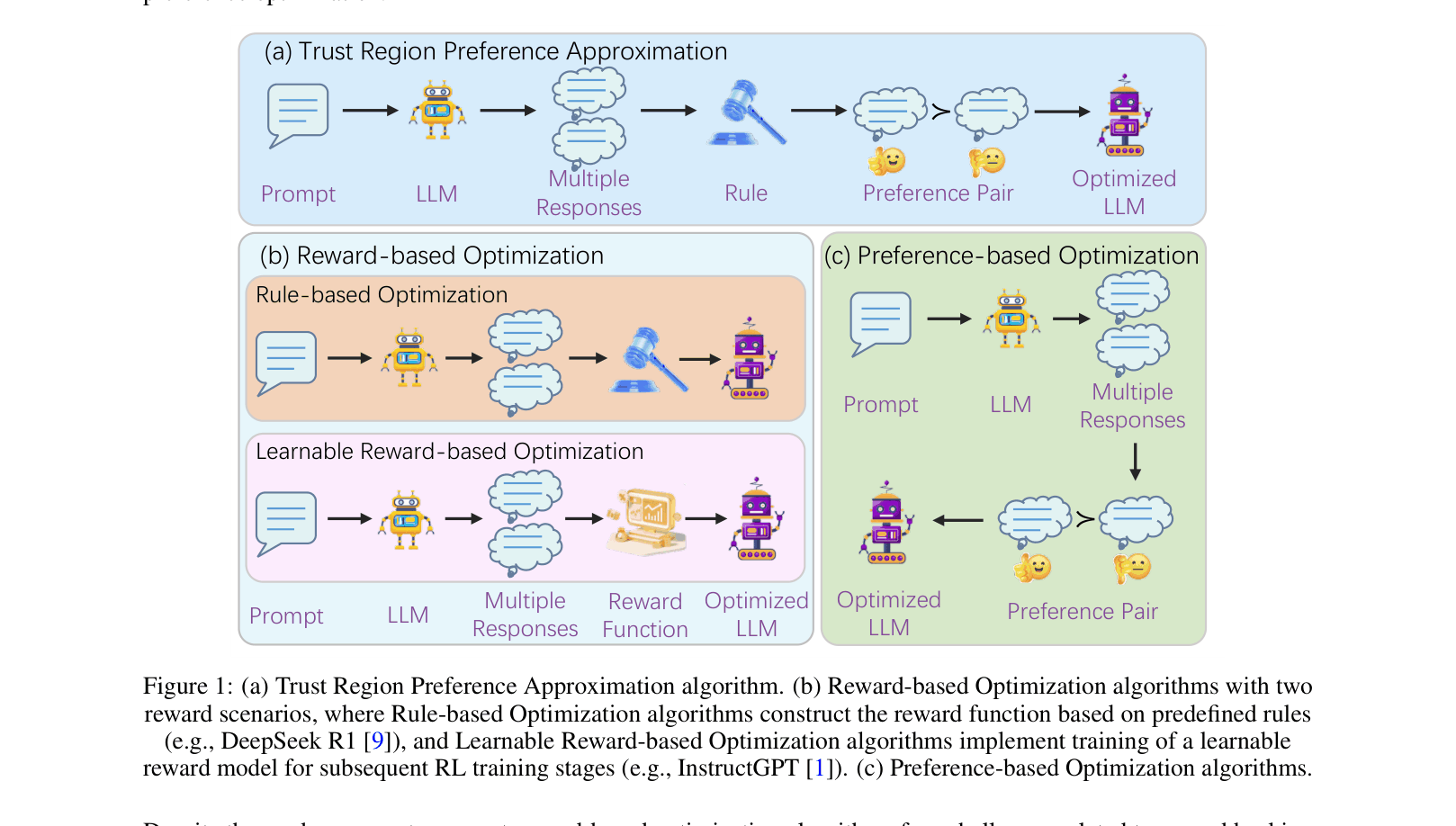
Comparison of RL pipelines: (a) TRPA, (b) Reward-based Optimization (like PPO/GRPO), and (c) Preference-based Optimization.
Evaluation Highlights
Achieves 93.8% average accuracy on K&K logic puzzles, matching o3-mini-high (93.5%) and significantly outperforming DeepSeek-R1 (80.7%)
Improves mathematical reasoning on AIME 2024 to 57%, a +14 point absolute gain over the base DeepSeek-R1-Distill-Qwen-7B model (43%)
Demonstrates strong Out-Of-Distribution (OOD) generalization, scoring 86% on 8-person logic puzzles (unseen during training) compared to DeepSeek-R1's 83% and GPT-4o's 11%
Breakthrough Assessment
8/10
Offers a theoretically grounded fix to Online DPO's instability and matches or beats specialized reasoning baselines (GRPO, DeepSeek-R1) with a simpler, reward-free preference framework.
⚙️ Technical Details
Problem Definition
Setting: Reinforcement learning for reasoning where a policy generates solution chains that are evaluated by predefined rules
Inputs: Reasoning prompt x (e.g., math problem, logic puzzle)
Outputs: Reasoning chain y containing chain-of-thought and final answer
Pipeline Flow
Prompting: Policy generates multiple responses for a prompt
Rule Evaluation: Responses are classified into Preference Levels (1-4)
Pair Construction: Construct preference pairs (y_winner, y_loser) based on levels
Optimization: Update policy using TRPA loss with KTPO and KL regularization
System Modules
Policy Model
Generates reasoning responses
Model or implementation: Qwen2.5-7B-Instruct or DeepSeek-R1-Distill-Qwen-7B
Rule Evaluator
Assigns preference levels to responses based on format and correctness
Model or implementation: Rule-based script (Python function)
Pair Constructor
Creates training pairs from evaluated responses
Model or implementation: Deterministic logic
TRPA Optimizer
Updates policy weights
Model or implementation: Gradient Descent with TRPA Loss
Novel Architectural Elements
Integration of rule-based discrete preference levels directly into an online DPO-style loop
KTPO mechanism: Anisotropic beta scaling that applies stronger constraints/weights when the winning response is optimal (Level 1)
Modeling
Base Model: Qwen2.5-7B-Instruct-1M (Logic tasks) / DeepSeek-R1-Distill-Qwen-7B (Math tasks)
Training Method: Trust Region Preference Approximation (TRPA)
Objective Functions:
Purpose: Maximize likelihood of preferred responses while staying close to the previous policy.
vs. GRPO: TRPA is preference-based (no reward function construction), uses KL constraint against old policy, and employs KTPO.
vs. Online DPO: TRPA adds a trust region (KL penalty vs old policy) and anisotropic beta (KTPO), with proofs of monotonic improvement toward the correct target distribution.
vs. PPO: TRPA avoids training a separate reward model / value function for the preference signal (though it implicitly uses rules as ground truth).
Limitations
Relies on the ability to define clear rules for preference levels (harder for open-ended creative tasks)
Theoretical guarantees rely on the assumption that the preference data fits the Bradley-Terry model
Requires generating multiple responses (rollouts) per prompt during training, which is computationally intensive compared to offline methods
Code is publicly available on GitHub. Hyperparameters (LR, batch size) are explicitly reported. Base models are open weights (Qwen, DeepSeek).
📊 Experiments & Results
Evaluation Setup
Reasoning tasks with verifiable ground truth
Benchmarks:
K&K Logic Puzzle (Logic Reasoning (Knights and Knaves))
AIME 2024 (Mathematical Reasoning)
MATH 500 (Mathematical Reasoning)
Olympiad Bench (Mathematical Reasoning)
Metrics:
Pass@1 Accuracy
Statistical methodology: Not explicitly reported in the paper
Key Results
Benchmark
Metric
Baseline
This Paper
Δ
K&K Logic Puzzle (Avg)
Pass@1
0.807
0.938
+0.131
K&K Logic Puzzle (OOD, 8 people)
Pass@1
0.83
0.86
+0.03
AIME 2024
Pass@1
0.43
0.57
+0.14
MATH 500
Pass@1
0.86
0.87
+0.01
Olympiad Bench
Pass@1
0.47
0.63
+0.16
Experiment Figures
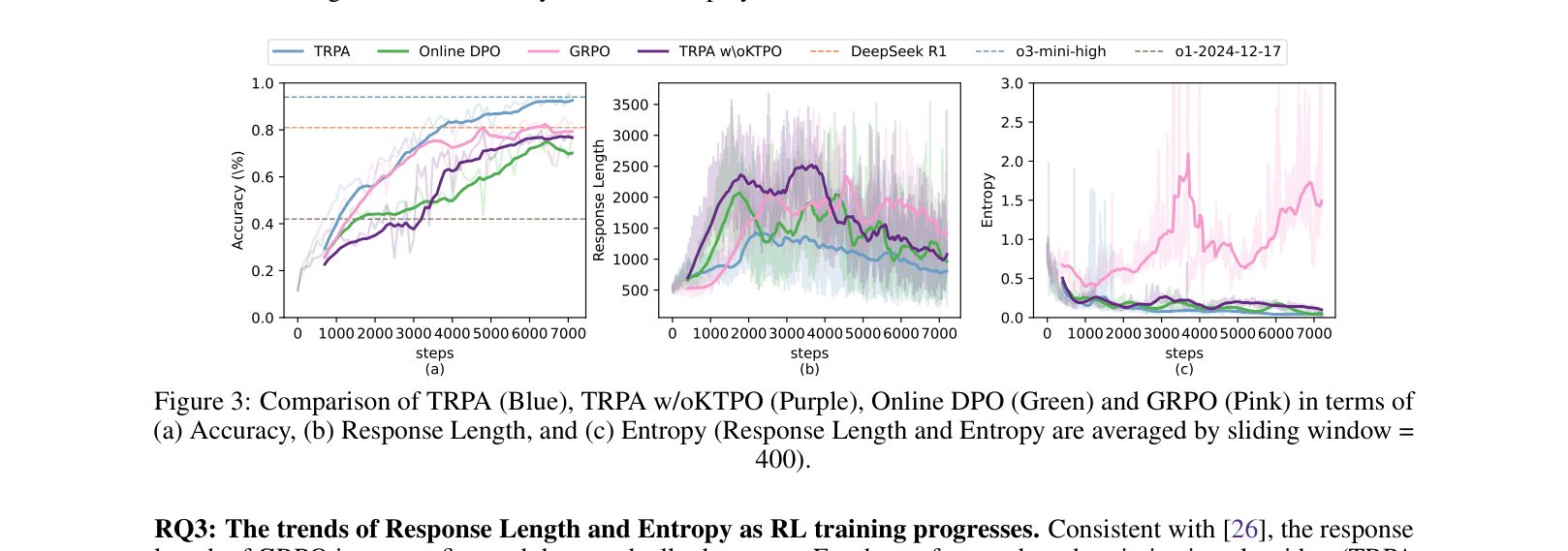
Training curves for Accuracy, Response Length, and Entropy comparing TRPA, Online DPO, and GRPO.
Logit ratios of Winner vs Loser responses over training steps.
Main Takeaways
TRPA significantly improves reasoning capabilities over base models and reward-based baselines like GRPO, especially on hard tasks (AIME, Logic Puzzles).
The algorithm exhibits strong stability in training, maintaining lower response lengths and stable entropy compared to GRPO, which tends to oscillate.
Ablation studies confirm the importance of the KTPO technique; removing it leads to worse accuracy and higher entropy.
TRPA mitigates the 'simultaneous change' problem seen in preference optimization, where winner and loser probabilities move in the same direction.
📚 Prerequisite Knowledge
Prerequisites
Reinforcement Learning with Human Feedback (RLHF)
Direct Preference Optimization (DPO)
Proximal Policy Optimization (PPO)
Kullback-Leibler (KL) Divergence
Key Terms
TRPA: Trust Region Preference Approximation—the proposed algorithm that combines rule-based preference construction with a KL-constrained optimization objective
Online DPO: A variant of Direct Preference Optimization where data is sampled from the current policy during training rather than a fixed dataset
GRPO: Group Relative Policy Optimization—a reward-based RL algorithm that normalizes rewards within a group of outputs for the same prompt
PBA: Posterior Boltzmann Approximation—a class of algorithms whose loss function theoretically targets the optimal Boltzmann distribution defined by the reward
KTPO: Kahneman-Tversky Preference Optimization—a technique in TRPA that scales the DPO coefficient beta based on the preference level of the response, inspired by Prospect Theory
Reward Hacking: When an RL agent learns to exploit flaws in the reward function to get high scores without actually performing the intended task correctly
Chain-of-Thought: A prompting technique where the model generates intermediate reasoning steps before the final answer