AEnt adapts entropy regularization for LLMs by calculating entropy only on top-k tokens and dynamically adjusting the coefficient, preventing the failures of standard entropy methods in large vocabulary spaces.
Core Problem
Standard entropy regularization, widely used in classic RL, fails in LLM training because the vocabulary space is massive and optimal tokens are sparse.
Why it matters:
Without entropy control, policy gradient methods like PPO/GRPO suffer from collapse, where the model over-reinforces locally optimal actions and stops exploring.
Existing entropy bonuses introduce massive bias in LLMs because pushing probability mass to hundreds of thousands of irrelevant tokens drowns out the signal for the few correct ones.
Current LLM-RL methods often abandon entropy regularization entirely due to these failures, missing out on potential exploration and stability gains.
Concrete Example:In a math reasoning task, an LLM might get stuck repeating a specific format that yields partial reward but incorrect answers. Standard entropy regularization would try to force the model to explore all 100,000+ tokens equally, effectively destroying the coherent generation needed to solve the problem, rather than just exploring plausible alternative reasoning steps.
Key Novelty
Adaptive Clamped Entropy (AEnt)
Calculates entropy using a re-normalized policy over a small, dynamic set of 'top-k' tokens rather than the full vocabulary, focusing exploration on plausible next tokens.
Automatically adjusts the entropy coefficient during training to keep the clamped entropy within a target range, increasing regularization when the policy collapses and decreasing it when exploration is sufficient.
Architecture
The pseudocode for the AEnt algorithm, detailing the loop of data sampling, advantage estimation, and the specific update steps for the policy and entropy coefficient.
Evaluation Highlights
+3.4% accuracy on MATH dataset using Qwen2.5-Math-1.5B compared to the GRPO baseline.
+5.4% accuracy on MATH dataset using DeepSeek-R1-Distill-Qwen-1.5B compared to the GRPO baseline.
Outperforms static entropy regularization and recent methods like constant-coefficient entropy consistently across multiple benchmarks.
Breakthrough Assessment
7/10
Offers a theoretically grounded and empirically effective fix for a known failure mode in LLM-RL (entropy regularization). While a modification to existing algorithms rather than a new paradigm, it significantly improves standard baselines.
⚙️ Technical Details
Problem Definition
Setting: Finite-horizon Markov Decision Process (MDP) for sequential token generation
Inputs: Input token sequence (query) s
Outputs: Next token a from vocabulary A
Pipeline Flow
Policy Rollout (generate responses)
Clamped Entropy Calculation (on top tokens)
Coefficient Adjustment (dynamic tuning)
Policy Update (GRPO + Entropy Bonus)
System Modules
Policy Model
Generates reasoning traces and answers
Model or implementation: Qwen2.5-Math-1.5B or DeepSeek-R1-Distill-Qwen-1.5B
Entropy Controller
Computes the adaptive entropy bonus and updates the coefficient
Model or implementation: AEnt Algorithm
Novel Architectural Elements
Dynamic entropy coefficient adjustment mechanism based on clamped entropy bounds
Loss function integrating clamped entropy over a reduced token space
Modeling
Base Model: Qwen2.5-Math-1.5B and DeepSeek-R1-Distill-Qwen-1.5B
Training Method: AEnt (applied on top of GRPO)
Objective Functions:
Purpose: Optimize policy to maximize reward while staying close to old policy.
Formally: Standard GRPO objective (E[min(r_t A_t, clip(...) A_t)]).
Purpose: Encourage exploration within plausible tokens.
Formally: L_AEnt = L_GRPO + lambda * H_clamped(pi), where H_clamped is entropy of renormalized top-k probabilities.
vs. GRPO: AEnt adds an adaptive exploration bonus.
vs. Entropy-Regularized GRPO: AEnt computes entropy on truncated vocabulary to reduce bias from irrelevant tokens.
vs. TRPO [not cited in paper]: TRPO constrains updates via KL divergence; AEnt encourages exploration via entropy but clamps the space to avoid noise.
Limitations
Theoretical analysis relies on simplified softmax policy assumptions.
Experimental validation is limited to math reasoning tasks.
Requires careful tuning of the entropy target ranges (H_low, H_high).
Reproducibility
Code availability is not provided. Hyperparameters for the baseline GRPO and the specific bounds for AEnt (lambda_low, H_low, etc.) are not detailed in the main text.
📊 Experiments & Results
Evaluation Setup
Math reasoning tasks using Chain-of-Thought (CoT) prompting.
Benchmarks:
MATH (Mathematical reasoning (various difficulties))
GSM8K (Grade school math)
Metrics:
Accuracy (Pass@1)
Statistical methodology: Not explicitly reported in the paper
Key Results
Benchmark
Metric
Baseline
This Paper
Δ
MATH
Accuracy
69.0
72.4
+3.4
MATH
Accuracy
72.0
77.4
+5.4
MATH
Accuracy
73.5
77.4
+3.9
Experiment Figures
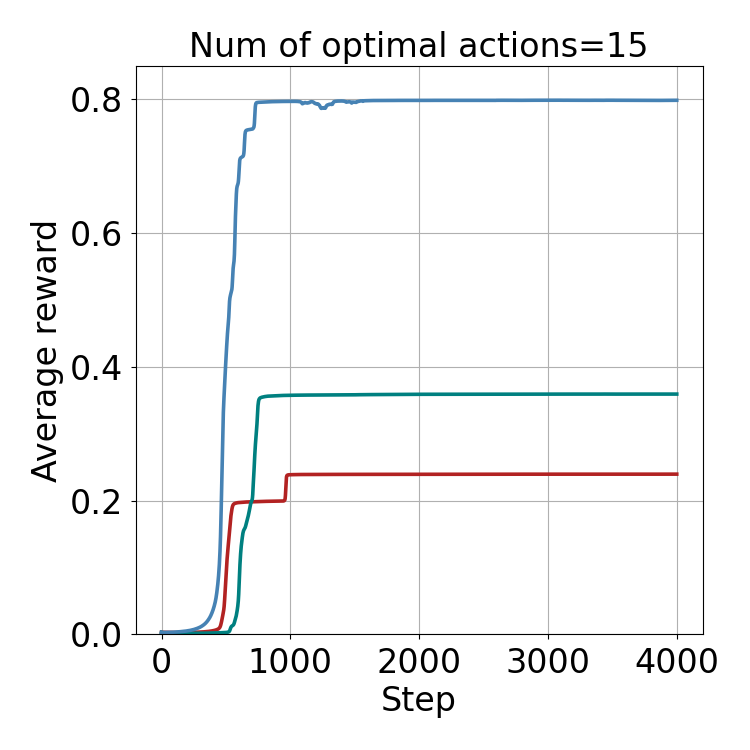
A numerical simulation on a synthetic MDP comparing No-Entropy, Standard Entropy, and Clamped Entropy regularization.
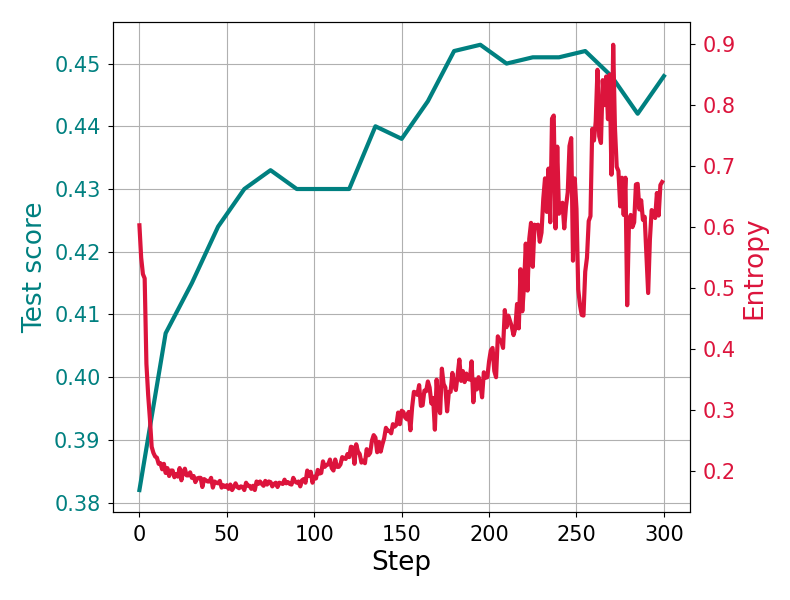
Training curves showing Entropy vs. Training Steps for standard GRPO.
Main Takeaways
Standard entropy regularization provides minimal to no gain in LLM-RL due to the large action space.
Clamping the token space for entropy calculation effectively reduces bias and focuses exploration.
Adaptive coefficient adjustment prevents entropy collapse and stabilizes training, leading to consistent performance improvements across different base models.
📚 Prerequisite Knowledge
Prerequisites
Reinforcement Learning (Policy Gradients, PPO)
Entropy Regularization
LLM Post-training pipelines
Key Terms
GRPO: Group Relative Policy Optimization—a PPO variant that estimates advantages by comparing multiple outputs for the same prompt rather than using a learned critic model
Entropy Regularization: Adding a bonus term to the loss function proportional to the policy's entropy, encouraging the model to maintain randomness and explore
Policy Gradient: A class of RL algorithms that optimize the policy directly by increasing the probability of actions that yield high rewards
Clamped Entropy: Entropy calculated on a truncated probability distribution (renormalized over the top-k tokens) to focus on relevant parts of the action space
Token Space: The vocabulary of the Large Language Model, typically containing hundreds of thousands of discrete tokens