Fudan University,
Children’s Hospital of Fudan University
arXiv
(2025)
ReasoningRLBenchmarkQA
📝 Paper Summary
Medical LLMsReasoning capabilitiesSynthetic data generation
FineMedLM-o1 enhances medical reasoning by training on synthetic long-form reasoning data and utilizing Test-Time Training (TTT) to adapt the model to specific problems during inference.
Core Problem
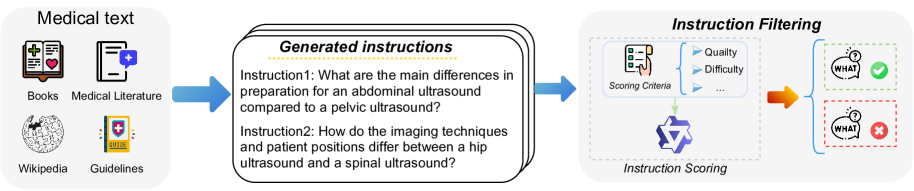
Existing medical LLMs struggle with deep reasoning required for complex problems (e.g., differential diagnosis) because datasets lack logical chain-of-thought structures and o1-style long-form reasoning traces.
Why it matters:
Current medical datasets lack robust logical structures, leading to fragile models that fail at critical thinking
Complex medical problems require comprehensive reasoning to reach reliable conclusions, not just direct answers
Without reasoning capabilities, LLMs are prone to medical errors and hallucinations in high-stakes healthcare scenarios
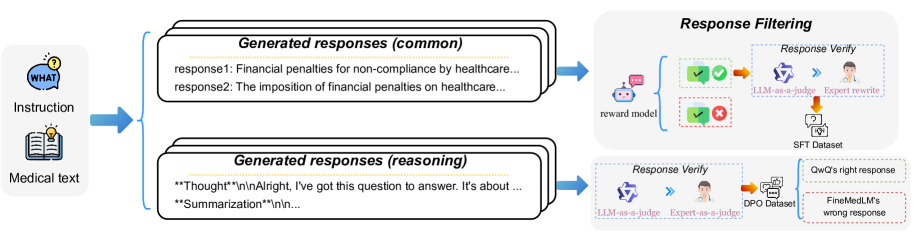
Concrete Example:When presented with a complex instruction requiring differential diagnosis, a standard model might provide a direct, potentially incorrect answer. In contrast, a model trained with reasoning data produces a 'chain of thought'—analyzing symptoms step-by-step and ruling out conditions—before concluding, as illustrated in the paper's comparison of direct vs. reasoning responses.
Key Novelty
Medical Test-Time Training (TTT) and o1-style Synthetic Data
First application of TTT in the medical domain: the model retrieves relevant reasoning data and fine-tunes itself on the fly during inference to better adapt to the specific problem context
Creation of FineMed, a large-scale synthetic medical dataset containing 'o1-style' long-form reasoning traces generated by advanced reasoning models (QwQ) to teach deep thinking
Architecture
The complete training and inference workflow including SFT, DPO, and the Test-Time Training (TTT) mechanism.
Evaluation Highlights
Achieves a 23% average performance improvement over prior models on key medical benchmarks (aggregated result from abstract)
Test-Time Training (TTT) provides an additional 14% performance boost during inference
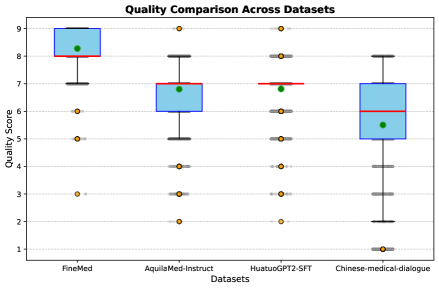
FineMed dataset achieves higher quality and complexity scores compared to open-source baselines like AquilaMed-Instruct and HuatuoGPT2-SFT in LLM-as-a-judge evaluations
Breakthrough Assessment
8/10
Introduces Test-Time Training to the medical domain and constructs a high-quality synthetic dataset with long-form reasoning, addressing a critical gap in medical LLM reasoning capabilities.
⚙️ Technical Details
Problem Definition
Setting: Medical dialogue and reasoning
Inputs: Medical queries or instructions (e.g., diagnosis requests, treatment planning)
Outputs: Accurate, reasoned medical responses
Pipeline Flow
Retrieval: Retrieve similar reasoning data
Adaptation: TTT (temporary fine-tuning)
Generation: Produce response
Restoration: Reset parameters
System Modules
Retriever
Retrieve the most similar instance from the long-form reasoning subset of FineMed
Model or implementation: bge-large-en-v1.5
Test-Time Trainer
Temporarily fine-tune the model on the retrieved data to adapt to the specific reasoning pattern
Model or implementation: FineMedLM-o1 (Llama3.1-8B based)
Generator
Generate the final answer for the benchmark instance using the adapted weights
Model or implementation: FineMedLM-o1 (Adapted)
Parameter Restorer
Restore model parameters to their original state to prevent catastrophic forgetting for subsequent tasks
Model or implementation: N/A
Novel Architectural Elements
Integration of an ephemeral fine-tuning loop (Test-Time Training) directly into the inference pipeline for medical domain adaptation
Modeling
Base Model: Llama3.1-8B
Training Method: 3-stage SFT followed by DPO and Test-Time Training (TTT)
Objective Functions:
Purpose: Supervised Fine-Tuning.
Formally: Standard cross-entropy loss on instruction-response pairs.
Purpose: Direct Preference Optimization.
Formally: DPO loss maximizing likelihood of preferred (reasoning) responses over dispreferred ones.
Adaptation: Full fine-tuning (in stages)
Training Data:
Stage 1: 228,000 general medical samples
Stage 2: 25,600 Internal Medicine samples
Stage 3: 10,240 Endocrinology samples
DPO Cold-Start: 12,800 complex reasoning samples
DPO Preference: 33,000 pairs (correct reasoning vs. incorrect/cold-start responses)
vs. AquilaMed/HuatuoGPT2: FineMedLM-o1 incorporates 'o1-style' long-form reasoning data and uses TTT, whereas others rely on standard instruction tuning or Deita-based complexity filtering.
vs. General Medical LLMs: Uses a 3-stage fine-grained SFT strategy (General -> Internal -> Endo) rather than mixing all medical data.
Limitations
Test-Time Training increases inference latency due to the on-the-fly fine-tuning step.
The method relies on the quality of retrieved data; irrelevant retrieval could potentially degrade TTT performance.
Specific quantitative results for individual benchmarks (e.g., MedQA accuracy) are not provided in the snippet, only aggregate improvements.
Code and data will be released at https://github.com/hongzhouyu/FineMed. The paper details the prompts used for classification and data generation in Appendices.
📊 Experiments & Results
Evaluation Setup
Evaluation on medical benchmarks and synthetic data quality assessment via LLM-as-a-judge
Benchmarks:
Unspecified medical benchmarks (Medical reasoning and dialogue)
Metrics:
Quality score (1-10)
Complexity score (1-10)
Performance improvement (%)
Statistical methodology: LLM-as-a-judge (Qwen) used for dataset quality scoring
Experiment Figures
Comparison of dataset quality and complexity distributions between FineMed and other datasets (AquilaMed-Instruct, HuatuoGPT2-SFT, Chinese-med-dialogue).
t-SNE visualization of the FineMed dataset's first-level department data in semantic space.
Main Takeaways
FineMedLM-o1 achieves a 23% average performance improvement over prior models on medical benchmarks (aggregated reported result).
Incorporating Test-Time Training (TTT) yields an additional 14% performance boost, validating the effectiveness of adapting to retrieved reasoning patterns at inference time.
The FineMed dataset exhibits higher average quality and complexity scores compared to other open-source medical datasets (AquilaMed-Instruct, HuatuoGPT2-SFT) when evaluated by an LLM judge.
Visual analysis (t-SNE) confirms that the proposed fine-grained classification framework effectively separates medical data into distinct department clusters.
📚 Prerequisite Knowledge
Prerequisites
Supervised Fine-Tuning (SFT)
Direct Preference Optimization (DPO)
Test-Time Training (TTT)
Reinforcement Learning basics
Key Terms
TTT: Test-Time Training—a technique where the model is temporarily trained (fine-tuned) on relevant data during the inference phase to adapt to the current input before generating an answer
o1-style data: Data containing long-form, step-by-step reasoning traces (similar to OpenAI's o1 model) rather than just direct answers, used to teach models 'how to think'
SFT: Supervised Fine-Tuning—training a pre-trained model on labeled instruction-response pairs
DPO: Direct Preference Optimization—a method to align language models with human preferences by optimizing on paired preferred/dispreferred responses
CoT: Chain-of-Thought—a prompting or data style where the model generates intermediate reasoning steps
LLM-as-a-judge: Using a strong Large Language Model (like Qwen) to evaluate the quality and complexity of text generated by other models
t-SNE: t-distributed Stochastic Neighbor Embedding—a visualization technique for high-dimensional data