📝 Paper Summary
Identity-preserved image generation
Text-to-Image Generation
InfiniteYou injects identity features into DiT-based models like FLUX via a separate residual branch (InfuseNet) rather than modifying attention layers, enhancing identity preservation without compromising generation quality.
Core Problem
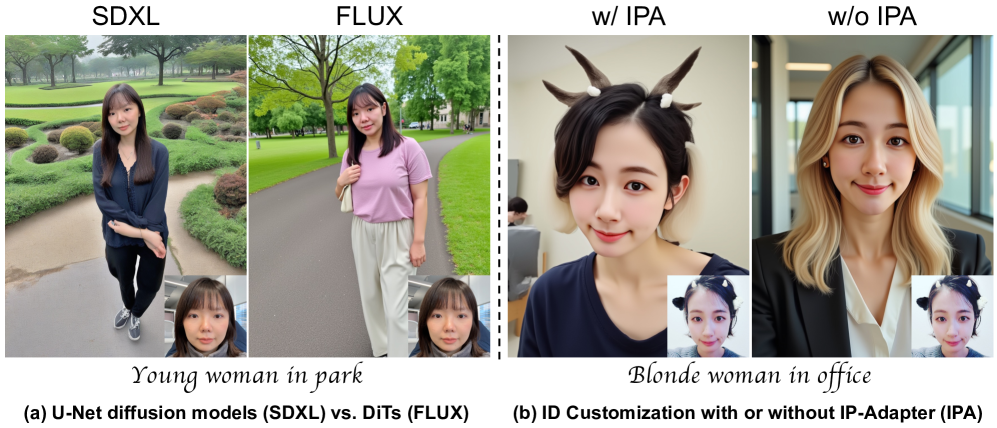
Existing identity-preservation methods for DiTs (like FLUX) rely on modifying attention layers via IP-Adapters, which degrades text alignment, aesthetics, and base model generation capabilities.
Why it matters:
- Current methods struggle with 'face copy-paste' artifacts where the identity is preserved but the image looks unnatural or poorly aligned with the text prompt
- State-of-the-art DiT models like FLUX offer superior generation quality over U-Nets (SDXL), but effective identity-injection modules for them are scarce
- Modifying attention layers directly (standard practice) entangles text and identity control, causing conflict and reducing the model's aesthetic quality
Concrete Example:
When asking for 'a woman wearing a VR headset' with a specific identity, standard IPA-based methods might paste the face awkwardly or ignore the headset to preserve the face. InfiniteYou generates the headset correctly while keeping the identity natural.
Key Novelty
InfuseNet: A Parallel Residual Identity Branch
- Instead of modifying the base model's attention layers (like IP-Adapter), InfuseNet runs as a parallel branch that injects identity features solely through residual connections
- Treats identity injection as a control signal (similar to ControlNet) rather than a texture override, disentangling it from the text prompts processed by the base model
- Uses a multi-stage training strategy with synthetic Single-Person-Multiple-Sample (SPMS) data to teach the model robust identity preservation across diverse styles
Architecture
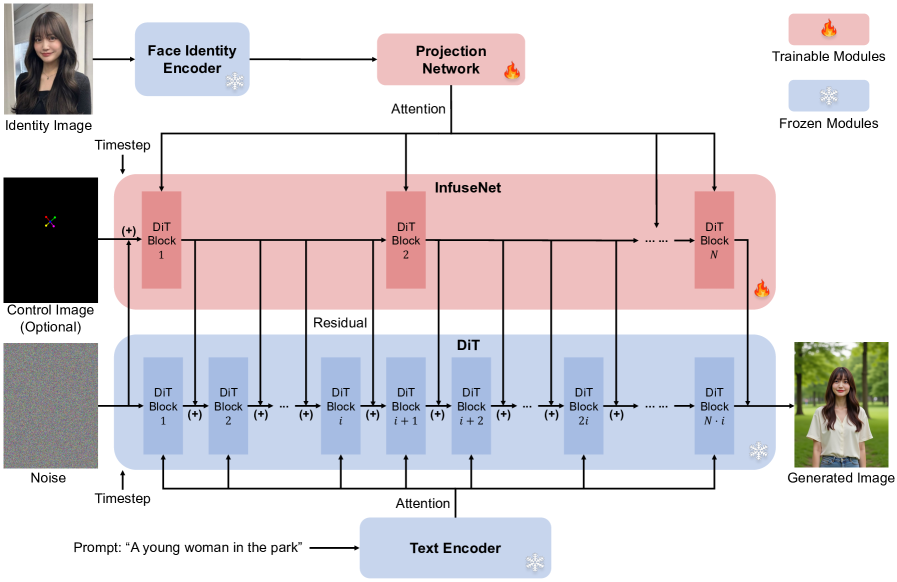
The overall framework of InfiniteYou (InfU) showing the InfuseNet parallel branch interacting with the frozen FLUX base model.
Evaluation Highlights
- Achieves higher identity similarity (Identity Score) compared to PuLID-FLUX and InstantX IP-Adapter on benchmark tests
- Significant qualitative improvements in text-image alignment and aesthetic quality compared to IP-Adapter methods which often degrade into copy-paste artifacts
- Successfully disentangles identity from style, allowing flexible recrafting (e.g., changing age, accessories) where baselines fail
Breakthrough Assessment
8/10
Effective adaptation of ControlNet-like residual injection for identity preservation in DiTs (FLUX), solving the quality degradation issues of attention-based injection methods.