📝 Paper Summary
3D Point Cloud Learning
Parameter-Efficient Fine-Tuning (PEFT)
Spectral Domain Learning
PointGST efficiently fine-tunes frozen point cloud models by transforming spatial tokens into the spectral domain using a graph-based adapter, de-correlating confused features and injecting task-specific geometric information.
Core Problem
Standard fine-tuning of point cloud models is computationally expensive, while existing efficient methods fail to address 'inner confused tokens'—where pre-trained features struggle to distinguish fine-grained structures in the spatial domain.
Why it matters:
- Pre-trained point cloud models have grown 30x in size (22M to 657M parameters), making full fine-tuning storage-intensive and impractical for large-scale deployment
- Current spatial-domain PEFT methods merge new learnable modules with confused frozen features, complicating optimization and limiting performance gains
- Frozen pre-trained models lack the ability to learn intrinsic geometric structures of downstream data, relying solely on general representations captured during pre-training
Concrete Example:
When two parts of a point cloud have similar geometries but different semantics, a frozen pre-trained model might output similar features (confusion). Existing methods process these confused features directly in the spatial domain, whereas PointGST separates them into orthogonal spectral components to distinguish them.
Key Novelty
Point Cloud Graph Spectral Tuning (PointGST)
- Constructs multi-scale graphs on the point cloud to calculate spectral bases (eigenvectors) that capture intrinsic geometric information of the downstream data
- Uses a Point Cloud Spectral Adapter (PCSA) to transform spatial point tokens into the spectral domain, where orthogonal bases naturally de-correlate confused features
- Performs fine-tuning in this compressed spectral space using lightweight linear layers before transforming back, enabling efficient adaptation with minimal parameters
Architecture
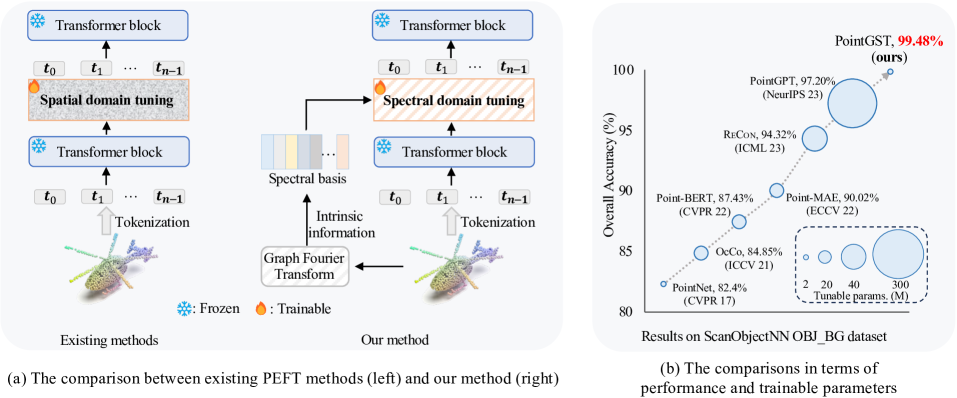
Overview of the PointGST framework compared to traditional Spatial PEFT. It shows the workflow: Input -> Frozen Encoder -> Graph Construction -> Spectral Transformation (PCSA) -> Spectral Tuning -> Inverse Transformation -> Output.
Evaluation Highlights
- Achieves 99.48% accuracy on ScanObjectNN (OBJ_BG), establishing a new state-of-the-art with only 0.67% trainable parameters
- Outperforms fully fine-tuned PointMAE by +1.6% accuracy on ScanObjectNN (OBJ_BG) while using significantly fewer parameters
- Surpasses previous best PEFT method (DAPT) by +2.23% on ScanObjectNN (OBJ_BG) using the PointMAE backbone
Breakthrough Assessment
8/10
Proposes a fundamentally new perspective (spectral domain) for point cloud PEFT, achieving SOTA results that surpass even full fine-tuning on key benchmarks with negligible parameter costs.