📝 Paper Summary
Post-Training Quantization (PTQ)
Model Compression
MRECG identifies that loss oscillation in post-training quantization is caused by capacity mismatches between adjacent modules and resolves it by jointly optimizing those specific modules.
Core Problem
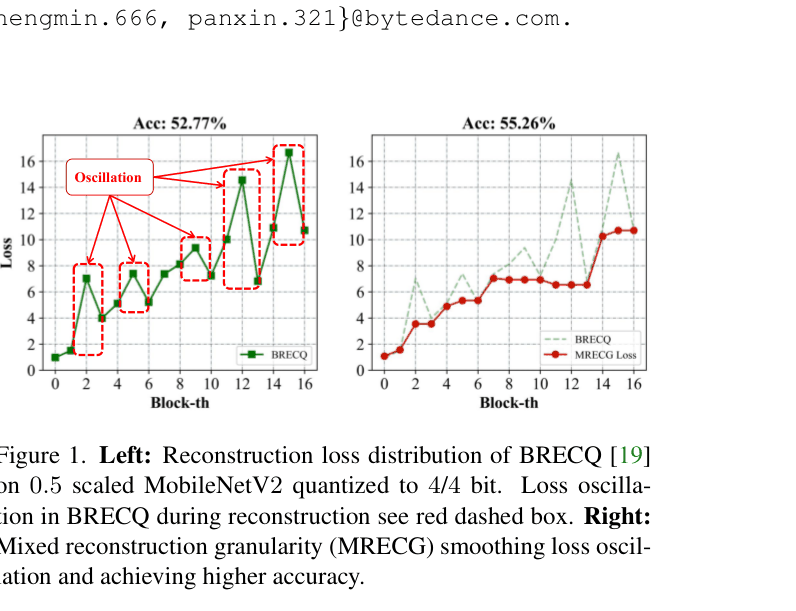
Existing PTQ methods suffer from 'oscillation' where reconstruction loss spikes during layer-by-layer or block-by-block optimization, causing irreversible accuracy degradation.
Why it matters:
- Oscillation indicates that error accumulation in specific layers is breaking through the model's capacity to recover, leading to severe performance drops in low-bit settings (e.g., 2-bit)
- Current methods like BRECQ and AdaRound treat all blocks uniformly or randomly, ignoring the structural causes of error spikes
- The problem is particularly acute in compact models like MobileNetV2 where depthwise convolutions create significant capacity bottlenecks
Concrete Example:
In MobileNetV2, a depthwise convolution layer often has much lower capacity than its adjacent layers. When quantizing sequentially, this capacity drop causes the reconstruction loss to spike (oscillate) rather than decrease smoothly, leading to a 6.61% accuracy drop in 2/4bit quantization compared to the proposed method.
Key Novelty
Mixed REConstruction Granularity (MRECG)
- Theoretically proves that loss oscillation is caused by the difference in 'Module Capacity' (ModCap) between adjacent layers; small capacity in a later module amplifies error accumulation
- Proposes a metric to quantify module capacity using parameter counts, bit-width, and stride scaling (or reconstruction loss for data-dependent scenarios)
- Dynamically merges adjacent modules with the largest capacity differences into a single optimization block (joint optimization) to smooth out oscillations
Architecture
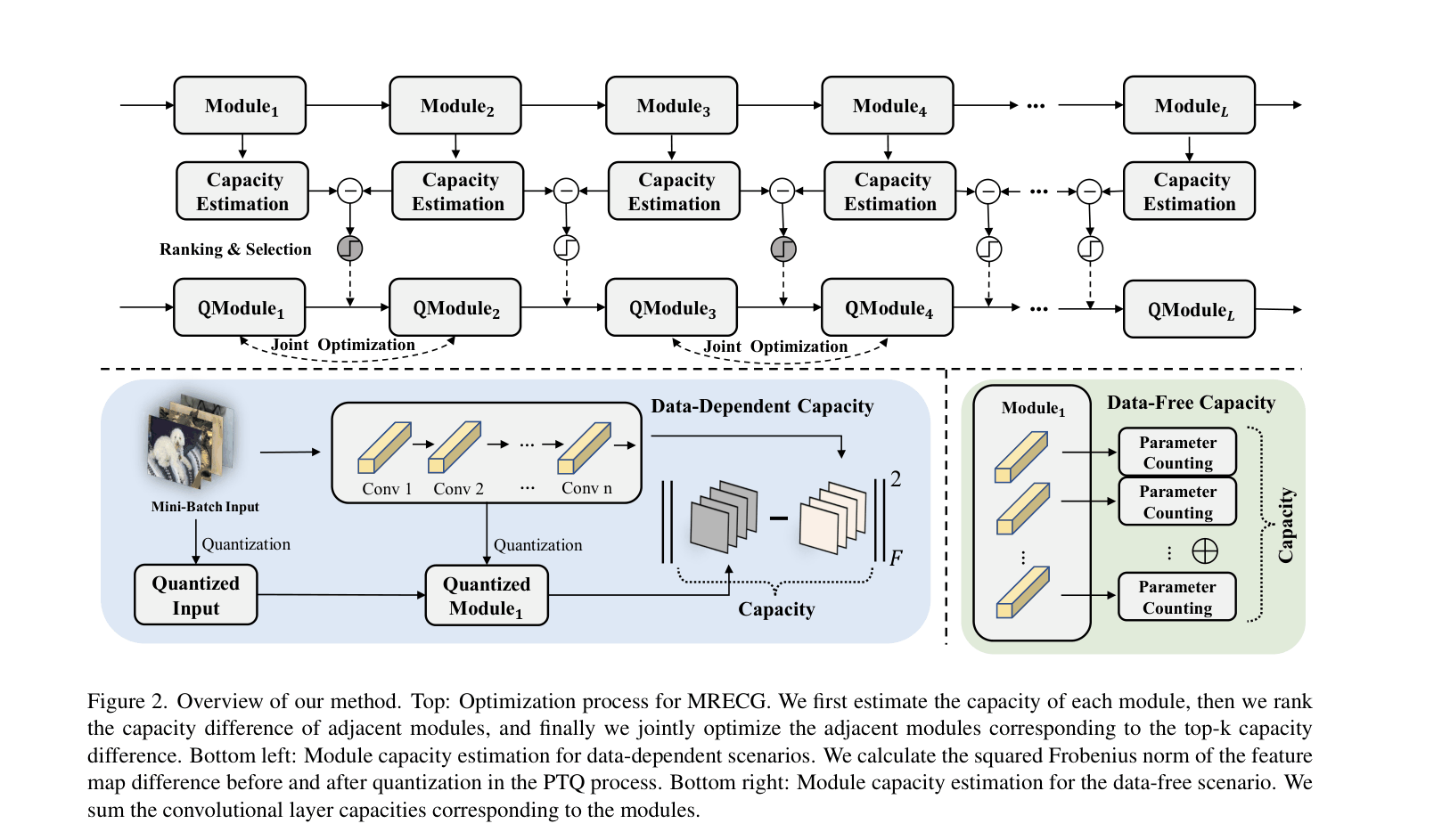
The workflow of MRECG, showing capacity estimation, ranking of capacity differences, and the selective joint optimization of modules.
Evaluation Highlights
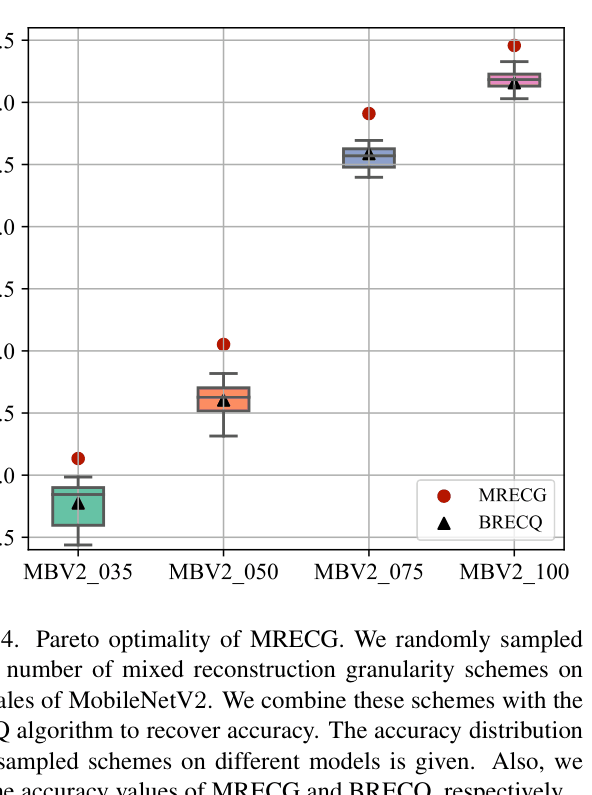
- +6.61% Top-1 accuracy on MobileNetV2x0.5 (2/4bit) compared to BRECQ, achieving 41.16%
- +6.19% Top-1 accuracy on MobileNetV2x1.0 (2/4bit) compared to BRECQ, achieving 58.49%
- +1.9% Top-1 accuracy on ResNet-50 (2/4bit) compared to BRECQ, achieving 70.04%
Breakthrough Assessment
8/10
Identifies a fundamental theoretical oversight in PTQ (oscillation) and provides a principled, effective solution that yields massive gains in difficult low-bit settings.