📊 Experiments & Results
Evaluation Setup
Interactive game generation (Minecraft) using VPT dataset
Benchmarks:
- Minecraft Action Following (Action-conditioned Video Generation)
Metrics:
- Action F1
- Action Precision
- Action Recall
- Fréchet Video Distance (FVD)
- PSNR
- VBench (visual quality)
- Statistical methodology: Not explicitly reported in the paper
Key Results
| Benchmark | Metric | Baseline | This Paper | Δ |
|---|---|---|---|---|
| RLIR significantly improves action-following metrics across both autoregressive and diffusion architectures compared to base models. | ||||
| Minecraft (MineWorld) | Action F1 | 0.78 | 0.85 | +0.07 |
| Minecraft (NFD) | Action F1 | 0.65 | 0.72 | +0.07 |
| Visual quality improves alongside action accuracy, likely because better action coherence reduces artifacts. | ||||
| Minecraft | FVD | Not explicitly reported as exact number in text | Not explicitly reported as exact number in text | Improved (Lower) |
Experiment Figures
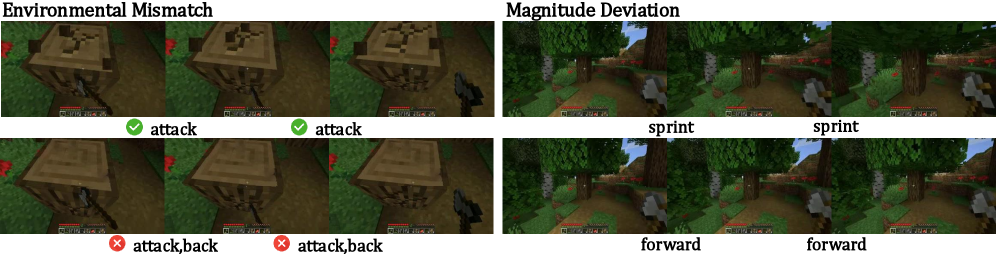
Sensitivity of IDM to visual artifacts. A manually retouched image (cracks on trunk) causes the IDM to misclassify the action.
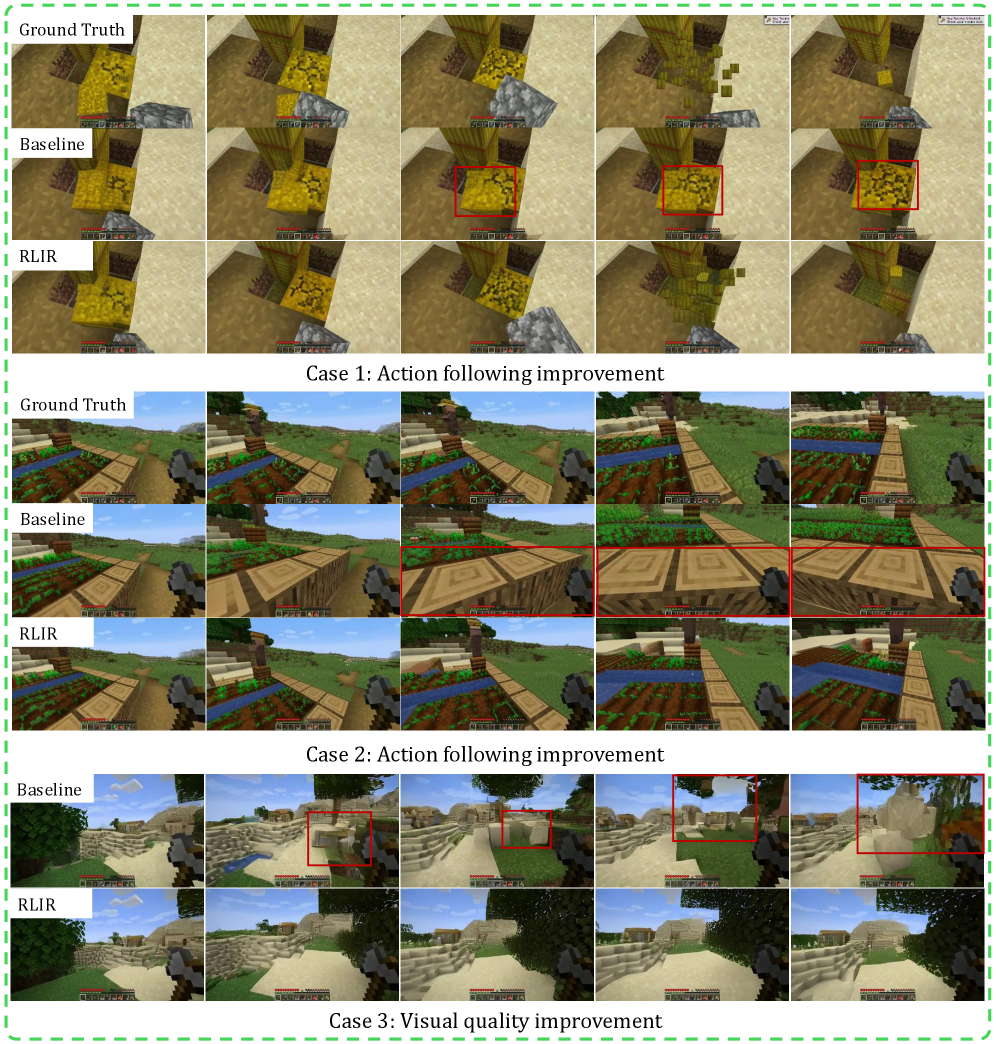
Qualitative comparison of generated videos before and after RLIR
Main Takeaways
- Consistent 5-10% gains in action-following (F1, Recall, Precision) across both autoregressive and diffusion paradigms
- Visual quality (FVD, VBench) improves simultaneously, suggesting that enforcing action consistency helps reduce visual artifacts (e.g., blurring during rapid movement)
- The method is data-efficient, converging with only ~1,000 training samples
- Human evaluation confirms that quantitative gains align with user preferences for both control and visual fidelity