Junseok Park, Hyeonseo Yang, Min Whoo Lee, Won-Seok Choi, Minsu Lee, Byoung-Tak Zhang
Seoul National University,
Sungshin Women’s University,
AIIS
arXiv
(2025)
RLBenchmark
📝 Paper Summary
Curriculum LearningReward Shaping
Inspired by toddler development, this paper proposes a Sparse-to-Dense (S2D) reward curriculum that starts with free exploration and transitions to potential-based dense rewards, improving generalization and smoothing the policy loss landscape.
Core Problem
Static reward densities fail to balance exploration and exploitation effectively: sparse rewards slow down learning, while dense rewards often bias agents toward suboptimal local minima.
Why it matters:
Complex environments with high-dimensional inputs (e.g., egocentric 3D observations) require extensive exploration that dense rewards discourage.
Existing methods relying solely on one reward type or Dense-to-Sparse transitions struggle to maintain optimal strategies or achieve robustness.
Rugged policy loss landscapes in deep RL make optimization volatile and challenging, hindering generalization.
Concrete Example:In a maze, an agent with only dense rewards might get stuck trying to walk through a wall toward the goal (short-term gain), while an agent with only sparse rewards might wander aimlessly without ever finding the goal due to lack of feedback.
mimics human toddlers who transition from 'innate explorers' (engaging with environments without immediate rewards) to goal-directed learners guided by denser feedback
Uses Potential-Based Reward Shaping (PBRS) to densify rewards during the transition while theoretically preserving the optimal policy
Reverses the conventional 'easy-to-hard' or 'dense-to-sparse' intuition by prioritizing early free exploration to build robust cognitive maps before optimization
Architecture
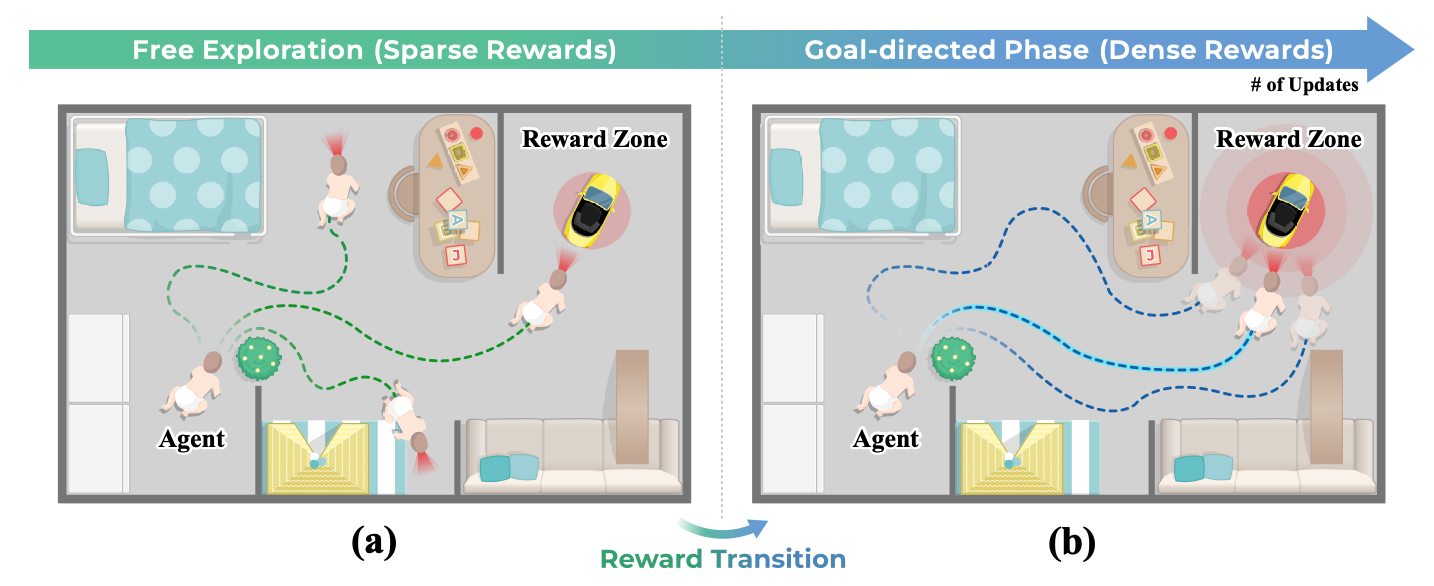
Conceptual illustration of the Toddler-inspired Reward Transition
Breakthrough Assessment
7/10
Offers a counter-intuitive but biologically grounded approach (Sparse-to-Dense) that addresses the specific problem of loss landscape smoothing in RL, though results in the provided text are qualitative.
⚙️ Technical Details
Problem Definition
Setting: Goal-Oriented Reinforcement Learning modeled as a Markov Decision Process (MDP)
Inputs: State s_t from the environment (e.g., egocentric images)
Determines the active MDP formulation (M_i) and reward function (R_i) based on the training timestep t
Model or implementation: Stage Indicator Function I(t; T)
Reward Shaper
Augments the base sparse reward with a potential-based dense term during the second phase
Model or implementation: Potential Function Phi(s)
Novel Architectural Elements
Integration of a specific Sparse-to-Dense temporal schedule driven by a potential function into the RL training loop, explicitly designed to smooth the loss landscape
Modeling
Base Model: Reinforcement Learning Policy Network (Architecture not specified in text)
Training Method: Curriculum Learning with Potential-Based Reward Shaping (PBRS)
Objective Functions:
Purpose: Maximize expected cumulative reward under the changing reward structure.
No statistical significance tests reported in the provided text
Reproducibility
No replication artifacts mentioned in the paper. Code URL is not provided in the text. Environment details (ViZDoom, Minecraft) are mentioned but specific configurations are not detailed in the provided excerpt.
📊 Experiments & Results
Evaluation Setup
Evaluation on robotic manipulation and 3D visual navigation tasks
Benchmarks:
Robotic Arm Manipulation (Dynamic manipulation)
ViZDoom (Egocentric 3D navigation)
Minecraft Maze (Egocentric 3D navigation) [New]
Metrics:
Success Rate
Sample Efficiency
Sharpness (Loss Landscape Metric)
Statistical methodology: Not explicitly reported in the paper
Main Takeaways
S2D transitions achieve higher success rates and greater sample efficiency compared to 'only sparse', 'only dense', and 'dense-to-sparse' strategies.
Visualizing the policy loss landscape using a Cross-Density Visualizer reveals that S2D transitions significantly smooth the landscape, reducing ruggedness (peaks and valleys).
S2D leads to wider minima in the neural network parameters, which correlates with better generalization and robustness to variations.
Early free exploration under sparse rewards allows agents to establish robust initial parameters (latent learning), akin to Tolman's rats forming cognitive maps.
📚 Prerequisite Knowledge
Prerequisites
Reinforcement Learning (MDPs, Policies)
Reward Shaping (Potential-based)
Curriculum Learning
Key Terms
S2D: Sparse-to-Dense—the proposed reward transition strategy moving from sparse feedback to dense feedback
PBRS: Potential-Based Reward Shaping—a method to add shaping rewards based on a potential function without altering the optimal policy
MDP: Markov Decision Process—a mathematical framework for modeling decision making in situations where outcomes are partly random and partly under the control of a decision maker
Loss Landscape: The geometric structure of the loss function in the parameter space; smoother landscapes with wider minima generally imply better generalization
Wide Minima: Regions in the loss landscape where the loss remains low even with small perturbations to parameters, associated with better robustness
D2S: Dense-to-Sparse—a contrasting baseline strategy where rewards start dense and become sparse
Latent Learning: Learning that occurs without immediate reinforcement, as demonstrated in Tolman's maze experiments