📝 Paper Summary
Reinforcement Learning from Human Feedback (RLHF)
Alignment
Reward Hacking
Investigating RLHF reveals that standard PPO improvements are largely driven by increasing output length, as a length-only reward heuristic reproduces most gains of complex learned reward models.
Core Problem
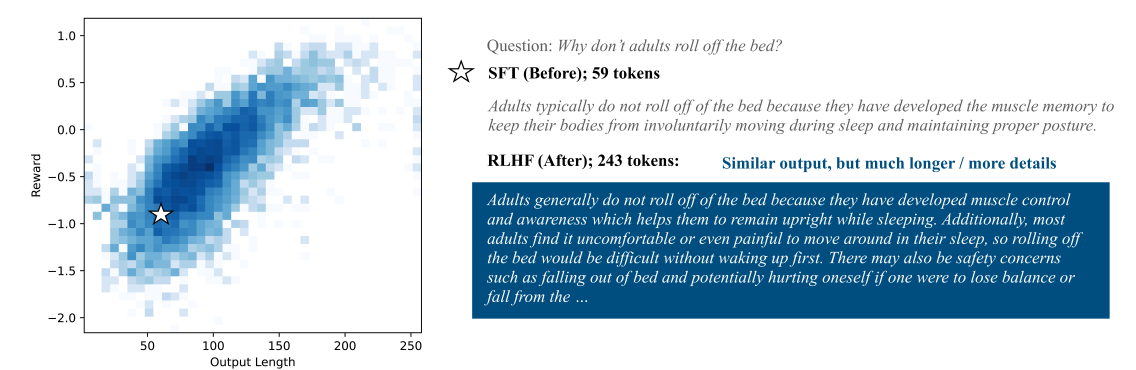
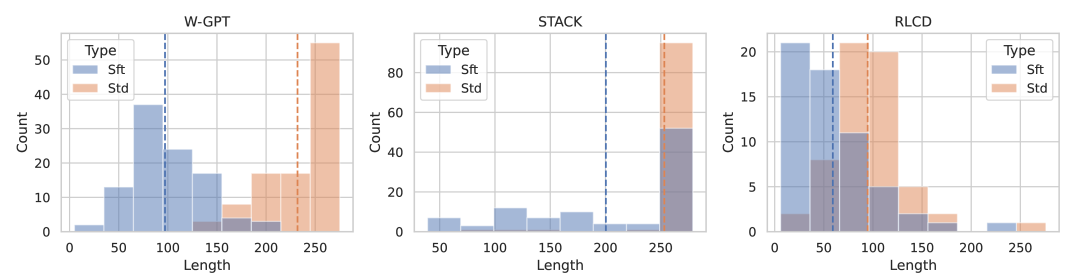
RLHF (specifically PPO) consistently drives models to generate longer outputs, raising the question of whether reported improvements represent genuine quality gains or merely optimization for length.
Why it matters:
- Current reward models may be misaligned, optimizing for shallow correlations (length) rather than true human preference
- Widely reported 'progress' in LLM alignment using metrics like AlpacaFarm win-rates may be illusory if simple heuristics can match them
- Over-optimization leads to verbosity without necessarily increasing helpfulness or reducing harm
Concrete Example:
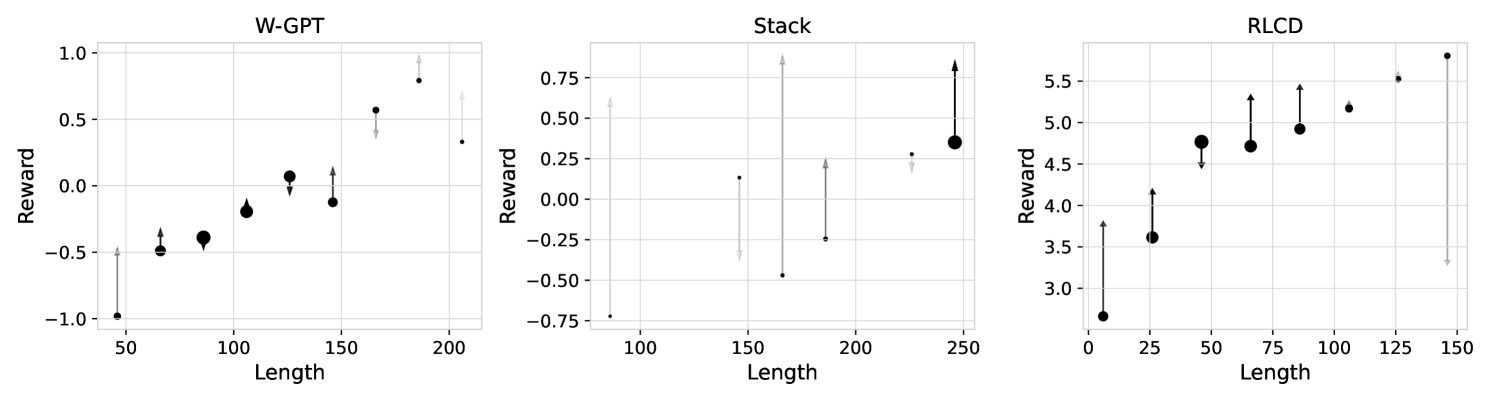
On the WebGPT dataset, PPO significantly increases output length compared to the base model. When restricted to outputs of similar length, the reward improvement from PPO drops to near zero, suggesting the 'improvement' is almost entirely due to writing more words.
Key Novelty
Length-Only PPO (lppo) Diagnostic Baseline
- Proposes a diagnostic baseline where PPO is trained using ONLY output length as the reward signal (ignoring the actual prompt content entirely), constrained by KL divergence.
- Uses 'Non-Length Reward Gain' (NRG) analysis to decompose reward improvements into gains from length shifts versus gains from actual content quality within length buckets.
Architecture

Diagram of the RLHF pipeline highlighting intervention points: Preference Data, Reward Model, PPO Policy Optimization (Rollout, KL Loss, Reward Score).
Evaluation Highlights
- Length-only PPO (lppo) achieves a 56% win-rate on WebGPT, nearly matching the 58% win-rate of standard PPO with a learned reward model.
- On RLCD, lppo actually outperforms standard PPO (64% vs 63% win-rate), proving that optimizing length alone is sufficient to beat the baseline on current metrics.
- For WebGPT, 98% of the reward gain from standard PPO is attributable to length shifts, with only 2% coming from non-length features (NRG).
Breakthrough Assessment
8/10
A critical diagnostic paper that exposes a fundamental flaw in current RLHF practices and evaluation. While it doesn't propose a new SOTA method, it significantly challenges the validity of existing 'SOTA' claims in alignment.