Institute of Software, Chinese Academy of Sciences,
University of Chinese Academy of Sciences,
City University of Hong Kong
arXiv
(2025)
RLReasoningBenchmark
📝 Paper Summary
Reinforcement Learning for LLMsReasoning capabilities (Chain-of-Thought)
SPO improves reasoning in LLMs by estimating advantages at the segment level via Monte Carlo sampling, avoiding the instability of token-level critics and the coarseness of trajectory-level sparse rewards.
Core Problem
Existing RL methods for LLMs operate at extreme granularities: token-level methods (PPO) require unstable, expensive critic models, while trajectory-level methods (GRPO) rely on sparse final rewards that fail to assign credit accurately in long reasoning chains.
Why it matters:
Accurate credit assignment is critical for complex STEM reasoning where a single error can invalidate a long solution
Training critic models for LLMs is computationally expensive and empirically unreliable due to high variance across prompts
Coarse-grained trajectory feedback causes models to struggle with identifying specific positive/negative contributions, leading to slow convergence or overfitting
Concrete Example:In a long mathematical proof, a model might reason correctly for 90% of the steps but fail at the very end. GRPO assigns a negative reward to the entire sequence, discouraging the correct parts. PPO attempts to score every token but often produces noisy values due to critic inaccuracy.
Key Novelty
Segment-Level Advantage Estimation via Monte Carlo (SPO)
Partitions generated sequences into contiguous segments (mid-grained) rather than treating them as single tokens or whole trajectories
Estimates the value of each segment using Monte Carlo rollouts directly from the policy, eliminating the need for a separate critic model
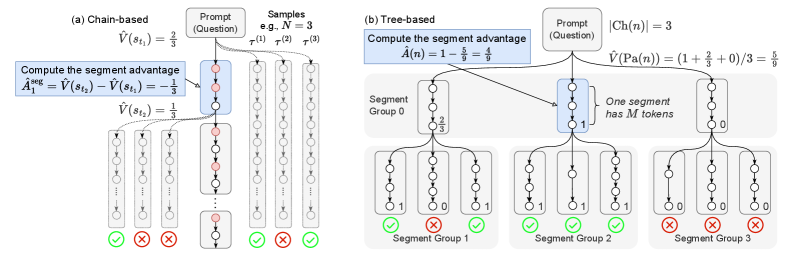
Introduces specialized sampling strategies (Chain vs. Tree) to balance computational cost and sample efficiency for short versus long reasoning tasks
Architecture
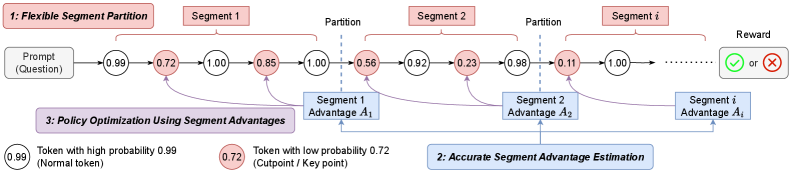
Overview of the SPO framework including Segment Partition, Advantage Estimation, and Policy Optimization.
Evaluation Highlights
SPO-chain achieves 6–12 percentage point accuracy improvements over PPO and GRPO on the GSM8K benchmark (Short CoT)
SPO-tree achieves 7–11 percentage point accuracy improvements over GRPO on the MATH500 benchmark (Long CoT) under 2K and 4K context evaluation
SPO-tree significantly reduces Monte Carlo estimation costs compared to chain-based sampling by reusing samples in a tree structure
Breakthrough Assessment
7/10
Addresses a fundamental granularity trade-off in RLHF/RLAIF. The removal of the critic model while maintaining denser feedback than GRPO is a significant methodological improvement, though results are currently limited to math reasoning benchmarks.
⚙️ Technical Details
Problem Definition
Setting: Language generation modeled as a Markov Decision Process (MDP) with deterministic transitions and sparse binary rewards
Inputs: Prompt tokens x
Outputs: Generated response sequence y
Pipeline Flow
Prompt Input
Trajectory Generation (Policy Rollout)
Segment Partition (Adaptive or Fixed)
Advantage Estimation (Chain-based or Tree-based MC)
Policy Optimization (Masked Gradient Update)
System Modules
Segment Partitioner
Divides the generated trajectory into contiguous segments for credit assignment
Model or implementation: Algorithm (Non-learnable)
Advantage Estimator
Estimates the advantage (value improvement) of each segment
Model or implementation: Monte Carlo Sampler (uses Policy Model)
Policy Optimizer
Updates the policy parameters using computed advantages
Model or implementation: LLM (Policy)
Novel Architectural Elements
Adaptive Cutpoint-based Partition: Dynamically segments trajectories based on drops in token probability rather than fixed lengths or semantic breaks
Tree-based Segment Advantage Estimation: A sampling structure where sibling nodes share history and prompts to allow reuse of MC samples for value estimation
Modeling
Base Model: Not explicitly reported in the provided text
Training Method: Segment Policy Optimization (SPO)
Objective Functions:
Purpose: Estimate the advantage of a specific segment by comparing the value of the state after the segment to the state before it.
Formally: A_k^{seg} = V(s_{t_{k+1}}) - V(s_{t_k})
Purpose: Update policy using segment advantages, focused only on critical tokens via masking.
Formally: Loss minimizes -sum(M_t * A_k^{seg} * r_t(theta)) where M_t is a mask for low-probability tokens
Key Hyperparameters:
MC_samples_N: 4 or 9
probability_threshold_rho: Not explicitly reported in the provided text
Compute: Significantly reduces estimation cost compared to VinePPO (which uses resampling) by using Tree-based sampling
Comparison to Prior Work
vs. VinePPO: SPO allows arbitrary partitions (not just heuristic/semantic) and uses Tree-based sampling to avoid costly resampling
vs. GRPO: SPO provides finer-grained (segment-level) feedback rather than a single signal for the whole trajectory
vs. PPO: SPO eliminates the critic model, using MC sampling for unbiased value estimation
Limitations
No statistical significance tests reported in the provided text
SPO-chain incurs computational overhead from MC sampling which may be costly for very long sequences (mitigated by SPO-tree)
Depends on defining appropriate segmentation strategies (cutpoints or fixed counts) which might be task-sensitive
Code is publicly available at https://github.com/AIFrameResearch/SPO. The paper describes the algorithms (cutpoint selection, tree sampling) in detail.
📊 Experiments & Results
Evaluation Setup
Mathematical reasoning tasks using Chain-of-Thought generation
Benchmarks:
GSM8K (Short Chain-of-Thought Math Reasoning)
MATH500 (Long Chain-of-Thought Math Reasoning)
Metrics:
Accuracy (percentage)
Statistical methodology: Not explicitly reported in the paper
Experiment Figures
Comparison of Chain-based vs. Tree-based Advantage Estimation strategies.
Main Takeaways
SPO outperforms both fine-grained (PPO) and coarse-grained (GRPO) baselines, demonstrating the effectiveness of mid-grained segment-level credit assignment.
SPO-chain is particularly effective for short reasoning tasks (GSM8K), achieving 6-12 percentage point gains.
SPO-tree is essential for long reasoning tasks (MATH500), achieving 7-11 percentage point gains while managing computational costs via sample reuse.
The probability-mask optimization strategy enhances performance by focusing policy updates on critical decision points (cutpoints) rather than all tokens.
📚 Prerequisite Knowledge
Prerequisites
Reinforcement Learning (MDPs, Policy Gradients)
Large Language Models (Token generation, Chain-of-Thought)
Monte Carlo estimation
Key Terms
SPO: Segment Policy Optimization—the proposed framework that assigns credit at the segment level using Monte Carlo estimation
CoT: Chain-of-Thought—a reasoning strategy where models generate intermediate steps before the final answer
PPO: Proximal Policy Optimization—a standard RL algorithm using a clipped surrogate objective and a critic model for token-level updates
GRPO: Group Relative Policy Optimization—a critic-free RL algorithm that normalizes rewards within a group of sampled trajectories
Monte Carlo (MC) estimation: Estimating the value of a state by averaging the rewards of multiple full trajectories simulated starting from that state
Cutpoint: A position in a generated sequence where the probability of the chosen token falls below a certain threshold, indicating a potential branching point in reasoning
Probability Mask: A technique in SPO that computes loss only for tokens with low probability (high uncertainty), focusing updates on critical decision points