VerIPO improves video reasoning by inserting a rollout-aware verifier into the RL loop that filters exploration data into high-quality contrastive pairs for efficient Direct Preference Optimization.
Core Problem
Applying reinforcement learning to Video-LLMs often yields short, shallow, or inconsistent reasoning chains, while supervised fine-tuning suffers from data scarcity and high annotation costs.
Why it matters:
Existing RL methods like GRPO (Group Relative Policy Optimization) are unstable and can encourage 'correct answers based on wrong thinking' (hallucinated reasoning).
Online RL training is computationally expensive and does not guarantee a stable increase in reasoning depth or chain length.
Manual annotation of long Chain-of-Thought data for video is prohibitively expensive and difficult to scale.
Concrete Example:A Video-LLM might correctly answer 'The man is running' but the reasoning chain claims 'The man is sitting on a chair', showing disjointed logic. VerIPO's verifier detects this inconsistency and uses it as a negative sample.
Key Novelty
GRPO-Verifier-DPO Iterative Loop
Iterates between exploration (GRPO), curation (Verifier), and exploitation (DPO) to gradually cultivate long reasoning capabilities.
Introduces a **Rollout-Aware Verifier** that filters GRPO outputs based on accuracy, consistency, repetition, and length to construct high-quality contrastive data.
Uses 'Reflective Preference Pairs' where the model is taught to prefer self-corrected reasoning over initial incorrect attempts, simulating reflection.
Architecture
Conceptual flow of the VerIPO training loop: GRPO -> Rollout-Aware Verifier -> DPO.
Evaluation Highlights
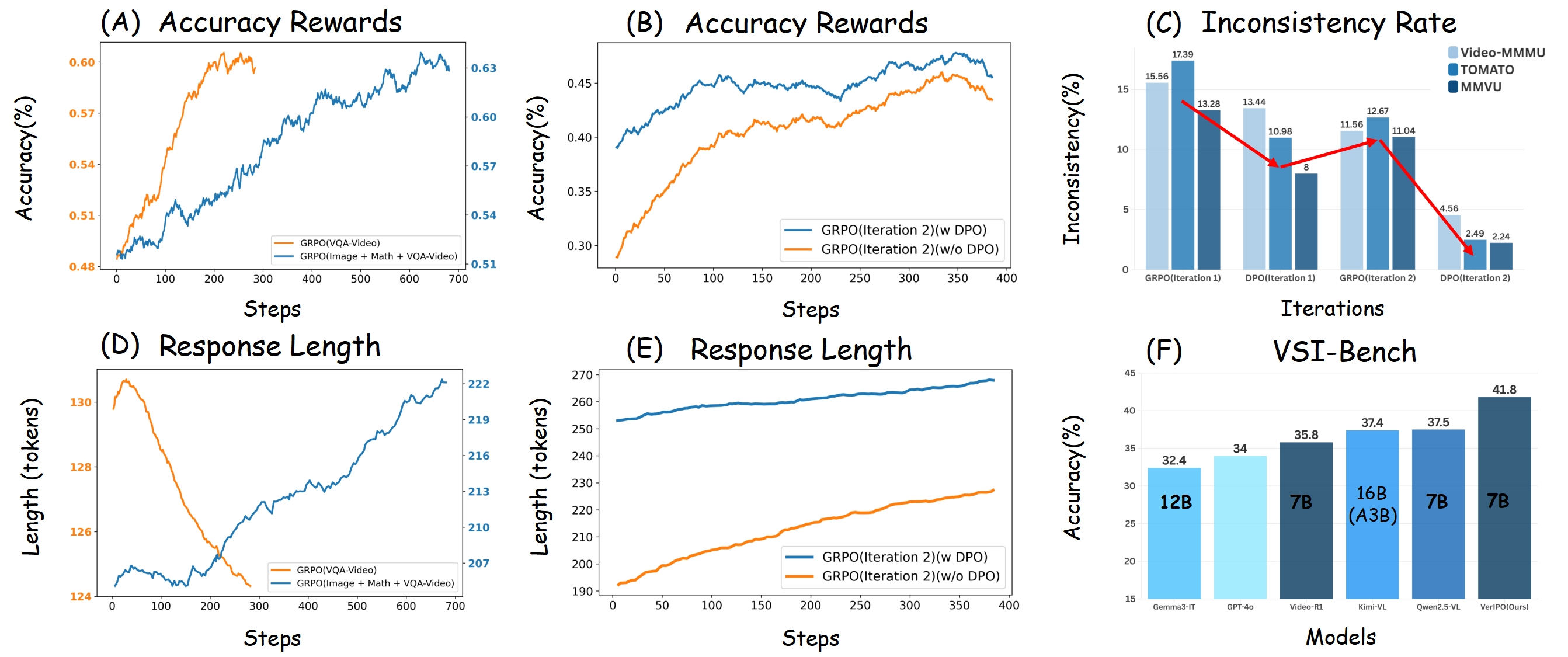
Achieves 7x faster optimization speed compared to standard GRPO by leveraging efficient DPO updates on curated data.
Outperforms RL-trained reasoning models (Video-R1, Kimi-VL-Thinking) and direct-answer models (Qwen2.5-VL-7B) on benchmarks like VSI-Bench and Video-MME.
Produces consistently longer and more contextually consistent Chain-of-Thoughts compared to baselines initiated with static long-CoT datasets.
Breakthrough Assessment
7/10
Addresses the stability and quality issues of RL for reasoning in multimodal models with a practical iterative pipeline. While improvements are qualitative or relative in the provided text, the methodology for self-training reasoning is sound.
⚙️ Technical Details
Problem Definition
Setting: Video Question Answering requiring long-form reasoning
Inputs: Video sequence V and Question q
Outputs: Reasoning chain (thought) r and Final Answer a
Pipeline Flow
Video-LLM (generates reasoning and answer)
System Modules
Video-LLM
Generate step-by-step reasoning and final answer given video and text input
Model or implementation: Qwen2.5-VL-7B
Modeling
Base Model: Qwen2.5-VL-7B
Training Method: VerIPO (GRPO -> Verifier -> DPO loop)
Objective Functions:
Purpose: Maximize advantage of better responses within a group.
Formally: GRPO objective maximizing clipped importance ratios relative to group baseline.
Purpose: Align model with curated preferences.
Formally: DPO loss minimizing negative log-likelihood of chosen responses over rejected ones.
Adaptation: Full fine-tuning (implied, visual encoder frozen during DPO)
Training Data:
Initial activation: Text-only and Image QA data
Iterative phase: Video QA data (VSI-Bench, Video-MME, etc.)
vs. Video-R1: VerIPO avoids expensive cold-start data by cultivating reasoning from scratch via iterative verification
vs. Standard GRPO: VerIPO inserts a Verifier and DPO stage to enforce consistency and efficiency, rather than relying solely on outcome rewards
vs. RFT (Reinforcement Fine-Tuning): VerIPO uses online rollouts to build reflective contrastive pairs dynamically, rather than static datasets
Limitations
Relies on the availability of ground truth answers or robust automated verifiers for the reward signal.
Verifier component introduces additional computational overhead during the data curation phase.
Iterative process requires careful balancing of curriculum from simple to complex tasks.
Reproducibility
No replication artifacts mentioned in the paper. Code, weights, and specific prompt templates are not provided in the text.
📊 Experiments & Results
Evaluation Setup
Video reasoning and understanding tasks
Benchmarks:
VSI-Bench (Video spatial reasoning)
Video-MME (Long video understanding)
Metrics:
Accuracy
Chain-of-Thought Length
Contextual Consistency
Statistical methodology: Not explicitly reported in the paper
Key Results
Benchmark
Metric
Baseline
This Paper
Δ
Training Efficiency
Training Speed
1.0
7.0
+6.0
Main Takeaways
VerIPO significantly accelerates training compared to standard GRPO by offloading policy refinement to a more efficient DPO stage.
Models trained with VerIPO consistently generate longer reasoning chains that are more contextually consistent with the final answer compared to direct RL baselines.
The iterative loop allows the model to outperform larger baselines and specialized reasoning models (Video-R1) without requiring expensive human-annotated long-CoT datasets.
📚 Prerequisite Knowledge
Prerequisites
Reinforcement Learning from Human/AI Feedback (RLHF)
Chain-of-Thought (CoT) prompting
Key Terms
GRPO: Group Relative Policy Optimization—an RL algorithm that optimizes a policy based on the relative performance of a group of outputs generated for the same input.
DPO: Direct Preference Optimization—an algorithm that fine-tunes models to align with preferences by minimizing a classification loss on chosen vs. rejected pairs.
Rollout: A single complete sequence (reasoning + answer) generated by the model during the exploration phase of RL.
CoT: Chain-of-Thought—a step-by-step reasoning process generated by the model before the final answer.
MRA: Mean Relative Accuracy—a continuous metric for distance estimation tasks used as a reward signal.
Video-LLM: Large Language Model adapted to process and reason over video inputs.
Cold Start: The initial phase of training where a model lacks sufficient capability to generate valid outputs for RL to reinforce.