AM-PPO stabilizes reinforcement learning by dynamically rescaling and gating advantage estimates using an adaptive controller that responds to evolving signal statistics like norm and variance.
Core Problem
Raw advantage estimates in PPO often exhibit significant variance, noise, and scale issues, which can destabilize gradient updates and hinder efficient policy learning.
Why it matters:
High variance in advantage signals leads to unstable policy updates and brittle training performance in continuous control tasks
Fixed scaling or simple normalization techniques (like standard GAE) may not adapt well to the changing statistical properties of the learning signal throughout training
Optimization landscapes in RL are often ill-conditioned, and poor advantage scaling exacerbates this, slowing down convergence
Concrete Example:In a continuous control task, if a raw advantage estimate is excessively large due to noise, standard PPO might make a destructive policy update even with clipping. AM-PPO's gating mechanism would detect this saturation and scale down the signal, preventing the instability.
Key Novelty
Adaptive Advantage Modulation Controller
Introduces a dynamic 'alpha' controller that monitors the statistics (L2 norm, standard deviation) of advantage batches during training
Applies a non-linear gating function (tanh-based) to the advantages, scaled by an adaptively evolving factor that targets a specific saturation level
Uses these modulated advantages not just for the policy update, but also as the regression target for the value function, ensuring consistency between actor and critic learning
Architecture
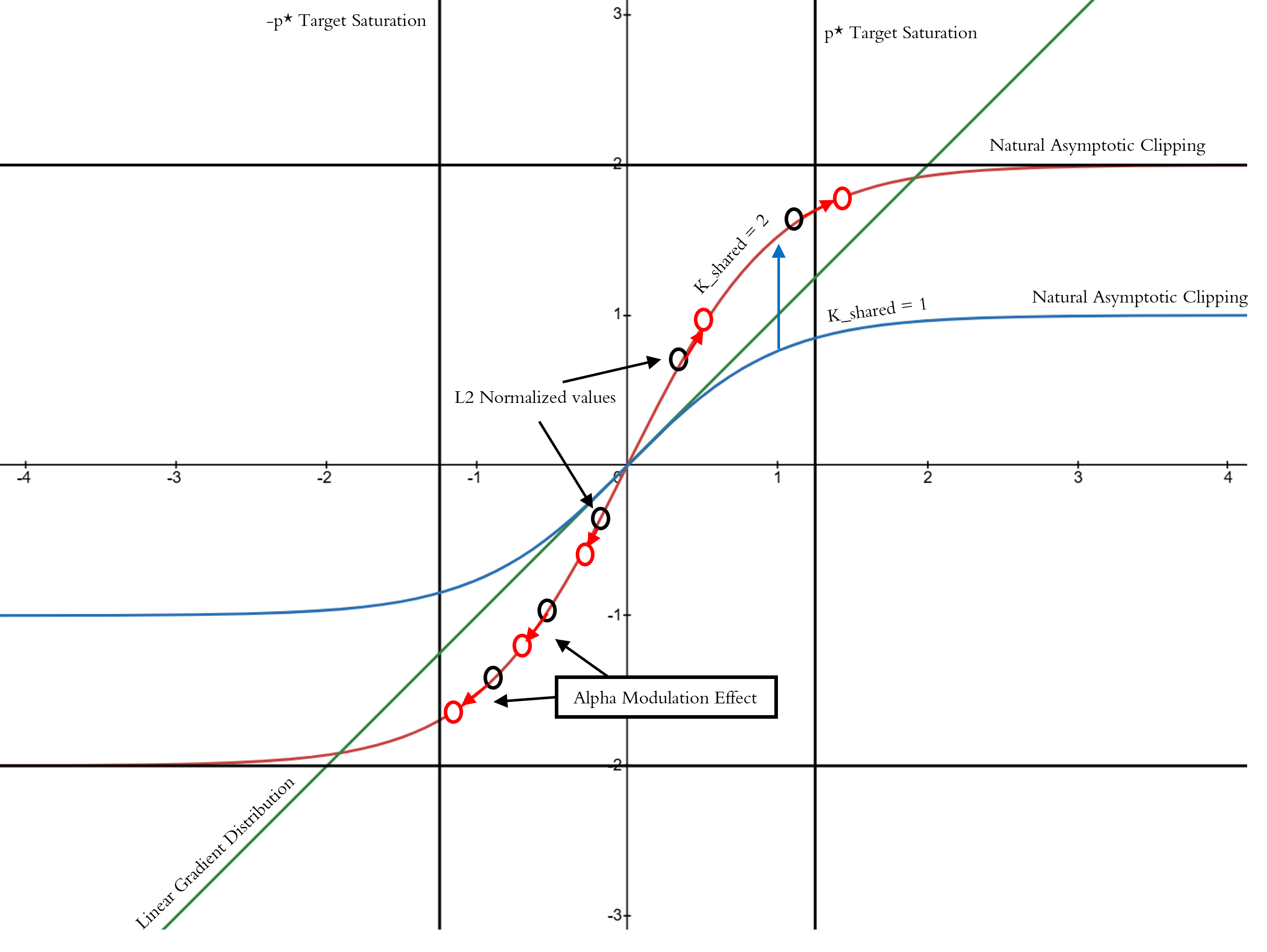
Mathematical visualization of the alpha modulation controller's effect on normalized values
Evaluation Highlights
Achieves superior reward trajectories compared to standard PPO across standard continuous control benchmarks
Significantly reduces the clipping rate required by adaptive optimizers, indicating a more stable optimization process
Demonstrates sustained learning progression where standard PPO might plateau or destabilize
Breakthrough Assessment
7/10
Proposes a theoretically grounded modulation mechanism that addresses a core instability in PPO. While empirical results are described as superior, the paper is a preprint with limited visible benchmark data in the provided text.
⚙️ Technical Details
Problem Definition
Setting: Reinforcement Learning in continuous control environments (Markov Decision Processes)
Inputs: State s_t from the environment
Outputs: Action a_t sampled from policy π_θ(a|s)
Pipeline Flow
Data Collection (Run policy in envs) → Raw Advantage Calculation (GAE)
epsilon_A: Small constant for numerical stability in std dev calculation
tau_A: Threshold for saturation calculation
Compute: Not explicitly reported in the paper
Comparison to Prior Work
vs. PPO: AM-PPO dynamically scales advantages based on their statistical properties (norm, saturation) rather than using static normalization
vs. PPO: AM-PPO trains the value function on modulated advantage targets rather than raw returns, ensuring consistency
vs. DynAG: Adapts the concept of dynamic learning signal adjustment specifically for RL advantage estimation rather than general gradient descent [not cited in paper as direct baseline, but as inspiration]
Limitations
Introduces additional hyperparameters (kappa, rho, tau) for the controller
Complexity of implementation is higher than standard PPO due to the feedback controller loop
Reliance on batch statistics means performance may be sensitive to batch size
Reproducibility
No code URL provided. Algorithms are described mathematically (Eq 1-9). Hyperparameters are referenced in Table 1 (values not extracted in text).
📊 Experiments & Results
Evaluation Setup
Continuous control reinforcement learning benchmarks
Benchmarks:
Standard continuous control benchmarks (Locomotion/Control (implied MuJoCo or similar))
Metrics:
Reward trajectories (cumulative reward)
Clipping rate (percentage of updates clipped)
Learning progression stability
Statistical methodology: Not explicitly reported in the paper
Main Takeaways
AM-PPO achieves superior reward trajectories compared to standard PPO baselines
The method significantly reduces the amount of clipping required by the optimizer, suggesting the modulated gradients are naturally more stable and consistent
Learning progression is sustained in later stages of training where standard PPO might plateau
The modulation of value function targets is critical, ensuring the critic learns from the same signal structure as the actor
PPO: Proximal Policy Optimization—an RL algorithm that improves training stability by limiting how much the policy can change in a single update
GAE: Generalized Advantage Estimation—a method to estimate the 'advantage' (how much better an action is than average) by balancing bias and variance
EMA: Exponential Moving Average—a statistical technique that weighs recent data points more heavily, used here to track evolving advantage statistics smoothly
tanh: Hyperbolic Tangent—a non-linear activation function that squashes values into the range [-1, 1], used here as a gating mechanism
TD error: Temporal Difference error—the difference between the estimated value of the current state and the actual reward plus the estimated value of the next state