📝 Paper Summary
Small Language Models
Multilingual Alignment
Code-Switching Mitigation
PureTC-1B stabilizes Traditional Chinese generation in small language models by eliminating unintended code-switching through a parameter-efficient pipeline of continual pre-training, supervised fine-tuning, and direct preference optimization.
Core Problem
Open-weight Small Language Models (SLMs) frequently exhibit token-level instability in Traditional Chinese (TC), unpredictably emitting Simplified Chinese, English, or other languages.
Why it matters:
- Unintended code-switching undermines the reliability required for professional AI applications in law, government, and education
- Model scale alone does not guarantee linguistic fidelity; even state-of-the-art open-source models suffer from spontaneous foreign-language token generation
- Prompt engineering is insufficient to prevent this instability, necessitating robust fine-tuning solutions that fit on commodity hardware
Concrete Example:
Under a Traditional Chinese prompt, a standard open-source SLM might spontaneously insert English words or Simplified Chinese characters into its response, compromising the linguistic purity required for official documents.
Key Novelty
Adapter-Only Stabilization Pipeline (PureTC-1B)
- Continual Pre-Training (CPT) shifts the model's language priors toward Traditional Chinese using broad and domain-specific corpora
- Supervised Fine-Tuning (SFT) aligns the model to follow instructions while enforcing single-language output
- Direct Preference Optimization (DPO) directly penalizes code-switched outputs by optimizing preferences for linguistically pure responses
Architecture
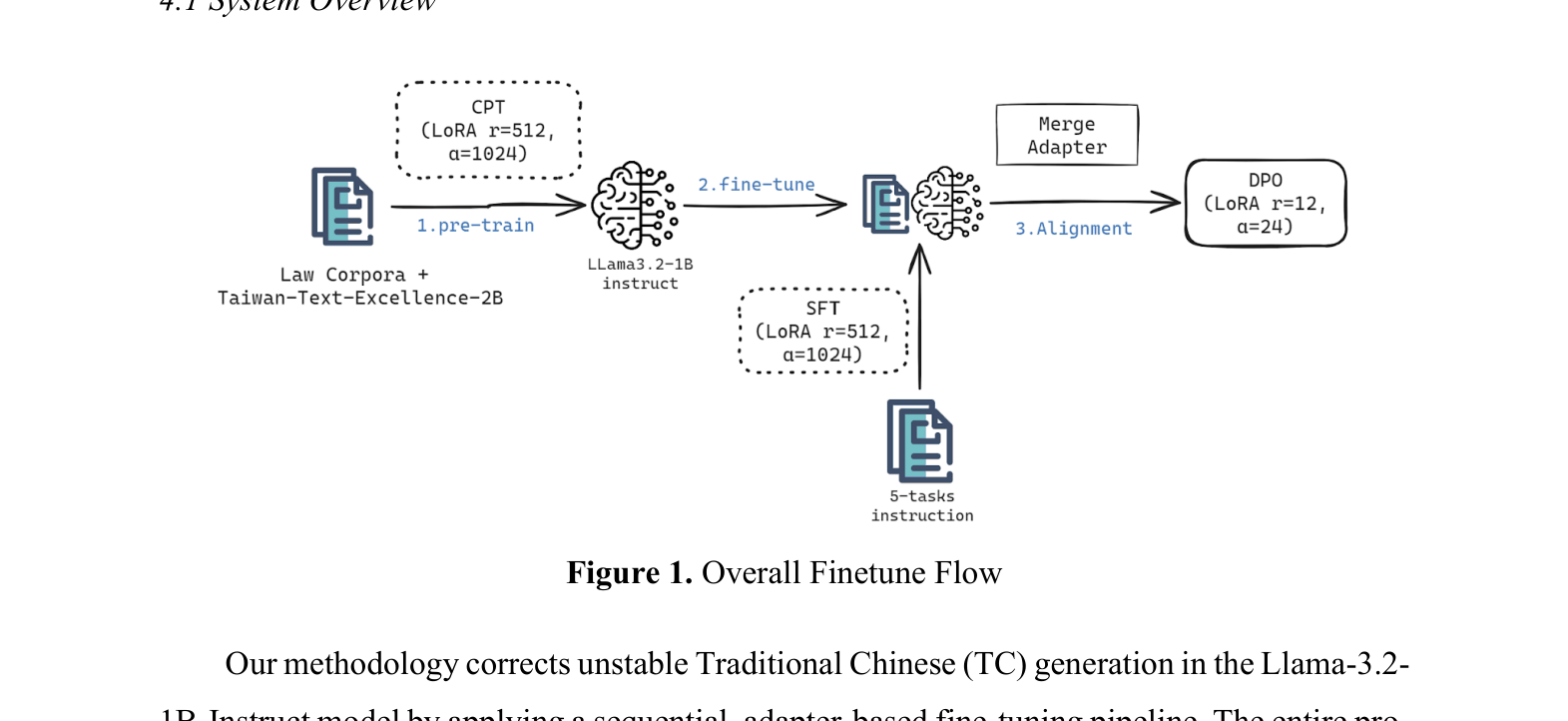
A conceptual text-based flowchart of the three-stage overall fine-tuning flow (CPT, SFT, DPO) applied to the base model using LoRA adapters.
Evaluation Highlights
- Reduces non-Traditional Chinese contamination (Other-Language Rate) by 51.3% relative (micro-average) compared to the Llama-3.2-1B-Instruct base model
- Increases strict perfect-purity rate (Pass@TC) from 9.5% to 29.9% (+20.4 pp) on the macro-average benchmark
- Outperforms larger baselines on Named Entity Translation, reducing incorrect-language tokens by 77.2% relative to Llama-3B and 57.2% relative to Qwen-1.5B
Breakthrough Assessment
7/10
Provides a highly practical, hardware-friendly recipe for stabilizing specific language generation in SLMs without full-parameter retraining, though noise robustness slightly degrades.