By systematically exploring design spaces, this paper discovers universal architectural patterns for parameter-efficient fine-tuning that outperform manually designed individual strategies.
Core Problem
Existing Parameter-Efficient Fine-Tuning (PEFT) strategies are typically hand-crafted and uniformly assigned across all network layers, ignoring potential structural optimizations.
Why it matters:
Applying the same strategy to all layers is sub-optimal because different layers capture distinct levels of information (e.g., surface syntax vs. deep semantics)
Discovering optimal tuning patterns improves model performance without increasing the parameter budget or computational overhead
A unified design space perspective reveals universal patterns that generalize across different models and tasks, reducing manual engineering
Concrete Example:Instead of blindly adding Adapter modules to every single layer of a T5 model, systematically grouping layers into a "spindle" pattern (fewer layers at the ends, more in the middle) and assigning different strategies (e.g., LoRA early, BitFit later) yields higher validation accuracy under the exact same parameter budget.
Key Novelty
PEFT Design Spaces
Defines a structured search space composed of four choices: how to group layers, how to allocate parameters, which groups to tune, and which specific tuning method to assign
Progressively refines this design space by evaluating randomly sampled models and greedily keeping structural constraints that yield the highest validation performance
Architecture
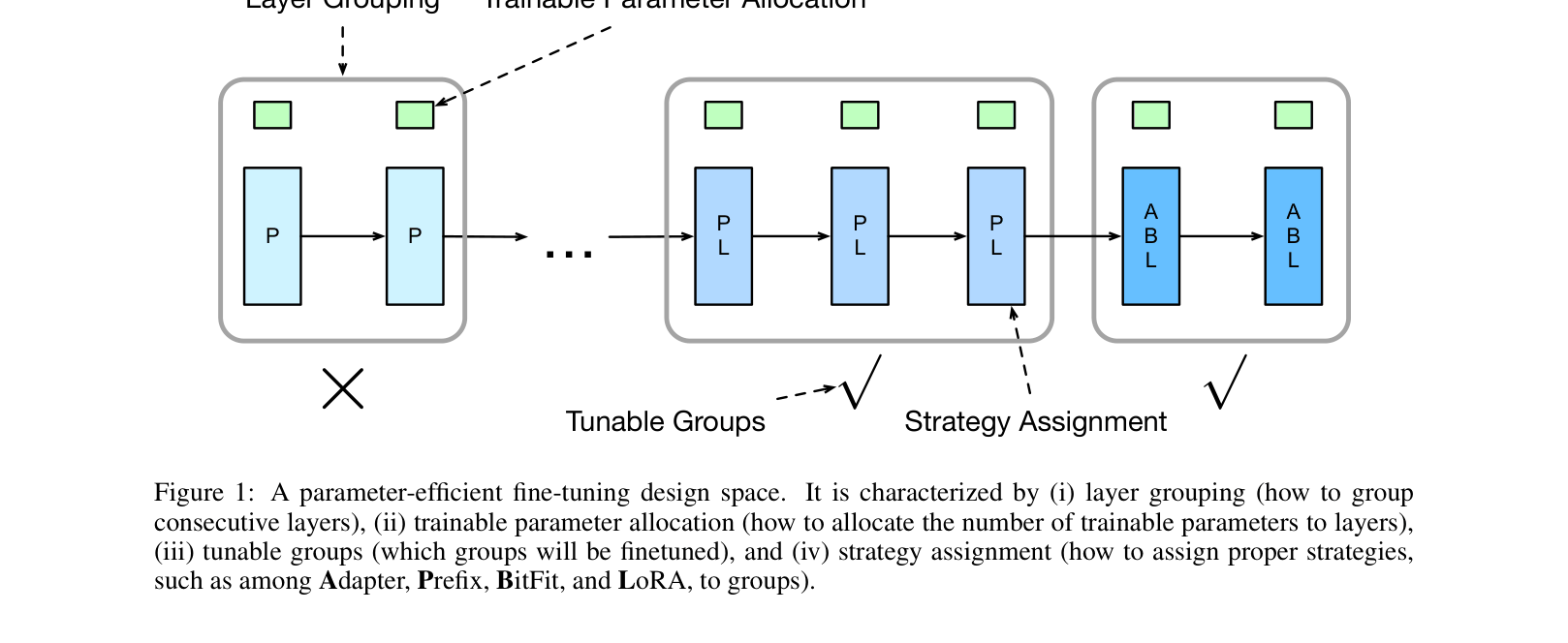
A visualization of the parameter-efficient fine-tuning design space components: Layer Grouping, Trainable Parameter Allocation, Tunable Groups, and Strategy Assignment
Evaluation Highlights
+2.4 points on GLUE (General Language Understanding Evaluation) average score over the best PEFT baseline using T5-base with a 0.5% parameter budget
Outperforms full fine-tuning by +1.2 points on GLUE using T5-base, demonstrating that proper PEFT design can surpass tuning all parameters
Discovered design patterns transfer seamlessly to RoBERTa and BART backbones on summarization and translation tasks without requiring a new search process
Breakthrough Assessment
8/10
Shifting PEFT from manual individual method design to systematic design space exploration is a highly impactful conceptual step, yielding robust configurations that reliably beat strong baselines.
⚙️ Technical Details
Problem Definition
Setting: Parameter-efficient fine-tuning of large pre-trained language models on downstream natural language processing tasks under a strict trainable parameter budget
Outputs: Task-specific textual outputs or classification logits
Pipeline Flow
Pre-trained Model Layers → Spindle Grouping → Uniform Parameter Allocation → Full Group Tuning → Heterogeneous Strategy Assignment → Output
System Modules
Group 1 (Early Layers)
Process initial token representations using specific PEFT strategies assigned via search (e.g., Adapter and LoRA for T5-base)
Model or implementation: Pre-trained Transformer Layers + Assigned PEFT modules
Group 2 & 3 (Middle Layers)
Process intermediate representations; these groups contain more layers (spindle pattern) and use distinct PEFT strategies (e.g., Adapter, Prefix, BitFit)
Model or implementation: Pre-trained Transformer Layers + Assigned PEFT modules
Group 4 (Late Layers)
Process final representations for task output; contains fewer layers and uses strategies like Prefix, BitFit, LoRA
Model or implementation: Pre-trained Transformer Layers + Assigned PEFT modules
Novel Architectural Elements
Spindle pattern grouping: Middle groups have more transformer layers than the first and last groups
Heterogeneous strategy assignment: Different types of PEFT modules (Adapter, Prefix, BitFit, LoRA) are assigned to different depth groups in the same network, rather than applying a single method uniformly
Modeling
Base Model: T5-base, T5-3b, RoBERTa-base, RoBERTa-large, BART-base, BART-large
Training Method: Supervised fine-tuning of selected PEFT parameters
Trainable Parameters: 0.5% of total parameters for Adapter, Prefix, LoRA, and the proposed methods; 0.1% for BitFit
Training Data:
GLUE benchmark datasets
XSum summarization dataset
WMT 2016 en-ro machine translation dataset
Key Hyperparameters:
learning_rate: 5e-5
batch_size: 128 (base models), 64 (large models)
epochs: 3 (low-compute search regime); 5 or 10 (full evaluation)
vs. UniPELT: Learns combinations of PEFT methods per-layer via gating during training, whereas the proposed method structurally assigns fixed optimal strategies to specific layer groups based on design space exploration [not cited in paper]
vs. AdapterFusion: Focuses on multi-task composition rather than discovering optimal grouping and allocation strategies for standard single-task PEFT across network layers
Limitations
The greedy search process evaluates components sequentially, which may miss optimal combinations found by joint optimization
The specific layer group assignment patterns (e.g., Group 1 getting Adapter and LoRA) discovered for T5-base differ from T5-3b, implying exact patterns might need re-discovery for vastly different architectures
Exploration is limited to a subset of all possible PEFT strategies (Adapter, Prefix, BitFit, LoRA) and predefined structural choices
Code is publicly available on GitHub. Hyperparameters (learning rate, batch size, warmup ratio) and dataset usages are explicitly reported in the paper.
📊 Experiments & Results
Evaluation Setup
Supervised fine-tuning of pre-trained models on classification and generation tasks under a strict trainable parameter constraint (0.5%)
Benchmarks:
GLUE (Natural Language Understanding)
XSum (Abstractive Summarization)
WMT 2016 en-ro (Machine Translation)
Metrics:
Accuracy
Matthews correlation
Spearman correlation
ROUGE (R-1/2/L)
BLEU
Statistical methodology: Significance tests reported. Proposed models are evaluated against the second-best PEFT methods at significance levels p < 0.05 (*) and p < 0.01 (**).
Key Results
Benchmark
Metric
Baseline
This Paper
Δ
GLUE
Average Score
83.3
85.7
+2.4
GLUE
Average Score
88.9
89.9
+1.0
GLUE
Average Score
86.4
87.1
+0.7
XSum
ROUGE-1
43.9
44.3
+0.4
Experiment Figures
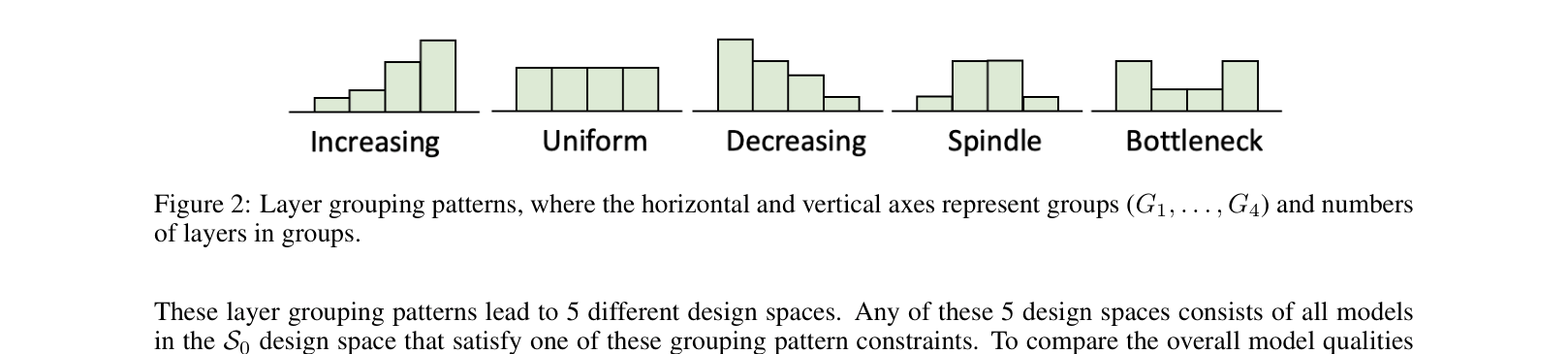
Visual representation of the five considered layer grouping patterns: Increasing, Uniform, Decreasing, Spindle, and Bottleneck
Main Takeaways
Applying Parameter-Efficient Fine-Tuning (PEFT) methods uniformly across all layers is sub-optimal; different transformer depths benefit from distinct tuning strategies
The 'spindle' layer grouping (fewer layers at the beginning and end, more in the middle) consistently yields the best validation accuracy compared to uniform or increasing distributions
Design patterns discovered on T5 backbones generalize remarkably well to different architectures (RoBERTa, BART) and task types (generation, translation) without needing to re-run the search process
📚 Prerequisite Knowledge
Prerequisites
Transfer learning and fine-tuning
Parameter-efficient tuning methods
Neural architecture search concepts
Key Terms
PEFT: Parameter-Efficient Fine-Tuning—adapting large pre-trained models by updating only a small fraction of parameters while freezing the rest
Adapter: A PEFT method that inserts small trainable feed-forward networks between existing layers of a model
Prefix tuning: A PEFT method that prepends trainable continuous virtual tokens to the input or hidden layers
BitFit: A PEFT method that only updates the bias terms in the pre-trained model while freezing weight matrices
LoRA: Low-Rank Adaptation—a PEFT method that decomposes weight updates into low-rank matrices to save parameters
Spindle pattern: A layer grouping strategy discovered in the paper where the numbers of layers in groups at both ends of the network are smaller than those in the middle groups
GLUE: General Language Understanding Evaluation—a standard benchmark collection for evaluating natural language understanding systems
Design space: A parameterized set of architectural or tuning choices that can be searched or refined to find optimal configurations