📝 Paper Summary
Parameter-Efficient Fine-Tuning (PEFT)
Neural Tangent Kernel (NTK) Theory
Optimization Dynamics
Regularizing fine-tuning to stay close to pretrained weights explicitly forces the process into a linearized regime, enabling performance prediction and optimal layer selection using Neural Tangent Kernel properties.
Core Problem
Parameter-Efficient Fine-Tuning (PEFT) methods lack a rigorous theoretical understanding of their training dynamics and layer selection choices, making informed algorithmic exploration difficult.
Why it matters:
- Full fine-tuning of Large Language Models (LLMs) is computationally prohibitive, necessitating efficient alternatives
- Current PEFT methods heuristically select layers or apply rank-limited updates without theoretical guarantees of success
- Understanding fine-tuning dynamics allows for better-informed, scalable, and more efficient model adaptation
Concrete Example:
When selecting layers for Low Rank Adaptation (LoRA), practitioners currently rely on trial and error. This theoretical framework uses spectral perturbation bounds to predict which layers will minimize error before actual training begins.
Key Novelty
Linearized Fine-Tuning via Explicit Inductive Bias
- Applies an explicit weight decay towards the original pretrained model to constrain fine-tuning to the lazy training regime
- Formulates the fine-tuning process as kernel regression using the fixed Neural Tangent Kernel (NTK)
- Uses the eigenvalue spectrum of the NTK to theoretically bound empirical risk and evaluate the impact of selecting specific layers for adaptation
Architecture
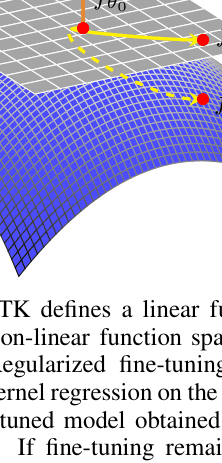
The conceptual approximation of regularized fine-tuning in parameter space by its dual in the tangent space
Breakthrough Assessment
7/10
Provides strong theoretical grounding for PEFT using the NTK, linking layer selection to spectral properties, though empirical results are missing from the provided text to fully verify practical impact.