CogACT decouples high-level reasoning from low-level control by using a VLM to generate a 'cognition feature' that conditions a specialized, large-scale diffusion transformer for precise action sequence generation.
Core Problem
Existing VLAs (like RT-2 and OpenVLA) force continuous, high-frequency robot actions into discrete language tokens or simple regression heads, limiting precision and failing to capture the multimodal, probabilistic nature of physical motion.
Why it matters:
Discrete tokenization designed for text is suboptimal for high-dimensional, continuous motor control
Simple regression averages across valid modes (e.g., going left vs. right around an obstacle), leading to invalid 'mean' trajectories
Current methods struggle with precision and smoothness, evidenced by low success rates in real-world manipulation tasks
Concrete Example:When a robot attempts to grasp a mug, there may be multiple valid trajectories. A standard regression VLA might average these into a shaky, invalid path. A token-based VLA might coarsely quantize the movement, losing fine motor control. CogACT's diffusion head models the full distribution of valid trajectories.
Key Novelty
Componentized Cognition-Action Architecture
Separates the 'brain' (VLM for reasoning) from the 'cerebellum' (Diffusion Transformer for motor control) unlike unified token-in-token-out models
Uses a learnable 'cognition token' in the VLM to extract a compressed semantic instruction that conditions the action generation module
Introduces a 'large' specialized action module (up to 300M parameters) rather than a small projection head, finding that scaling this module significantly improves performance
Architecture
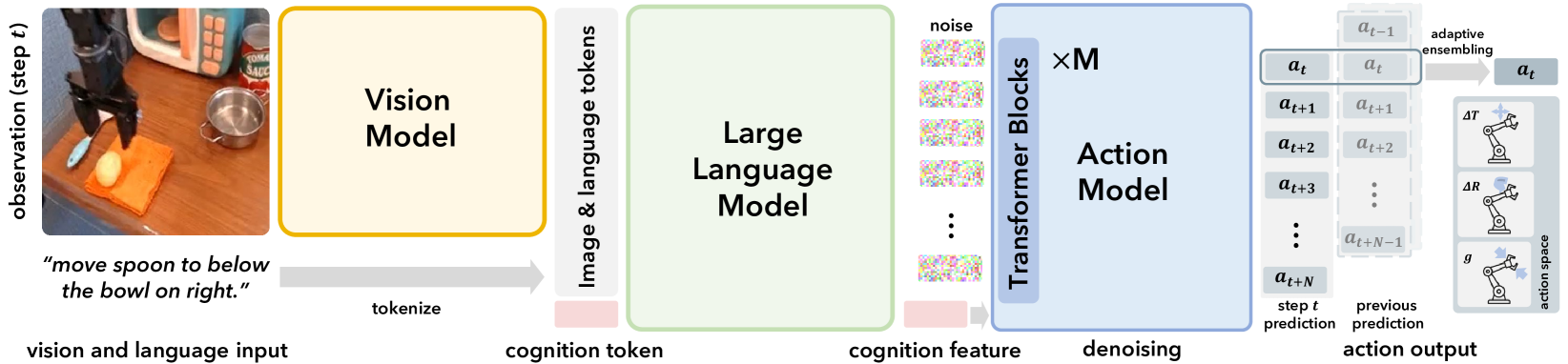
The complete CogACT pipeline showing the flow from Vision/Language inputs to Action outputs.
Evaluation Highlights
Surpasses OpenVLA (7B) by over 35% success rate in simulated evaluations
Outperforms OpenVLA (7B) by 55% success rate in real-world robot experiments
Exceeds the performance of the significantly larger RT-2-X (55B) by 18% absolute success rate in simulation
Breakthrough Assessment
8/10
Strong empirical results (+55% real-world improvement) and a logical architectural shift (decoupling cognition/action) that addresses a fundamental limitation of treating actions as text tokens.
⚙️ Technical Details
Problem Definition
Setting: Robotic manipulation given visual observations and language instructions
Inputs: Language instruction l and visual observation o_t at time t
Outputs: Sequence of continuous actions (a_t, ..., a_{t+N}) including 7-DoF end-effector pose and gripper state
Pipeline Flow
Input Processing: Images processed by Vision Encoders; Text processed by Tokenizer
Cognition Module: VLM fuses vision+text and outputs a 'Cognition Feature' via a special token
Action Module: Diffusion Transformer conditions on Cognition Feature to generate action sequence
System Modules
Vision Module
Extract visual features from raw camera input
Model or implementation: DINOv2 and SigLIP (concatenated features)
Language/Cognition Module
Integrate visual and linguistic info to reason about the task
Model or implementation: LLAMA-2 (7B backbone)
Action Module
Generate precise, continuous action sequences
Model or implementation: Diffusion Transformer (DiT) (up to 300M parameters)
Novel Architectural Elements
Explicit decoupling of VLM (Cognition) and Action Policy (Action Module) via a bottleneck 'Cognition Token'
Use of a 'large' (300M parameter) Diffusion Transformer as a dedicated action decoder within a VLA, distinct from small heads (Octo) or tokenizers (RT-2)
Modeling
Base Model: VLM backbone based on LLAMA-2 (7B), Vision encoders DINOv2 + SigLIP
Training Method: Supervised fine-tuning / End-to-end training with Diffusion Loss
Objective Functions:
Purpose: Train the action module to reconstruct actions from noise.
Formally: MSE loss between predicted noise epsilon_hat and ground truth noise epsilon
Training Data:
Trained on Open X-Embodiment dataset
Key Hyperparameters:
prediction_horizon_N: 15 (predicts current + 15 future actions)
context_length_action_module: 17 (N+2)
adaptive_ensemble_alpha: 0.1
Compute: Not reported in the paper
Comparison to Prior Work
vs. OpenVLA/RT-2: CogACT uses continuous diffusion for actions instead of discrete tokenization, allowing higher precision and better mode coverage
vs. Octo: CogACT uses a much larger, specialized action module (300M vs 3M) and conditions it on a VLM with internet-scale pretraining (Octo does not use a VLM backbone)
vs. RoboFlamingo: CogACT uses diffusion to model multimodal action distributions, whereas RoboFlamingo uses regression (MSE) which averages modes
Limitations
No statistical significance tests reported for the success rate improvements
Reliance on a specific VLM backbone (LLAMA-2) limits flexibility compared to model-agnostic heads
Inference cost of diffusion process (multiple denoising steps) is higher than single-step token prediction (though mitigated by short context N=15)
Reproducibility
Code and models are stated to be publicly released on the project page (URL not in snippet). Paper relies on Open X-Embodiment dataset (public). Uses standard backbones (LLAMA-2, DINOv2, SigLIP).
📊 Experiments & Results
Evaluation Setup
Robotic manipulation tasks in both simulation and real-world environments
Benchmarks:
Simulation Benchmark (Robotic manipulation (likely LIBERO/CALVIN based on [33] reference))
Real Robot Experiments (Physical manipulation tasks) [New]
Metrics:
Success Rate
Statistical methodology: Not explicitly reported in the paper
Key Results
Benchmark
Metric
Baseline
This Paper
Δ
Experiment Figures
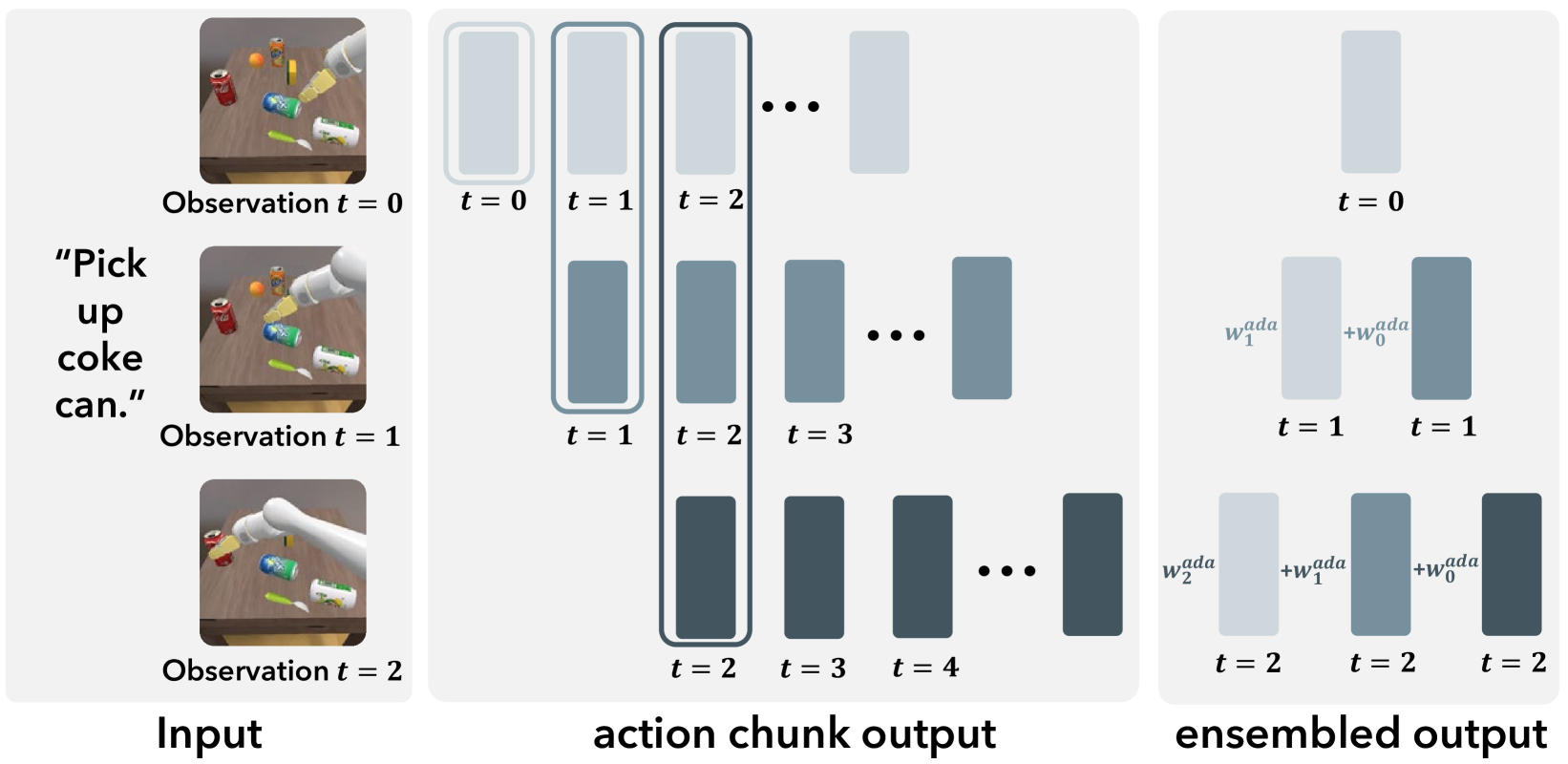
Illustration of the Adaptive Action Ensemble (AAE) strategy.
Main Takeaways
CogACT significantly outperforms OpenVLA (7B) by over 35% in simulation and 55% in real-world settings, demonstrating the superiority of the decoupled architecture.
CogACT (7B total) outperforms the much larger RT-2-X (55B) by 18% in simulation, showing that better architectural design (Diffusion Action Module) outweighs pure model scale for control.
The Adaptive Action Ensemble (AAE) strategy effectively fuses temporal predictions by weighting them based on similarity, avoiding the 'average of modes' problem common in fixed ensembles.
Scaling the Action Module (DiT) from small to large (up to 300M parameters) yields favorable performance scaling, suggesting a new avenue for VLA scaling beyond just increasing the VLM size.
📚 Prerequisite Knowledge
Prerequisites
Vision-Language Models (VLMs) and their tokenization schemes
VLA: Vision-Language-Action model—a system that integrates visual understanding, language reasoning, and robotic control
DiT: Diffusion Transformer—a type of generative model that uses transformer architecture to learn the noise-removal process in diffusion
7-DoF: 7 Degrees of Freedom—describes a robot arm's movement capability (x, y, z position + 3 rotation angles + 1 gripper state)
Cognition Token: A special learnable token added to the VLM input that aggregates reasoning information to condition the downstream action module
Adaptive Action Ensemble: A proposed algorithm that blends action predictions from previous time steps based on their similarity to the current prediction, rather than fixed weights