📊 Experiments & Results
Evaluation Setup
Zero-shot evaluation on standard VLM benchmarks
Benchmarks:
- VQA-v2 (Visual Question Answering)
- VizWiz (Visual Question Answering (blind users))
- ScienceQA (Multi-modal Science Questions)
- POPE (Object Hallucination Evaluation)
- MMBench (Comprehensive Multi-modal Ability)
Metrics:
- Accuracy (%)
- Statistical methodology: Not explicitly reported in the paper
Key Results
| Benchmark | Metric | Baseline | This Paper | Δ |
|---|---|---|---|---|
| Performance comparisons on standard multi-modal benchmarks show LLaVA-Phi often matching or beating larger models. | ||||
| ScienceQA | Accuracy | 66.8 | 71.4 | +4.6 |
| VQA-v2 | Accuracy | 50.9 | 71.4 | +20.5 |
| POPE | Accuracy | 85.9 | 85.0 | -0.9 |
| MMBench | Accuracy | 59.6 | 59.8 | +0.2 |
| MMBench | Accuracy | 36.0 | 59.8 | +23.8 |
Experiment Figures
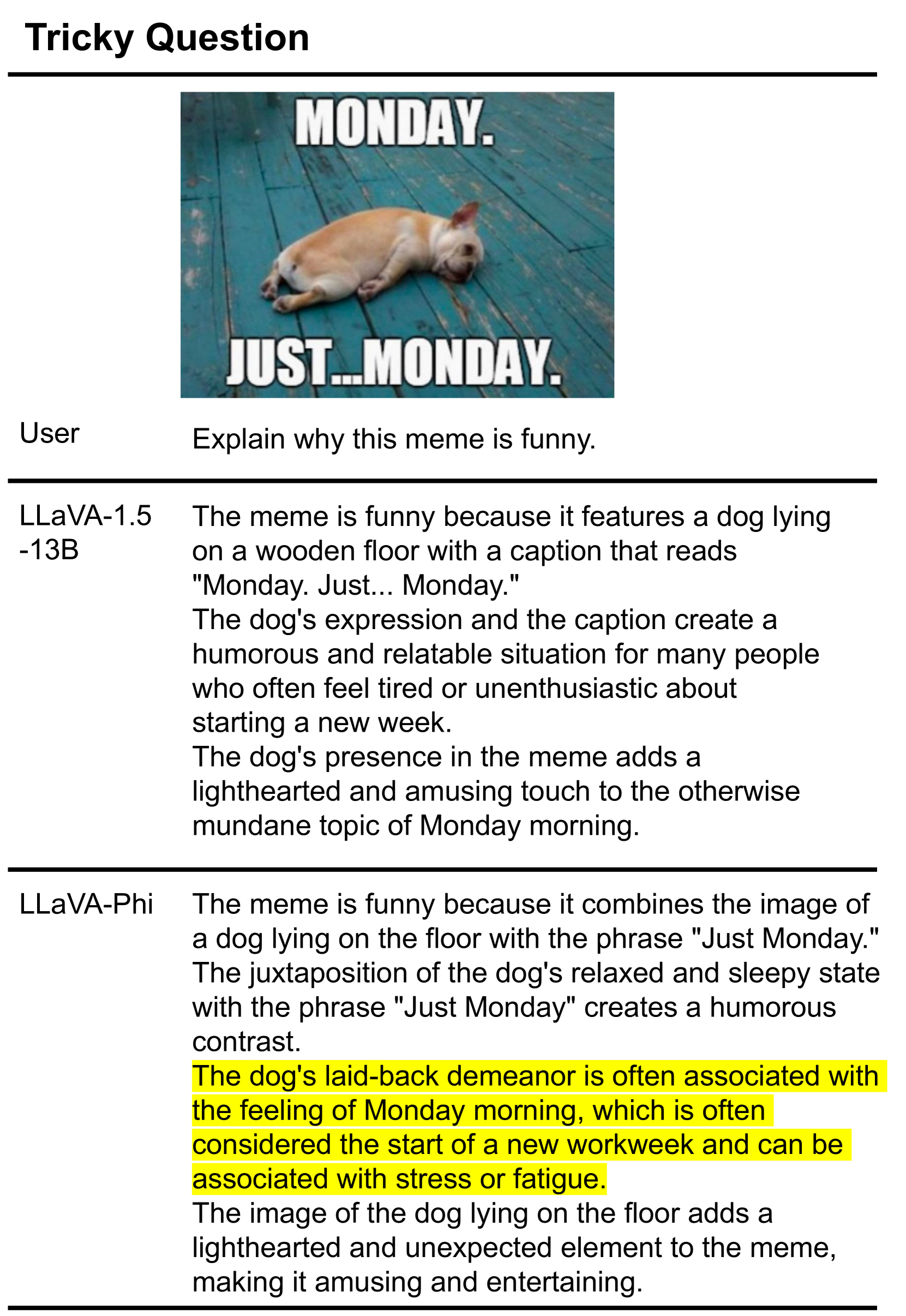
Qualitative comparison: Meme explanation
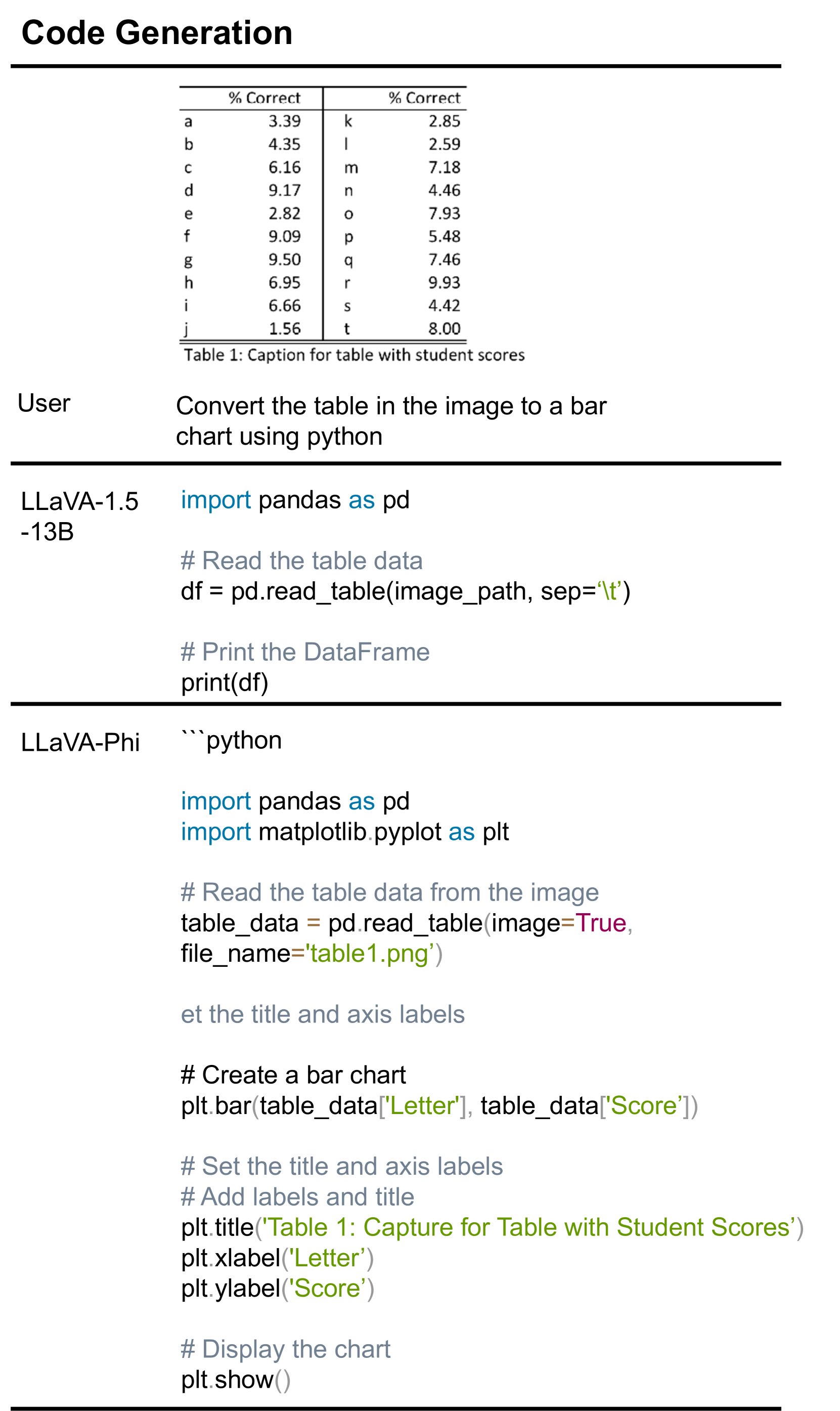
Qualitative comparison: Code generation from Excel table image
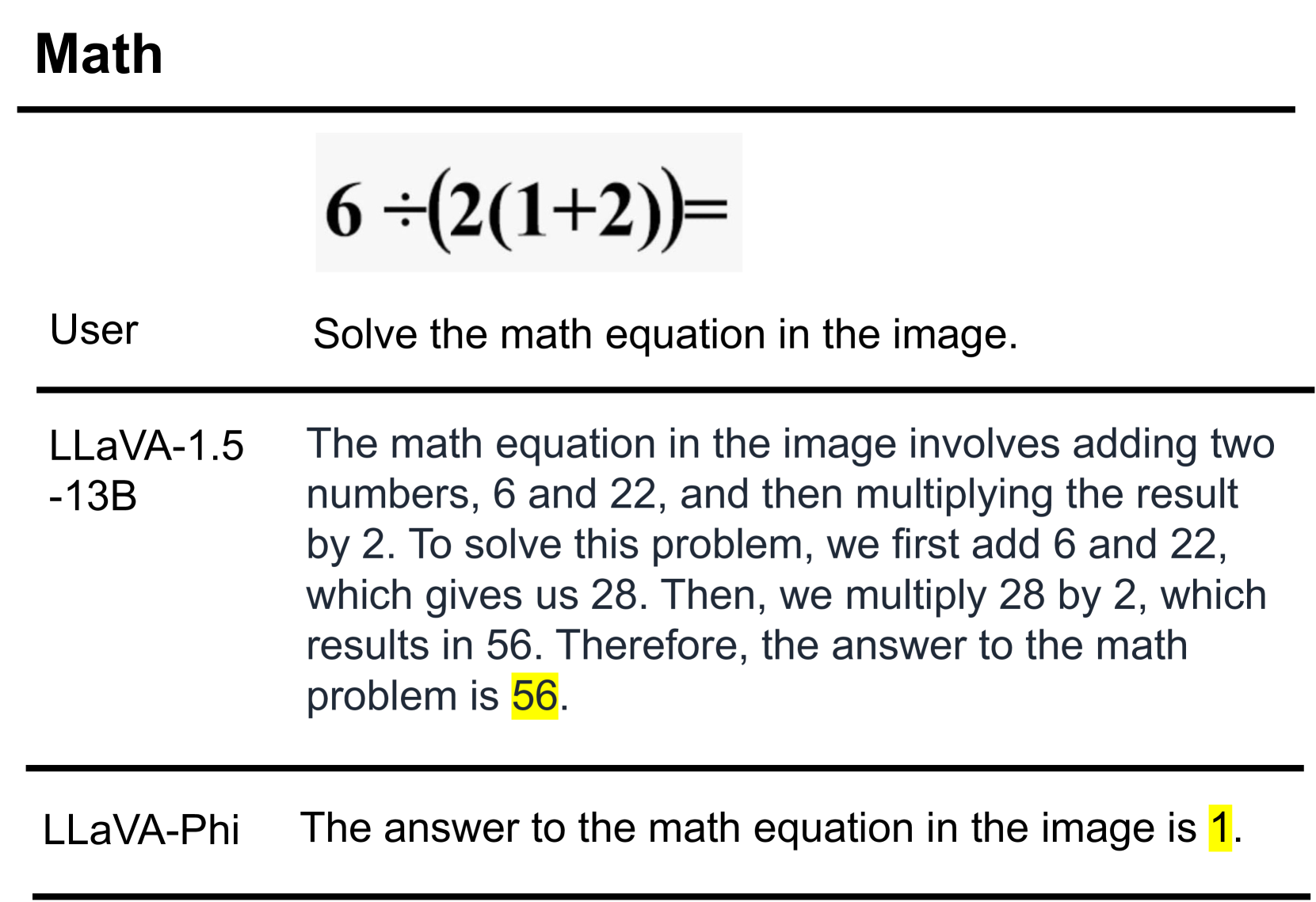
Qualitative comparison: Math problem solving with OCR
Main Takeaways
- LLaVA-Phi proves that small language models (2.7B) can drive effective multi-modal assistants if the base model is high-quality (Phi-2).
- The model excels particularly in tasks requiring reasoning and code generation (ScienceQA, coding demos), likely inheriting Phi-2's strengths.
- Consistently outperforms or matches larger 7B/9B/13B baselines (IDEFICS, InstructBLIP) on several benchmarks.
- Efficient training: Requires only 8 A100 GPUs for <10 hours total training time.