📝 Paper Summary
Visual Instruction Tuning
Hallucination Mitigation in LMMs
The paper mitigates multi-modal hallucination by fine-tuning models on LRV-Instruction, a dataset balancing positive and negative visual instructions, and evaluates performance via a GPT-4-based reference-free metric.
Core Problem
Current Large Multi-Modal Models (LMMs) frequently hallucinate inconsistent descriptions and tend to answer 'Yes' to existence questions regardless of image content.
Why it matters:
- LMMs inherit hallucination issues from Large Language Models (LLMs), leading to harmful consequences when users over-rely on them
- Existing training data lacks diversity and primarily consists of positive instruction samples, causing models to over-rely on language priors rather than visual evidence
- Evaluation metrics like CHAIR are unstable, and binary classification metrics require rigid templates, failing to capture open-ended hallucination
Concrete Example:
When asked to describe an image of a room, MiniGPT4 describes a nonexistent 'dog' engaging in a nonexistent activity like 'playing with a ball' because these words statistically co-occur in language, ignoring the actual image content.
Key Novelty
LRV-Instruction Dataset & GAVIE Evaluation
- Constructs a balanced dataset (LRV-Instruction) containing both positive instructions and three levels of negative instructions (Nonexistent Object, Existent Object, Knowledge Manipulation) to teach models to say 'No'
- Proposes GAVIE (GPT4-Assisted Visual Instruction Evaluation), where GPT-4 acts as a 'smart teacher' to score model responses against dense captions without needing ground truth answers
Architecture
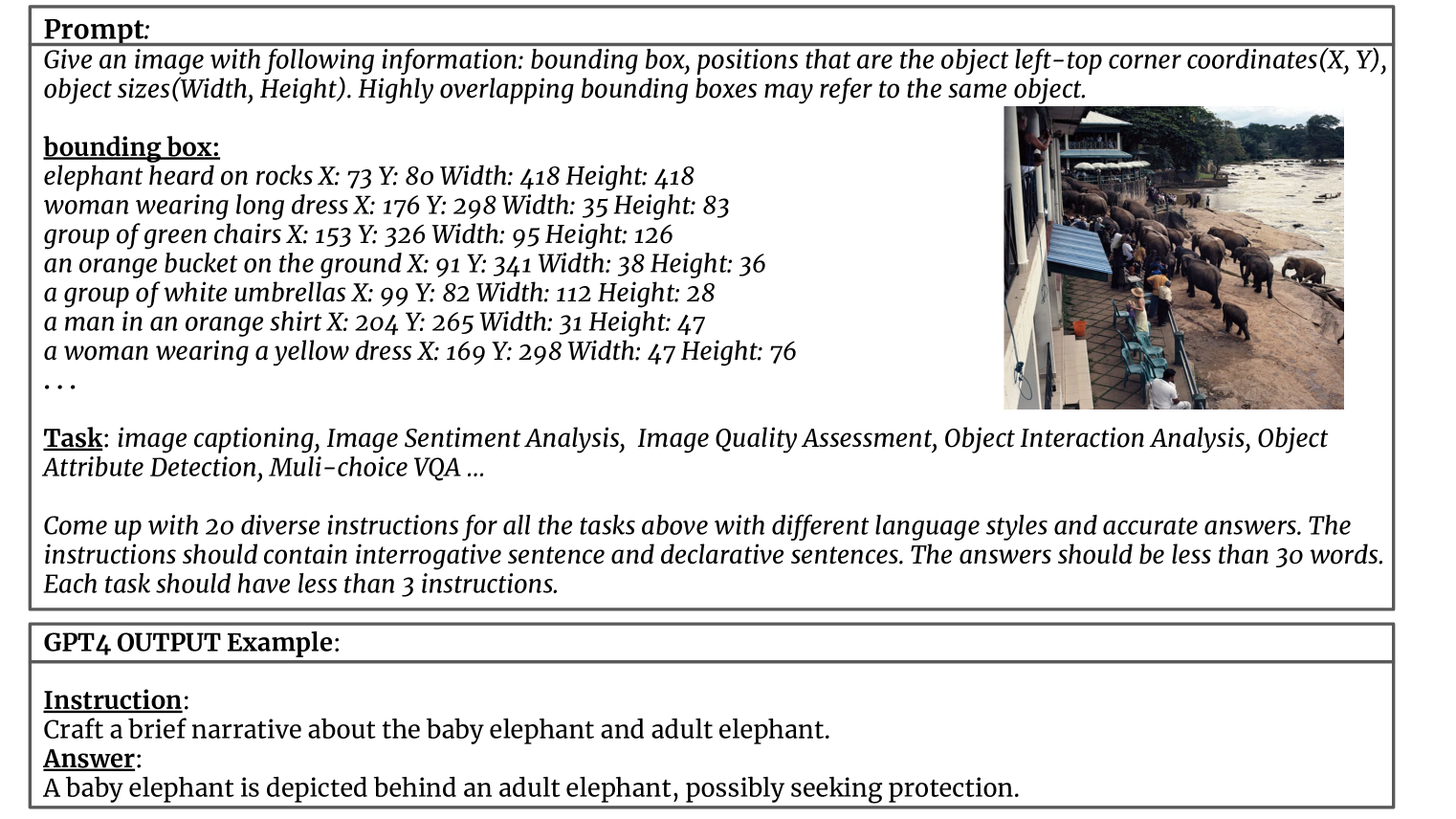
Illustration of the prompt used to generate visual instructions via GPT-4.
Evaluation Highlights
- Finetuned MiniGPT4 achieves 85.0 accuracy on POPE (Random split), surpassing the original MiniGPT4's 56.8 by +28.2 points
- Finetuned mPLUG-Owl achieves 7.44 Relevancy score on the GAVIE benchmark, outperforming InstructBLIP (6.61) and LLaVA (5.26)
- Including negative instructions (1:1 ratio) improves accuracy on negative samples from 48.0% to 77.1% compared to positive-only training
Breakthrough Assessment
7/10
Strong contribution in data-centric AI by proving that negative instruction samples are critical for robustness. The proposed evaluation metric is practical but relies on proprietary GPT-4.