Yingheng Tang, Wenbin Xu, Jie Cao, Jian Ma, Weilu Gao, Steven Farrell, Benjamin Erichson, Michael W. Mahoney, Andy Nonaka, Zhi Yao
Lawrence Berkeley National Laboratory,
University of Colorado at Boulder,
The University of Utah,
University of California at Berkeley
arXiv.org
(2025)
MMReasoningRAGBenchmark
📝 Paper Summary
Material Property PredictionMulti-modal Large Language ModelsAI for Science
MatterChat integrates a pretrained universal interatomic potential with a frozen Large Language Model via a trainable bridge module to enable structure-aware material property prediction and scientific reasoning.
Core Problem
Existing methods either lack language understanding (graph-based models) or lose structural resolution by relying on text descriptions like SMILES/CIF (LLM-based methods).
Why it matters:
High-fidelity methods like DFT are computationally prohibitive for large-scale screening
Pure graph models cannot handle user prompts, literature context, or explainable reasoning
Text-only LLMs fail to capture precise atomic interactions, leading to inferior quantitative predictions
Concrete Example:When predicting properties for a material like Yttrium Iron Garnet (YIG), a standard graph model gives a number without context, while a text-only LLM might hallucinate the structure. MatterChat takes the specific atomic graph, predicts it is magnetic, and generates a detailed synthesis protocol (mixing ratios, sintering conditions) grounded in that specific structure.
Key Novelty
Structure-Aware Multi-Modal Bootstrapping
Uses a pretrained universal machine learning interatomic potential (uMLIP) as a frozen graph encoder to extract physically meaningful atomic embeddings
Employs a BLIP2-style transformer bridge to align these dense atomic embeddings into the LLM's token space via trainable queries, avoiding expensive full-model retraining
Architecture
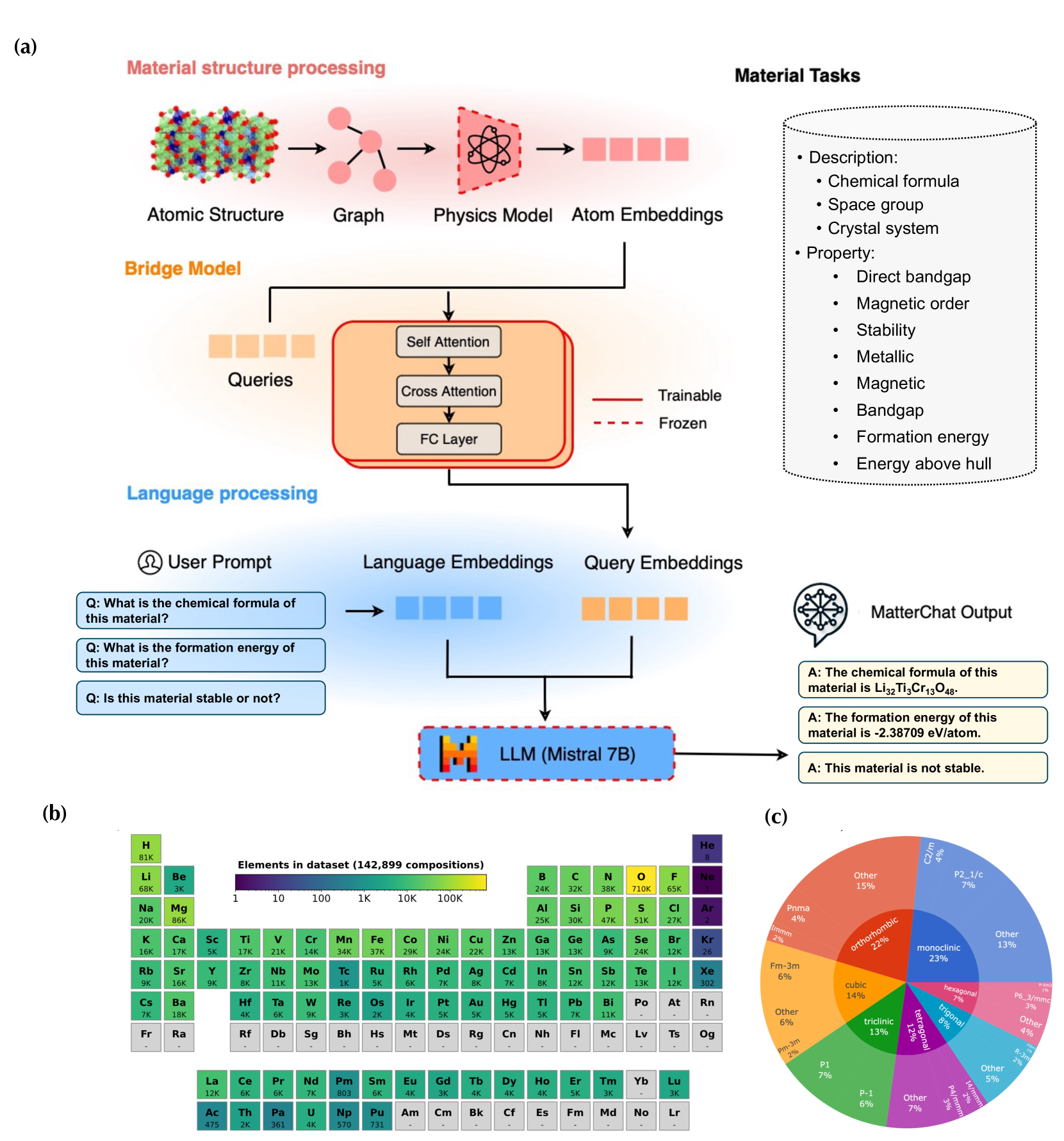
The architecture of MatterChat, detailing the data flow from material structure and text prompts to the final text output.
Evaluation Highlights
Outperforms general-purpose LLMs (GPT-4o, Gemini, DeepSeek) on formation energy estimation for GNoME-discovered materials
Surpasses physical graph-based baselines (SchNet, CHGNet) on numerical tasks like bandgap and energy prediction by leveraging multi-modal reasoning
Demonstrates effective retrieval-augmented generation (RAG) capabilities, improving robustness by retrieving similar materials during inference
Breakthrough Assessment
8/10
Successfully bridges the gap between precise physical potentials and reasoning-capable LLMs without retraining the backbone models. The ability to outperform specialized physical models on numerical tasks while retaining chat capabilities is significant.
⚙️ Technical Details
Problem Definition
Setting: Multi-modal regression and generation: Given a material structure graph G and a text prompt T, generate a text response R (which may contain numerical properties or explanations).
Inputs: Atomic structure (graph) and natural language user query
Outputs: Natural language text (containing property predictions, chemical formulas, or synthesis instructions)
Pipeline Flow
Material Processing Branch (Graph Encoder)
Bridge Model (Alignment)
Language Processing Branch (Prompt Encoding)
LLM (Generation)
System Modules
Material Processing Branch (Input Processing)
Encodes 3D crystal structures into atom-level embeddings
Model or implementation: CHGNet (pretrained uMLIP)
Bridge Model
Aligns atom embeddings with the LLM's token space
Model or implementation: Multi-layer Transformer (BLIP-2 style)
Language Processing Branch (Input Processing)
Processes user text prompts
Model or implementation: Tokenizer/Embedder (Mistral compatible)
LLM
Generates final text response based on fused inputs
Model or implementation: Mistral-7B
Novel Architectural Elements
Utilization of a pretrained uMLIP (CHGNet) as a frozen structure encoder within a multi-modal LLM pipeline
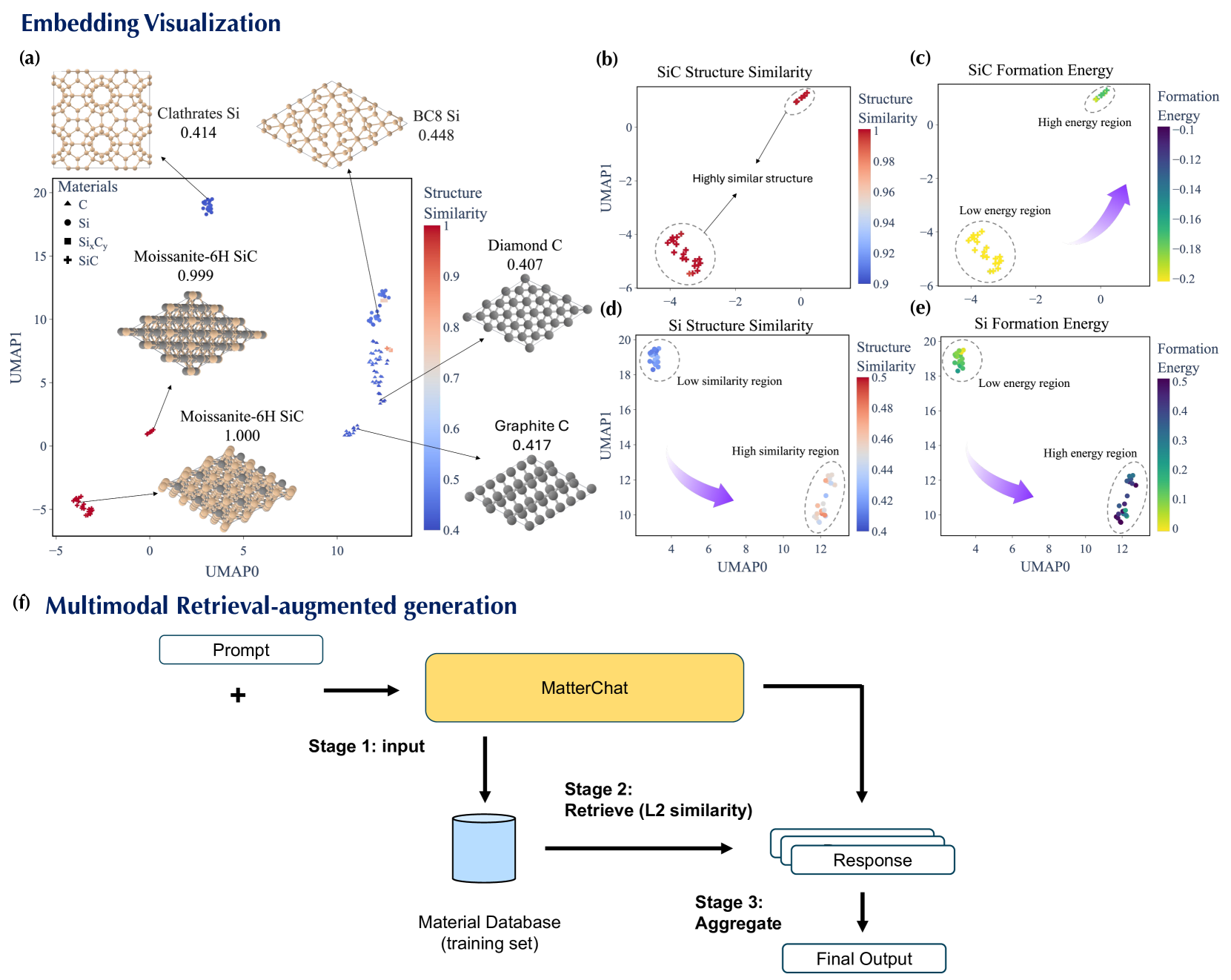
Integration of multi-modal RAG at inference time using embedding similarity from the bridge model
Modeling
Base Model: Mistral-7B
Training Method: Bootstrapping (training bridge only)
Adaptation: Bridge module training (Query Transformers)
142,899 material structures from Materials Project
12 tasks per structure (3 descriptive, 9 property prediction)
Key Hyperparameters:
query_vectors: 32
Compute: Not reported in the paper
Comparison to Prior Work
vs. Pure Graph Models (SchNet, CHGNet): MatterChat adds natural language interaction and scientific reasoning capabilities
vs. Text-based LLMs (GPT-4, Gemini): MatterChat uses full-resolution atomic embeddings via the bridge, avoiding information loss from SMILES/CIF representations
Limitations
Inherits limitations of the underlying uMLIP (CHGNet) regarding the chemical space covered
LLMs generally struggle with precise numerical regression, though MatterChat mitigates this via the bridge
Inference relies on the availability of the structure graph, not just chemical formula
Reproducibility
Code availability is not provided in the text. Training dataset (Materials Project) is public. The specific text-structure pairs dataset generation process is described.
📊 Experiments & Results
Evaluation Setup
Multi-task evaluation on material property prediction and description using the Materials Project dataset.
GNoME materials (Formation Energy Estimation (Generalization))
Metrics:
RMSE (Root Mean Squared Error) for regression
Accuracy for classification
Statistical methodology: Not explicitly reported in the paper
Experiment Figures
UMAP visualization of embeddings processed by the bridge model for Silicon and Carbon based materials.
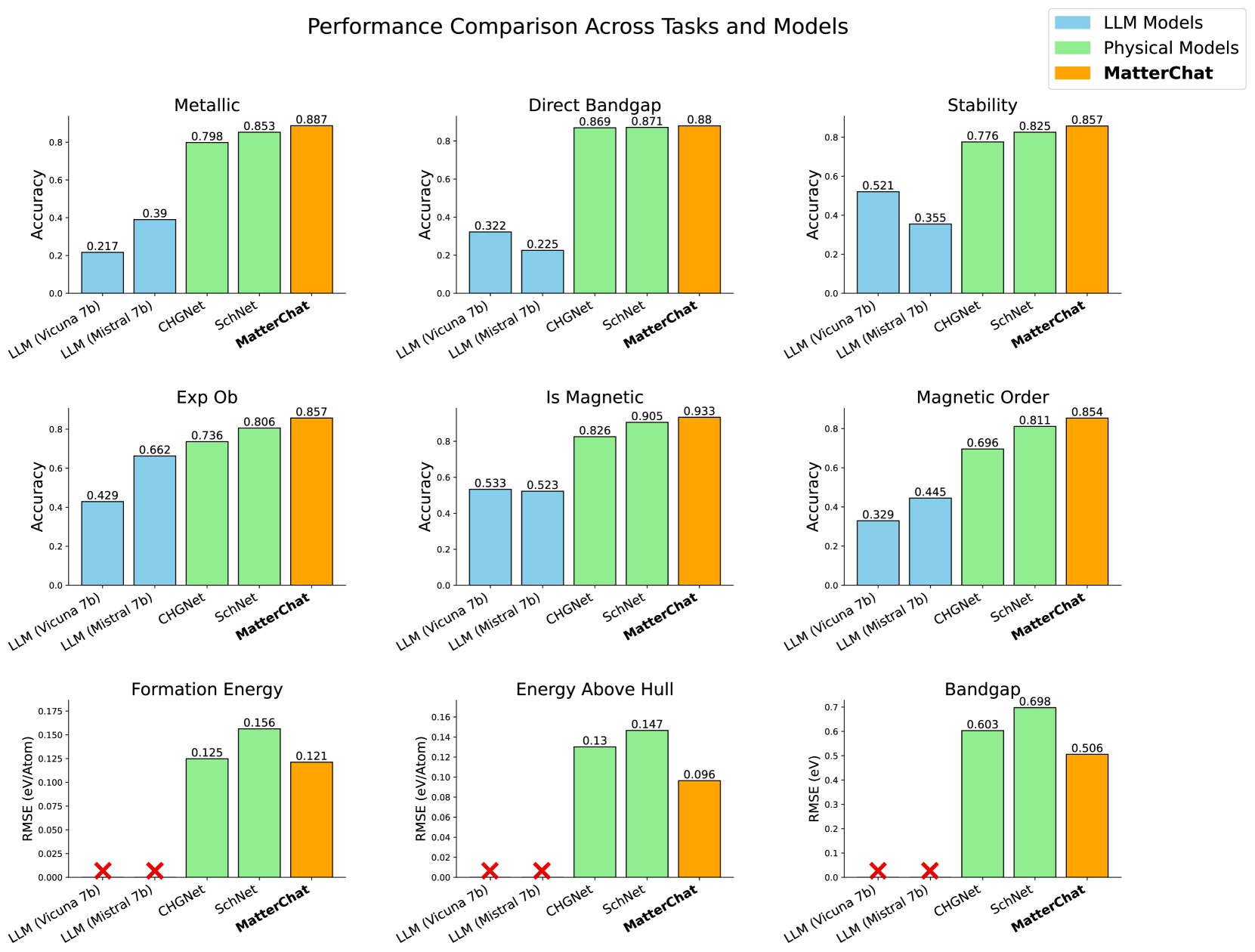
Performance comparison on 9 material property tasks against LLMs (Vicuna, Mistral) and physical models (SchNet, CHGNet).
Main Takeaways
MatterChat consistently outperforms general-purpose LLMs (GPT-4o, Gemini, DeepSeek) on material property prediction tasks, specifically formation energy estimation.
The model surpasses specialized physical ML models (SchNet and CHGNet) on numerical property prediction tasks (Formation Energy, Energy Above Hull, Bandgap), indicating that the multi-modal integration enhances quantitative precision.
Visualizations of the bridge embeddings show that the model clusters materials not just by composition but also by structural phase and formation energy, proving the embeddings preserve physical information.
The multi-modal RAG mechanism (retrieving 3 similar samples) further improves robustness during inference compared to single-pass inference.
📚 Prerequisite Knowledge
Prerequisites
Basics of Density Functional Theory (DFT) for material properties
Understanding of Graph Neural Networks (GNNs) for molecules
Familiarity with Transformer architectures and Multi-Modal LLMs
Key Terms
DFT: Density Functional Theory—a quantum mechanical modelling method used to investigate the electronic structure of many-body systems
CHGNet: Crystal Hamiltonian Graph Neural Network—a pretrained universal machine learning interatomic potential (uMLIP) used as the structure encoder
uMLIP: Universal Machine Learning Interatomic Potential—a model capable of predicting atomic interactions across the periodic table
SMILES: Simplified Molecular Input Line Entry System—a text notation for describing chemical structures
CIF: Crystallographic Information File—a standard text file format for describing crystal structures
RAG: Retrieval-Augmented Generation—enhancing model output by retrieving relevant reference data (here, similar materials) during inference
LoRA: Low-Rank Adaptation—a parameter-efficient fine-tuning technique that freezes pre-trained weights and injects trainable rank decomposition matrices
GNoME: Graph Networks for Materials Exploration—a deep learning tool for discovering new materials