📝 Paper Summary
Modularized RAG pipeline
Explainable AI for Mental Health
RED uses a personalized retrieval-augmented framework to detect depression in clinical interviews by generating user-specific queries and enhancing evidence with external social intelligence knowledge.
Core Problem
Automated depression detection often relies on black-box neural networks lacking interpretability or post-hoc LLM explanations prone to hallucination, while standard retrieval methods fail to account for the highly personalized nature of patient interviews.
Why it matters:
- Clinical interviews are the gold standard for diagnosis but require scarce professional resources, creating a need for automated but transparent systems.
- Existing black-box models provide no rationale for their predictions, which is critical in high-stakes mental health contexts.
- Generic retrieval queries ignore individual patient backgrounds (e.g., specific symptoms or life events), leading to suboptimal evidence gathering.
Concrete Example:
A standard system might ask a generic query about 'sleep issues' for all patients. However, for a patient mentioning 'insomnia due to work stress,' a personalized query tailored to that context would retrieve more relevant dialogue snippets, whereas the generic query might miss nuances or retrieve irrelevant chatter.
Key Novelty
RED (Retrieval-augmented Explainable Depression detection)
- Tailors retrieval queries to each patient by first using an LLM to infer a user profile from the dialogue, then generating specific queries for depression symptoms based on that profile.
- Enhances LLM reasoning with 'social intelligence' by retrieving relevant psychological concepts from an external knowledge graph (COKE) using event-centric retrieval.
- Uses an adaptive judgment module to decide when enough evidence has been collected, stopping retrieval early if sufficient information is found.
Architecture
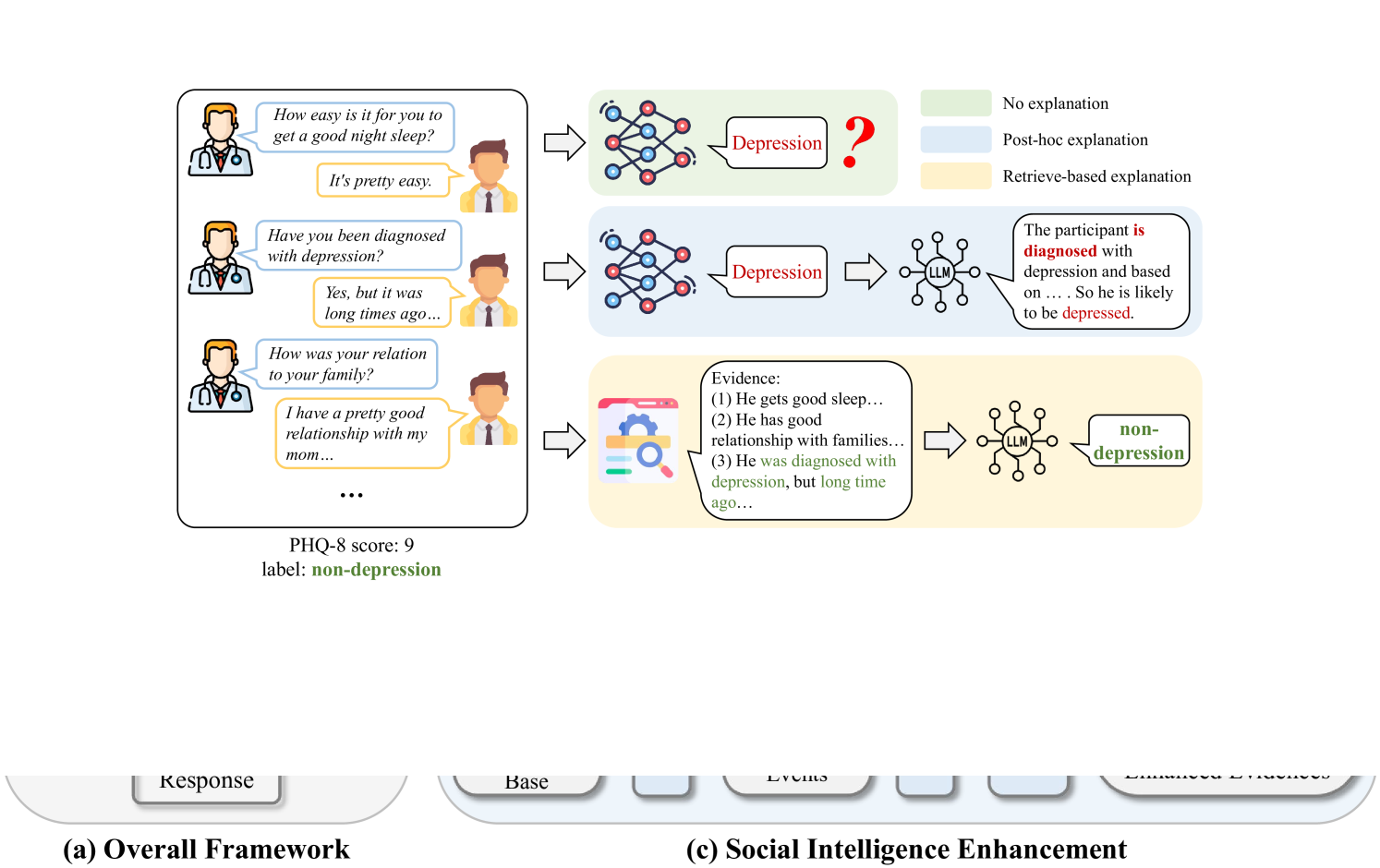
The overall architecture of the RED framework, illustrating the flow from user profiling to personalized query generation, adaptive retrieval, social intelligence enhancement, and final prediction.
Evaluation Highlights
- Outperforms state-of-the-art multimodal baselines (e.g., SEGA) by +4.0% in Macro F1 score on the DAIC-WoZ benchmark.
- Achieves higher precision (+6.0%) and recall (+3.0%) for the depressed class compared to the best LLM-based method (Personal RAG).
- Ablation studies confirm the Social Intelligence Enhancement module contributes significantly, improving Macro F1 by approximately 4% compared to the base model without it.
Breakthrough Assessment
7/10
Strong application of RAG to a sensitive domain with novel personalization and external knowledge integration components. Results are solid, though the scope is limited to one dataset.