3D Representation LearningSelf-Supervised LearningMulti-Modal Learning (2D-3D)
MM-Point enhances self-supervised 3D point cloud learning by maximizing mutual information between 3D objects and multiple 2D views simultaneously, using multi-level feature projection and incremental augmentation strategies.
Core Problem
Existing self-supervised 3D methods often rely solely on intra-modal data or simple 2D-3D alignment, failing to fully exploit the rich semantic information available across multiple diverse 2D views of the same object.
Why it matters:
3D data annotation is expensive and scarce, making self-supervised learning critical for real-world applications like autonomous driving and robotics.
Single-view 2D rendering provides limited information; leveraging multi-view consistency can provide superior supervision signals for 3D understanding.
Simple alignment between 3D and 2D modalities can lead to negative transfer due to their distinct nature; sophisticated interaction strategies are needed.
Concrete Example:A simple contrastive method might align a 3D chair with a single frontal 2D image. If the 2D view is occluded or ambiguous, the 3D representation degrades. MM-Point aligns the 3D chair with multiple views (front, side, top) simultaneously, ensuring the 3D feature captures the complete object geometry regardless of single-view ambiguity.
Treats each rendered 2D view as a unique pattern containing partial information about the 3D object, enforcing consistency across all views simultaneously rather than pairwise.
Uses a 'Multi-MLP' strategy to project features into multiple distinct spaces, allowing the model to capture different levels of semantic information for each view.
Employment of an incremental 'Multi-level Augmentation' strategy where different 2D views receive progressively stronger data augmentations to encourage learning of robust invariant features.
Architecture
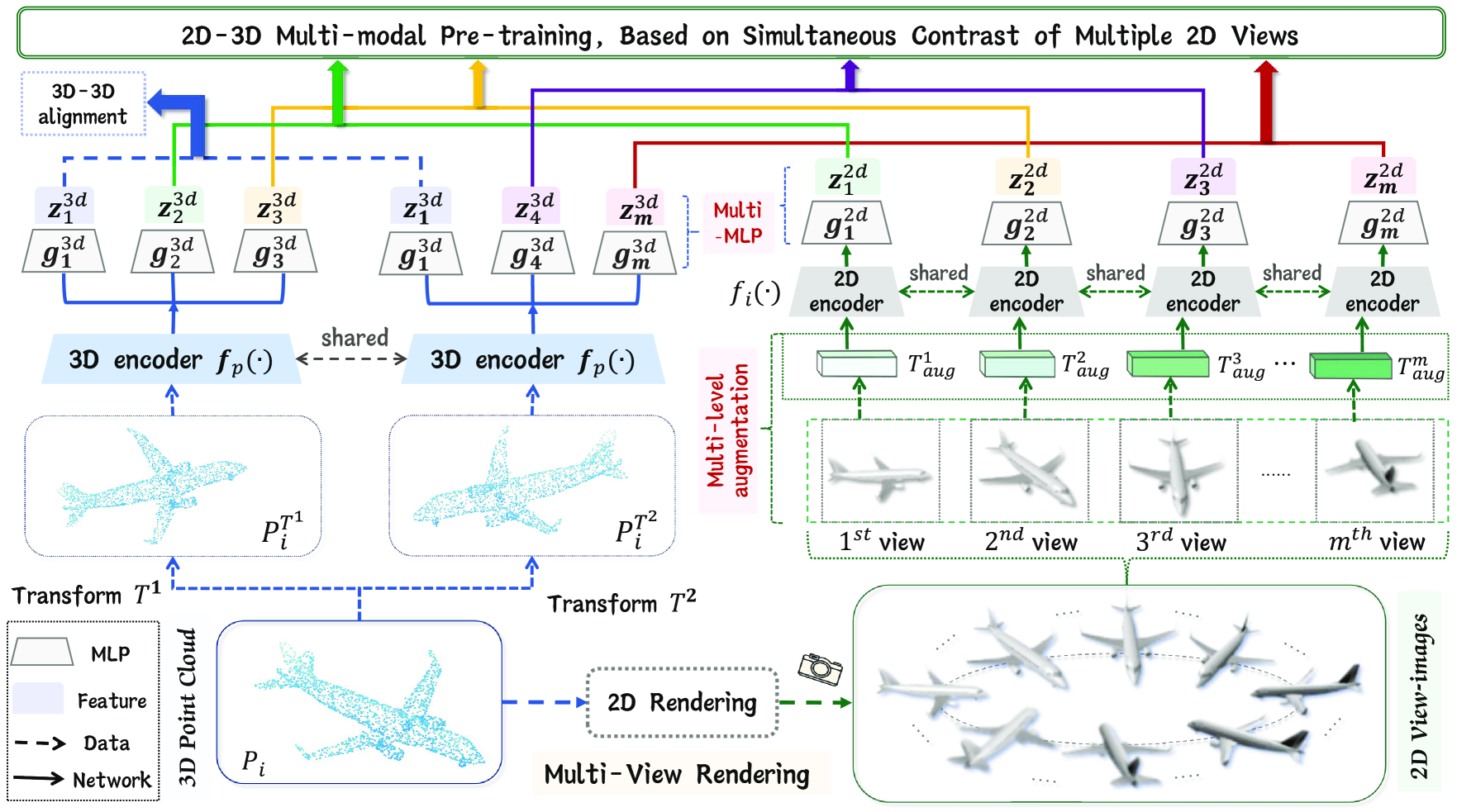
The overall MM-Point architecture, illustrating the parallel Intra-modal (3D-3D) and Inter-modal (2D-3D) contrastive learning pathways.
Evaluation Highlights
Achieves 92.4% accuracy on ModelNet40 (synthetic 3D object classification), setting a new state-of-the-art for self-supervised methods.
Achieves 87.8% accuracy on ScanObjectNN (real-world 3D object classification), surpassing previous self-supervised baselines and comparable to fully supervised methods.
Demonstrates effective transfer learning capability in 3D part segmentation and semantic segmentation tasks.
Breakthrough Assessment
8/10
Strong performance on standard benchmarks (ModelNet40, ScanObjectNN) surpassing existing self-supervised methods. The approach of simultaneous multi-view contrast with multi-level augmentation is a logical and effective extension of prior cross-modal work.
⚙️ Technical Details
Problem Definition
Setting: Self-supervised pre-training of 3D point cloud encoders using unlabeled 3D data and generated 2D multi-view images.
Inputs: 3D Point Cloud P_i and a set of corresponding rendered 2D images {I_ij} from different viewpoints.
Outputs: A learned feature representation vector for the 3D point cloud that can be used for downstream classification or segmentation tasks.
Pipeline Flow
Data Augmentation (Generate 2 variants of Point Cloud + Render m distinct 2D views)
Encoders (3D Encoder for Point Cloud, 2D Encoder for Images)
Multi-MLP Projection (Map features to multiple latent spaces)
Contrastive Loss Calculation (Intra-modal + Inter-modal losses)
System Modules
3D Encoder (Feature Extraction)
Extract features from 3D point clouds.
Model or implementation: Not explicitly detailed in text (likely standard backbones like DGCNN or PointNet++ based on context)
2D Encoder (Feature Extraction)
Extract features from rendered 2D images.
Model or implementation: Not explicitly detailed (standard CNN, e.g., ResNet, is implied for image encoding)
Multi-MLP Projection Heads
Map encoder features to multiple distinct latent spaces for multi-level contrast.
Model or implementation: Stack of MLP layers (G_H)
Multi-level Augmentation Module
Apply incrementally stronger augmentations to the sequence of 2D views.
Model or implementation: Algorithmic transformation sequence
Novel Architectural Elements
Multi-MLP Projection Strategy: Using multiple distinct projection heads to create separate feature spaces for contrasting different 2D views with the single 3D object.
Inter-plus Loss: A cumulative cross-modal loss function aggregating contrastive terms across all 2D view-3D pairs and 3D-2D pairs.
Modeling
Base Model: 3D Encoder (e.g., DGCNN/PointNet++) and 2D Encoder (e.g., ResNet)
Training Method: Self-supervised Contrastive Pre-training
Objective Functions:
Purpose: Intra-modal contrast to learn invariance to 3D augmentations.
Formally: Standard InfoNCE loss between two augmented views of the same point cloud.
Purpose: Inter-modal contrast to align 3D features with 2D features.
Formally: Loss_inter-plus = sum over all m views of (Loss_inter(P, I_j) + Loss_inter(I_j, P))
Training Data:
Inputs: 3D Point Clouds
Generated: m rendered 2D views per object from random angles
Key Hyperparameters:
m (number of 2D views): Not explicitly reported in the paper text (likely in experiments section not fully parsed or standard 12/20)
tau (temperature): Implicit in contrastive loss formulation (usually 0.07 or similar)
augmentation_strategy: Incremental intensity from view 1 to view m
Compute: Not reported in the paper
Comparison to Prior Work
vs. CrossPoint: CrossPoint aligns 3D with 2D but doesn't explicitly leverage simultaneous multi-view consistency; MM-Point uses multiple views at once with specific multi-level augmentations.
vs. PointContrast: PointContrast is purely intra-modal (3D-3D); MM-Point is multi-modal (2D-3D).
vs. Point-MAE: MM-Point is discriminative (contrastive) rather than generative (reconstruction).
Limitations
Computational cost likely increases with the number of 2D views rendered and processed.
Reliance on rendering quality for 2D views; poor rendering could introduce noise.
The paper does not explicitly detail the exact backbone architectures used for the reported results in the text provided.
Reproducibility
No replication artifacts mentioned in the paper. Code URL is not provided. Specific hyperparameters like learning rate, batch size, and specific backbone architectures are not detailed in the provided text.
📊 Experiments & Results
Evaluation Setup
Pre-training on unlabeled 3D datasets followed by linear probing or fine-tuning for classification and segmentation.
Benchmarks:
ModelNet40 (Synthetic 3D Object Classification)
ScanObjectNN (Real-world 3D Object Classification)
Metrics:
Classification Accuracy (%)
Statistical methodology: Not explicitly reported in the paper
Key Results
Benchmark
Metric
Baseline
This Paper
Δ
ModelNet40
Accuracy
Not reported in the paper
92.4
Not reported in the paper
ScanObjectNN
Accuracy
Not reported in the paper
87.8
Not reported in the paper
Experiment Figures
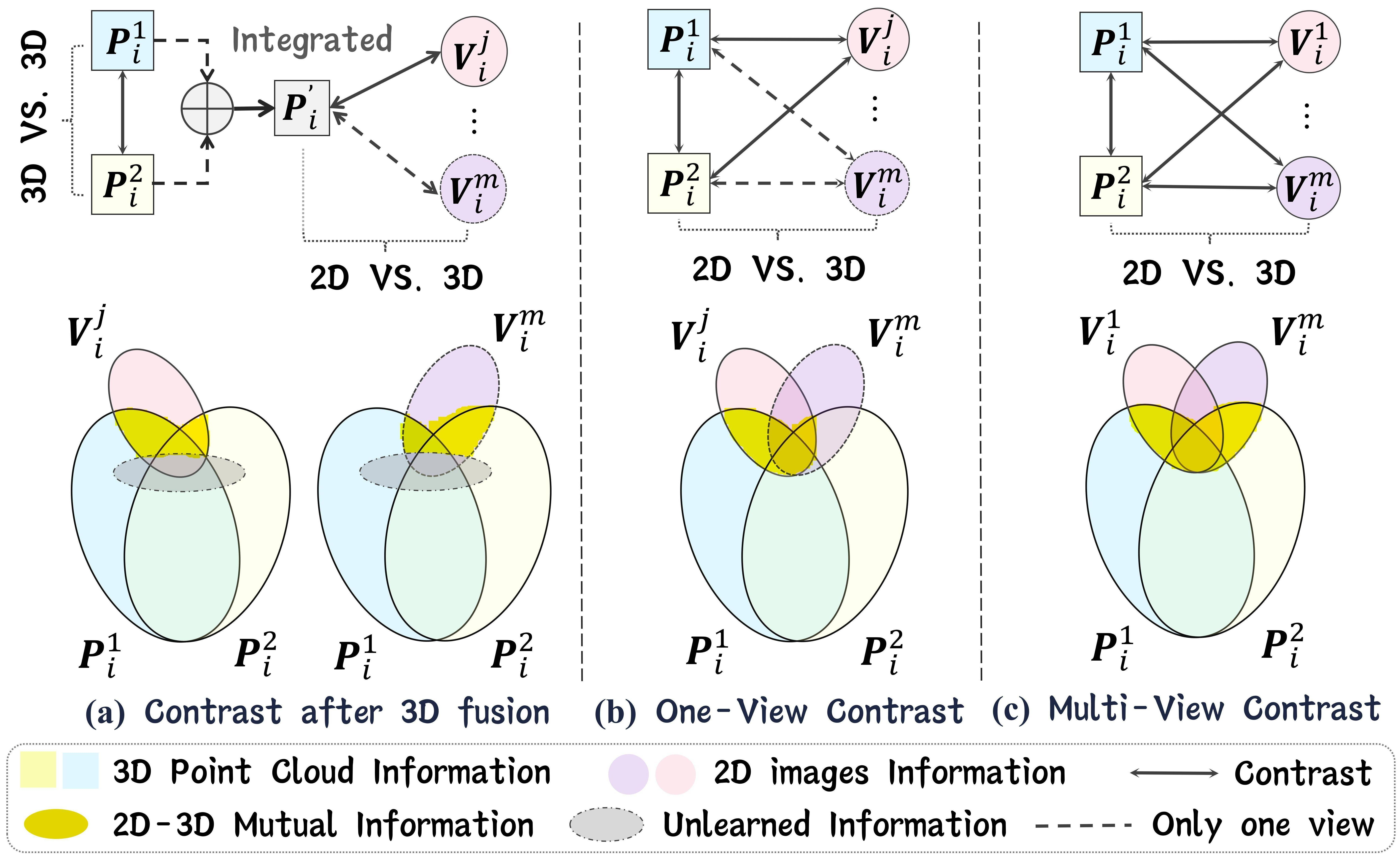
Visualization of mutual information changes.
Main Takeaways
MM-Point achieves state-of-the-art results on both synthetic (ModelNet40) and real-world (ScanObjectNN) datasets.
The method demonstrates strong transferability to segmentation tasks, suggesting the learned representations capture fine-grained geometry.
Integrating multi-view 2D information with multi-level augmentation effectively enhances 3D representation learning compared to single-view or simple alignment strategies.
📚 Prerequisite Knowledge
Prerequisites
Contrastive Learning (e.g., SimCLR, InfoNCE loss)
3D Point Cloud Processing (PointNet, DGCNN)
Multi-modal Learning (CLIP-style alignment)
Key Terms
Intra-modal: Learning relationships within the same data modality (e.g., contrasting two augmented versions of the same 3D point cloud).
Inter-modal: Learning relationships between different data modalities (e.g., contrasting a 3D point cloud with its corresponding 2D image).
InfoMax: Information Maximization principle—learning representations that maximize the mutual information between the input and the representation.
InfoMin: Information Minimization principle—reducing nuisance information in representations (often via strong augmentation) to retain only task-relevant semantics.
Projection Head: A small neural network (usually an MLP) that maps high-dimensional encoder features to a lower-dimensional space where contrastive loss is calculated.
ModelNet40: A widely used synthetic dataset for 3D object classification containing CAD models of 40 object categories.
ScanObjectNN: A challenging real-world dataset for 3D object classification containing scanned objects with background noise and occlusions.