📊 Experiments & Results
Evaluation Setup
Federated training across simulated distributed clients using 19 multimodal datasets.
Benchmarks:
- Bili series (Sequence recommendation / Link prediction)
- PixelRec50K (Multimodal product graph tasks)
- Social Media (Movies, RedditS) (Node classification)
Metrics:
- Accuracy (Node Classification)
- F1 Score (Node Classification)
- Recall@K (Retrieval)
- BLEU / ROUGE-L (Modality Generation)
- Statistical methodology: Not explicitly reported in the paper
Key Results
| Benchmark | Metric | Baseline | This Paper | Δ |
|---|---|---|---|---|
| Comparison of naive federated adaptations vs. isolated training shows that federated learning does not always guarantee improvement in multimodal settings. | ||||
| Cloth (Node Classification) | Accuracy | 82.45 | 78.32 | -4.13 |
| Evaluation of Graph Foundation Models (GFMs) against traditional architectures on complex tasks. | ||||
| Flickr30k | BLEU-4 | Not reported in the paper | Not reported in the paper | Not reported in the paper |
Experiment Figures
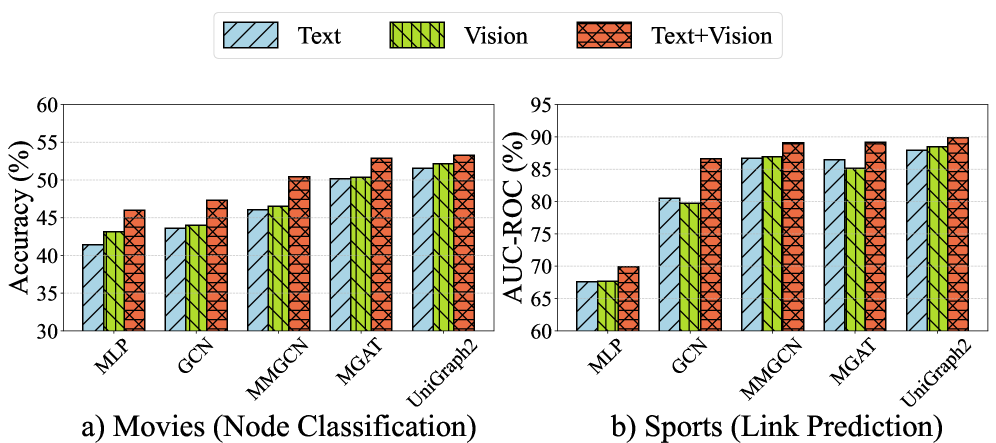
Performance comparison of single-modality (MLP, GCN) vs. multimodal models (MM-GCN, MGAT) across datasets.
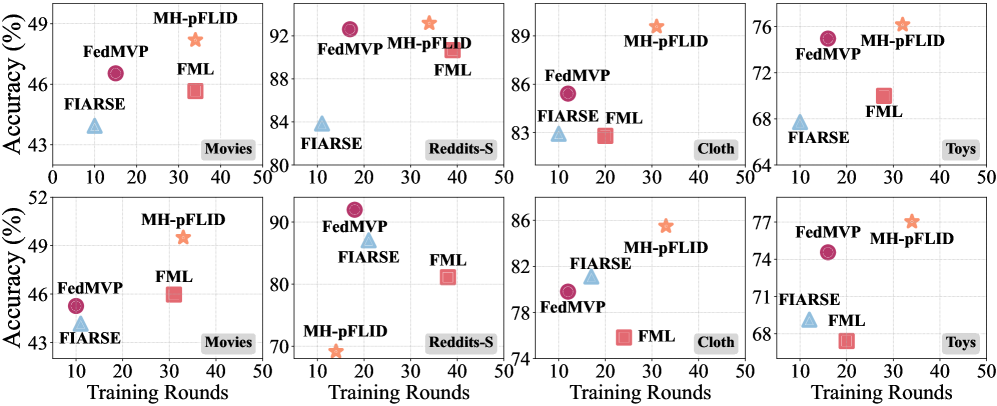
Radar charts comparing robustness of heterogeneous FGL methods (MH-pFLID, FedMVP, etc.) across 8 simulation settings.
Main Takeaways
- Necessity: Multimodal GNNs consistently outperform single-modality models, but graph structure is also essential (GCN > MLP), validating the MM-FGL paradigm.
- Effectiveness: Naive adaptations of FL to MM graphs often fail (negative transfer) due to semantic conflicts; specialized heterogeneous FGL methods are required.
- Robustness: Modality-NonIID combined with Label-NonIID creates the most severe performance degradation; MH-pFLID is the most robust method in these settings.
- Scalability: Graph Foundation Models (Two-Stage pipeline) generalize better to diverse downstream tasks (like generation) than task-specific MM-GNNs.