📝 Paper Summary
Medical Image Segmentation
Multi-modal learning
Brain Tumor Segmentation
MASM improves brain tumor segmentation by introducing specific modules to model low-level pairwise modality interactions and high-level complex modality relationships via a shift operation.
Core Problem
Existing multi-modal brain tumor segmentation methods often fail to effectively exchange information across scales or model complex, non-linear relationships between different MRI modalities (T1, T2, etc.).
Why it matters:
- Accurate tumor segmentation is critical for diagnosis and pre-surgical planning but is error-prone when manual.
- Simple concatenation (early fusion) overlooks inter-modality relationships essential for clinical diagnosis.
- Current fusion methods often neglect multi-scale information exchange or high-level spatial-modality fusion.
Concrete Example:
A tumor might be visible in T2-weighted images but ambiguous in T1; standard methods might fail to leverage the T2 signal effectively to correct the T1 ambiguity if they simply concatenate inputs without explicit interaction modeling.
Key Novelty
Modality-Aware and Shift Mixer (MASM)
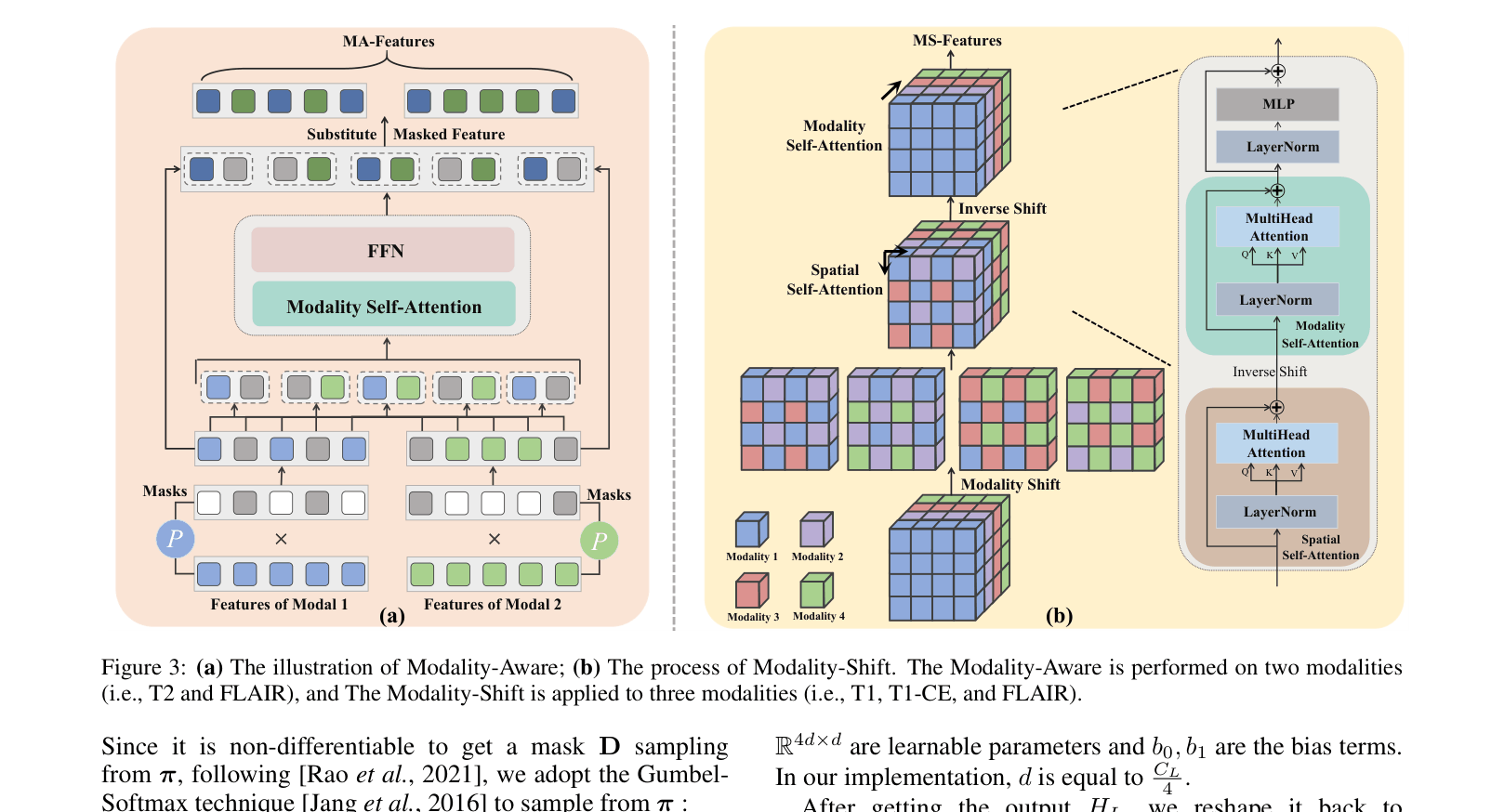
- Modality-Aware Module: Explicitly models pairwise dependencies between specific modality pairs (e.g., T2 and FLAIR) at low feature levels, mimicking how radiologists combine specific scans.
- Modality-Shift Module: Swaps image patches between modalities in a mosaic pattern before self-attention at high levels, enabling cross-modality interaction without extra parameters.
- Adaptive Token Pruning: Uses a decision mask to prune redundant patches in the Modality-Aware module, replacing them with features from aligned modalities.
Architecture
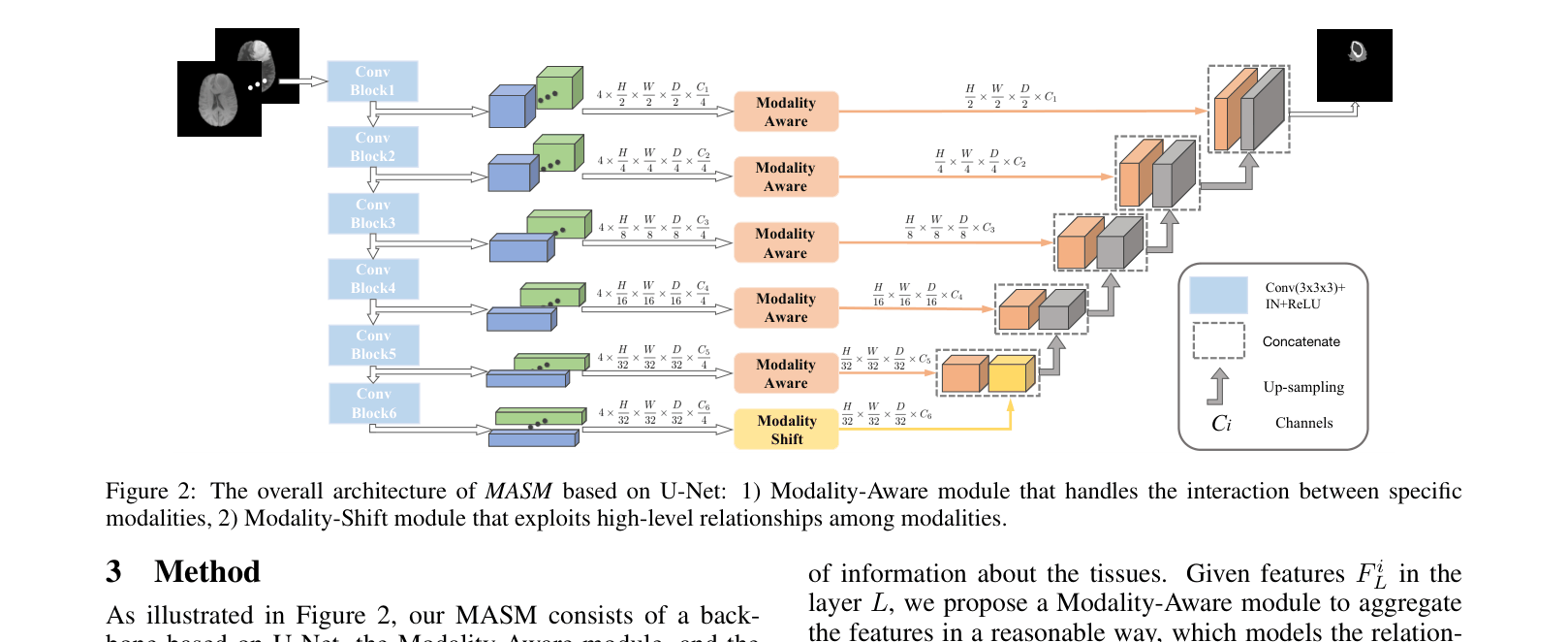
The U-Net based architecture of MASM, showing the shared encoder, the specific placement of Modality-Aware modules in skip connections, and the Modality-Shift module at the bottleneck.
Evaluation Highlights
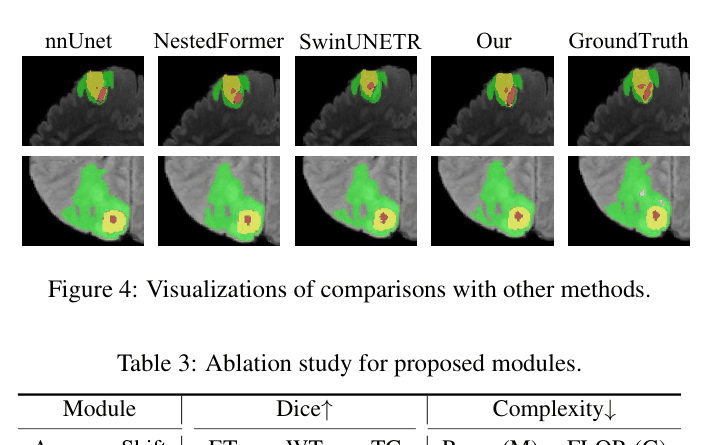
- Outperforms state-of-the-art methods on BraTS 2021 with an average Dice score of 0.912, surpassing the previous best (NestedFormer) by 0.004.
- Achieves significant computational efficiency, using ~160 GFLOPs compared to UNETR's ~1159 GFLOPs.
- Demonstrates robust performance across all tumor sub-regions (Enhancing Tumor, Whole Tumor, Tumor Core) in 5-fold cross-validation.
Breakthrough Assessment
7/10
Solid architectural innovation with the Shift module and specific modality pairing. Outperforms SOTA with significantly lower FLOPs, though the absolute metric gain is incremental.