📝 Paper Summary
Conversational Recommender Systems (CRS)
Retrieval-Augmented Generation (RAG)
G-CRS enhances LLM-based conversational recommendation without training by using a graph reasoner and Personalized PageRank to retrieve both candidate items and similar conversation examples for in-context learning.
Core Problem
Users in conversational systems express preferences through brief, incomplete statements, leading to knowledge sparsity that standard LLMs fail to handle due to a lack of domain-specific knowledge and collaborative patterns.
Why it matters:
- Standard RAG relies on semantic similarity, which fails to capture the complex item relationships and collaborative filtering patterns essential for accurate recommendations.
- Existing solutions either produce hallucinations or require computationally expensive fine-tuning of LLMs, limiting their applicability and scalability.
- Current systems struggle to reason about implicit user preferences when dialogue history is short or sparse.
Concrete Example:
If a user asks for 'movies like Braveheart', a standard LLM might hallucinate non-existent titles or suggest generic action movies. G-CRS uses the graph to find that the user likely enjoys Mel Gibson (actor/director) and retrieves 'Apocalypto' along with a past conversation where a user with similar interests was successfully recommended historical dramas.
Key Novelty
Graph Retrieval-Augmented Generation with In-Context Learning
- Replaces simple semantic retrieval with a two-stage graph exploration: first identifying latent entities via a graph reasoner, then using Personalized PageRank to find structurally related items and conversations.
- Unifies the retrieval of candidate items (what to recommend) and similar conversation demonstrations (how to recommend) in a single graph traversal step.
- Enables 'training-free' adaptation where the LLM learns domain-specific collaborative patterns purely through structured prompts containing these retrieved graph contexts.
Architecture
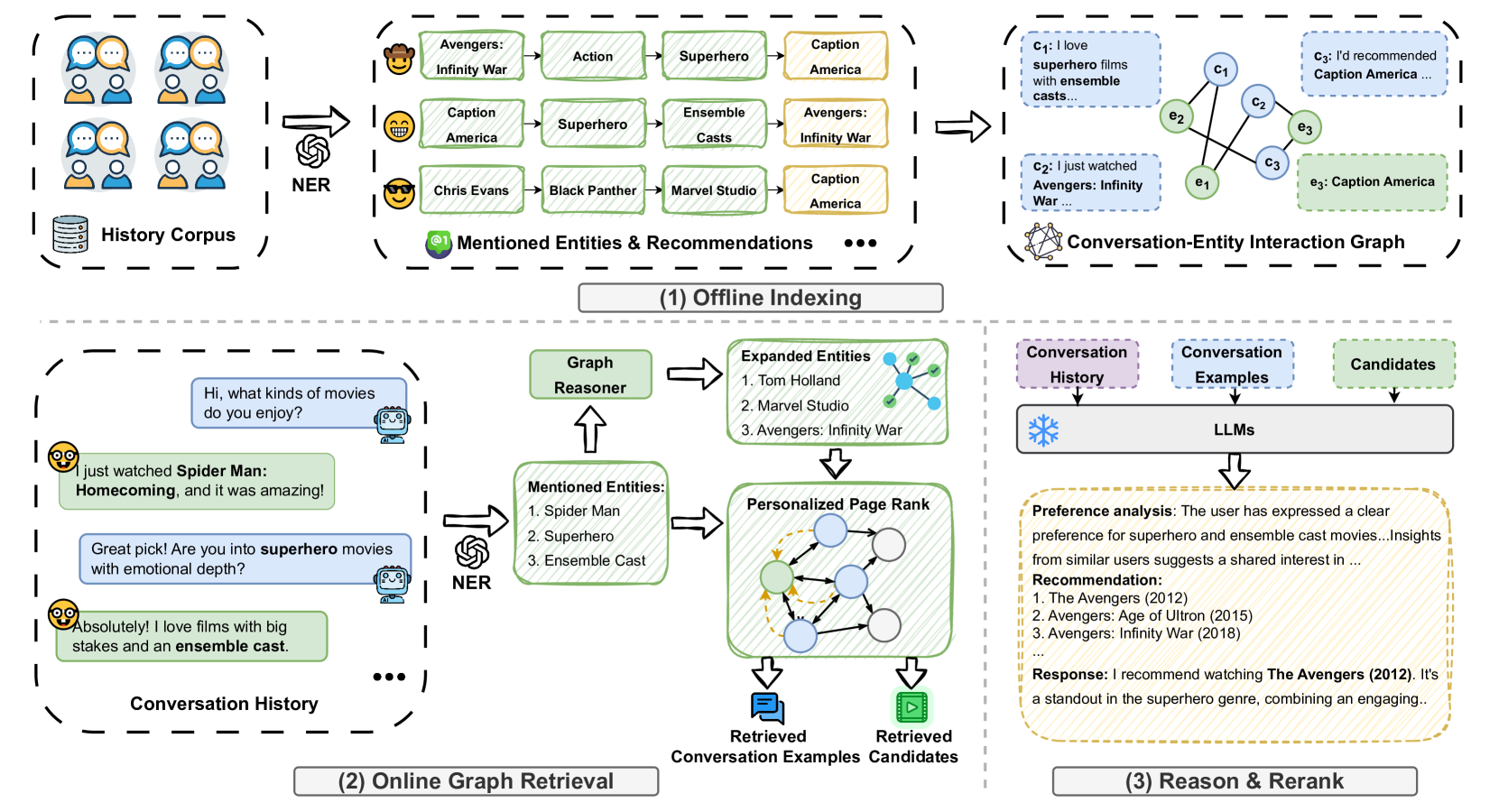
Overview of the G-CRS framework, detailing the offline indexing phase and the online inference pipeline.
Evaluation Highlights
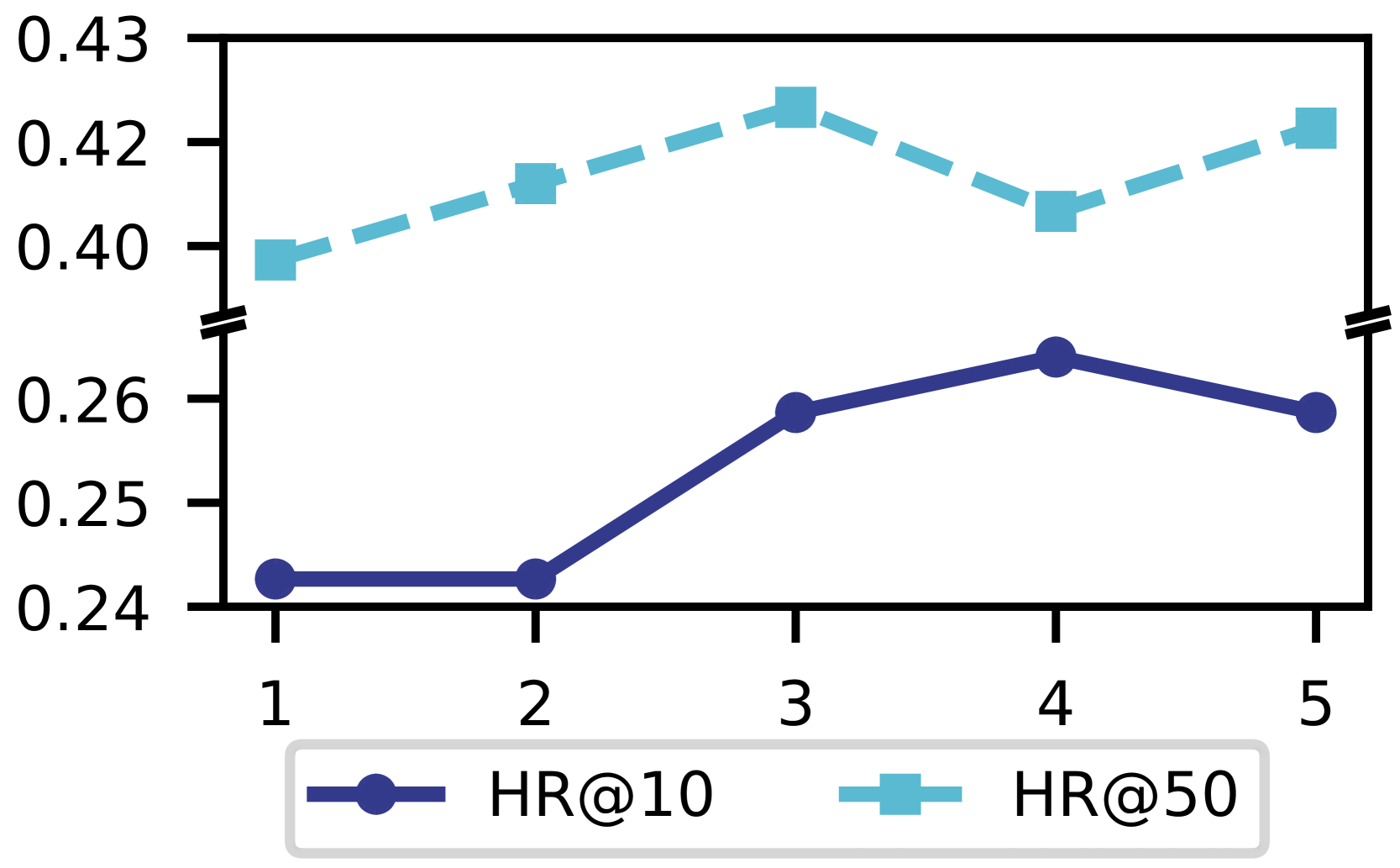
- Outperforms fine-tuned Llama3.1-8B by significant margins on ReDial (HR@50: 0.420 vs 0.368) and INSPIRED (HR@50: 0.408 vs 0.366) without any gradient updates.
- Surpasses specialized CRS models like KGSF and KBRD, achieving the highest HR@10 (0.245) and HR@50 (0.420) on the ReDial dataset.
- Achieves superior performance compared to standard RAG baselines (BM25, Sentence-BERT), improving HR@10 on ReDial from ~0.02 (BM25) to 0.245.
Breakthrough Assessment
7/10
Strong practical contribution by eliminating training needs while beating trained baselines. Novelty lies in using PPR to jointly retrieve items and conversation examples, though the individual components (PPR, LLMs) are established.