📊 Experiments & Results
Evaluation Setup
Joint and conditional generation across multiple modalities.
Benchmarks:
- MNIST-SVHN (Bi-modal generation (Simple Image + Complex Image))
- MHD (Multi-modal Handwritten Digits) (Tri-modal generation (Image, Trajectory, Sound))
- POLYMNIST (5-modal generation (Images with different backgrounds))
- CUB (Caltech Birds) (Image-Text generation)
Metrics:
- Coherence (%) (using pre-trained classifiers)
- FID (Fréchet Inception Distance)
- FAD (Fréchet Audio Distance)
- FMD (Fréchet Modality Distance)
- CLIP-Score
- Statistical methodology: Results averaged over 5 seeds. Standard deviations reported in appendix.
Key Results
| Benchmark | Metric | Baseline | This Paper | Δ |
|---|---|---|---|---|
| MNIST-SVHN results demonstrate MLD's superiority in both coherence and quality, particularly for the challenging SVHN modality. | ||||
| MNIST-SVHN | Joint Coherence | 48.78 | 85.22 | +36.44 |
| MNIST-SVHN | Joint(S) FID | 69.48 | 57.2 | -12.28 |
| MNIST-SVHN | M→S Conditional Coherence | 49.78 | 79.13 | +29.35 |
| MHD results show MLD handles heterogeneous modalities (Sound vs Image) better than baselines. | ||||
| MHD | Joint Coherence | 48.84 | 98.34 | +49.50 |
| MHD | Sound FAD (Joint) | 13.65 | 2.07 | -11.58 |
| POLYMNIST results confirm scalability to >2 modalities. | ||||
| POLYMNIST | Coherence (average) | ~90 | ~99 | +9 |
Experiment Figures
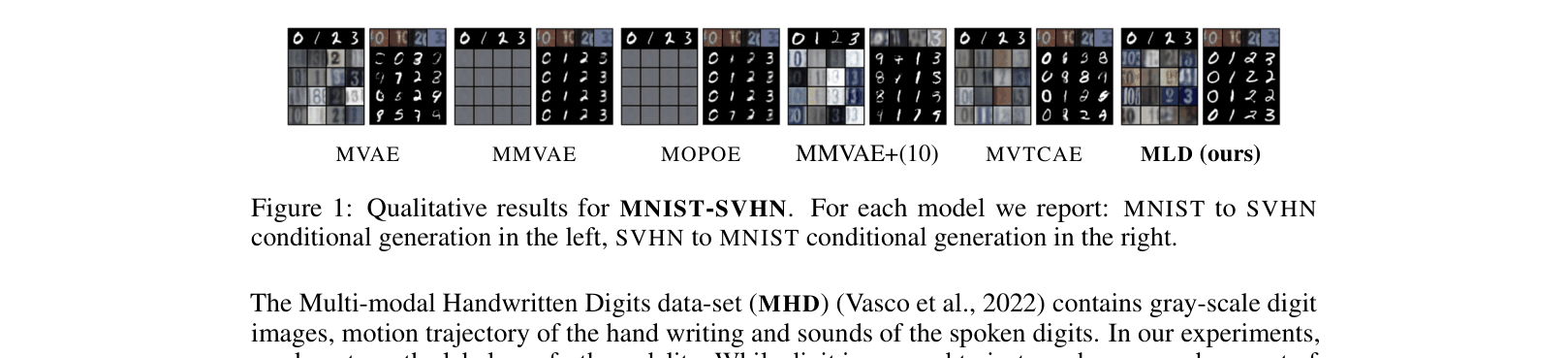
Qualitative comparison on MNIST-SVHN for conditional generation (MNIST → SVHN and SVHN → MNIST).
Main Takeaways
- MLD consistently breaks the coherence-quality tradeoff observed in VAEs, achieving state-of-the-art results in both metrics simultaneously.
- The 'multi-time' training method effectively enables a single network to handle any combination of conditional generation tasks without retraining.
- Independent training of autoencoders prevents 'modality collapse' (where weak modalities are ignored), a common issue in end-to-end trained Multi-modal VAEs.
- The method generalizes well to heterogeneous data types (Audio, Image, Trajectory, Text), outperforming baselines that struggle with diverse modalities.