📝 Paper Summary
Mechanistic Interpretability
Knowledge Representation in LLMs
Temporal Reasoning
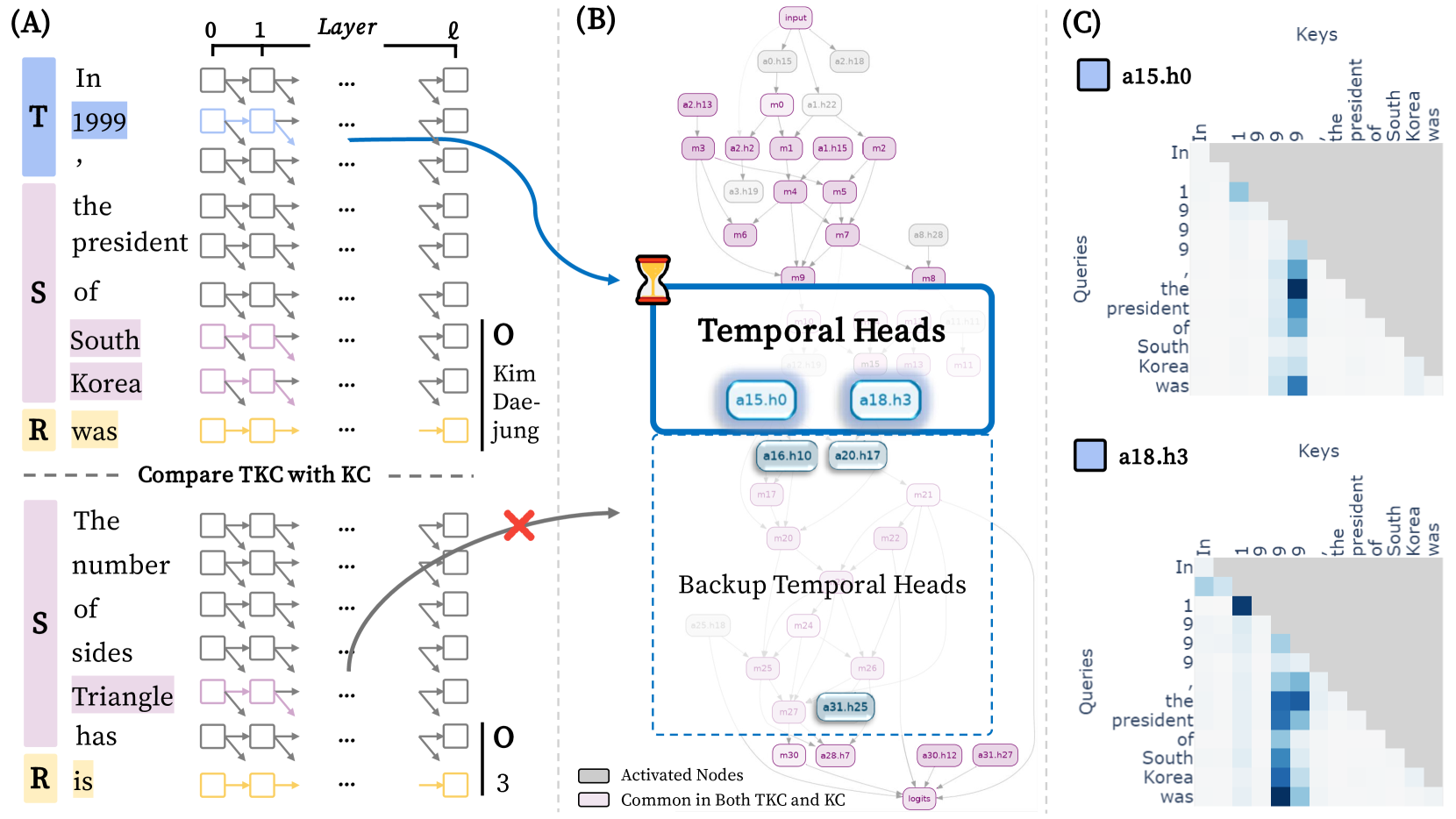
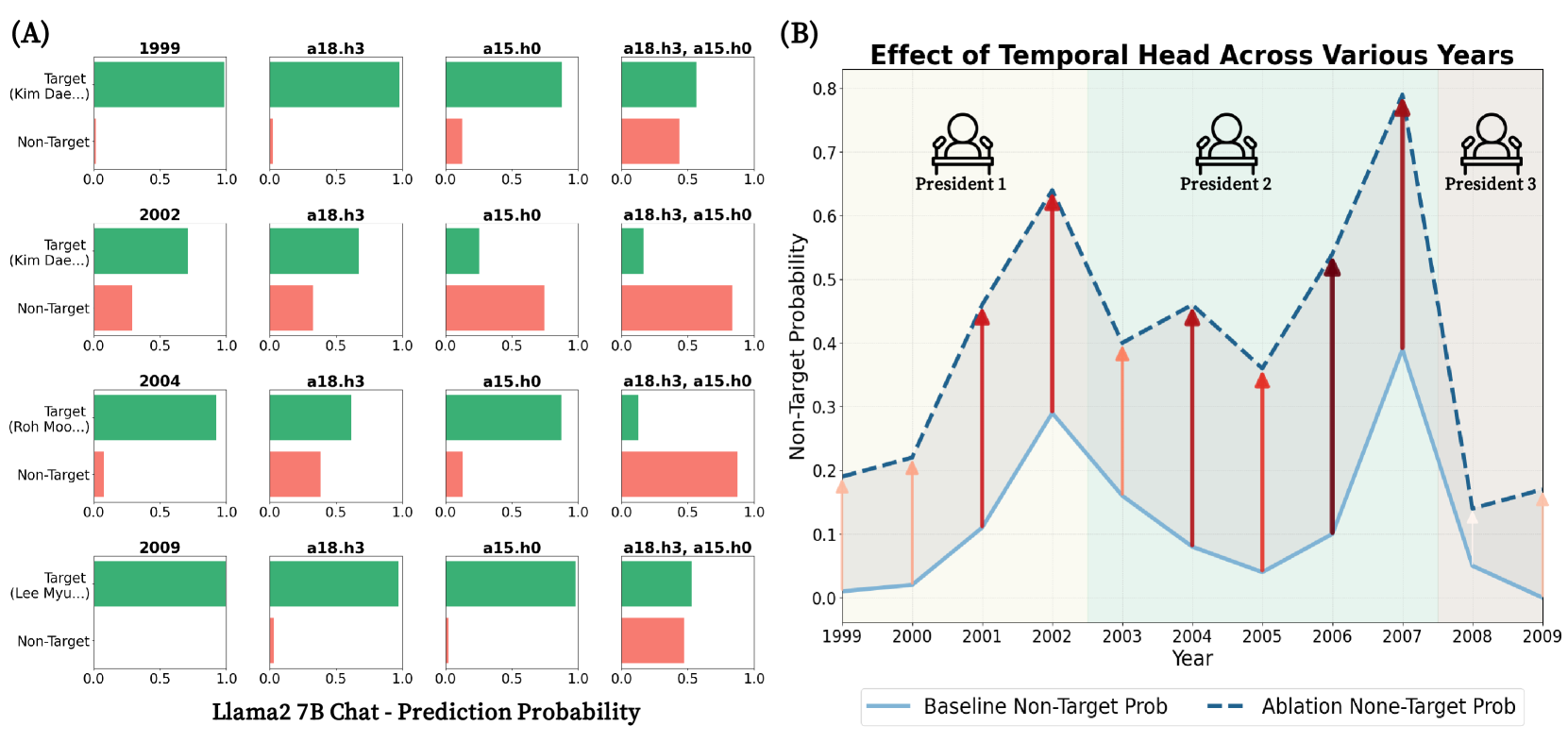
The paper identifies specific 'Temporal Heads' in LLMs that are exclusively responsible for processing time-dependent facts, showing that disabling them degrades temporal recall without affecting general capabilities.
Core Problem
LLMs struggle to accurately represent temporal knowledge—facts that change over time (e.g., 'President in 2004' vs 'President in 2008')—unlike static facts.
Why it matters:
- Real-world facts like political terms or sports team rosters evolve, requiring models to track changes rather than memorizing a single static answer
- Current understanding of how LLMs internally organize and recall this time-specific information is limited compared to static factual recall
- Without locating where temporal processing happens, it is difficult to intervene or edit outdated temporal knowledge effectively
Concrete Example:
When asking 'In 1999, [X] was a member of sports team', the model must retrieve the team relevant to that specific year. Existing analysis doesn't explain how the model distinguishes this from 'In 2004', potentially leading to temporal mismatches.
Key Novelty
Discovery of 'Temporal Heads' via Temporal Knowledge Circuits
- Applies circuit analysis to identify specific attention heads (e.g., a15.h0 in Llama-2) that activate exclusively for time-conditioned queries
- Demonstrates that these heads bind temporal conditions (years or text aliases) to subjects, distinct from heads used for static or common sense knowledge
- Proposes 'Temporal Knowledge Editing' by manipulating the activations of these specific heads to correct or reinforce time-specific factual recall
Architecture
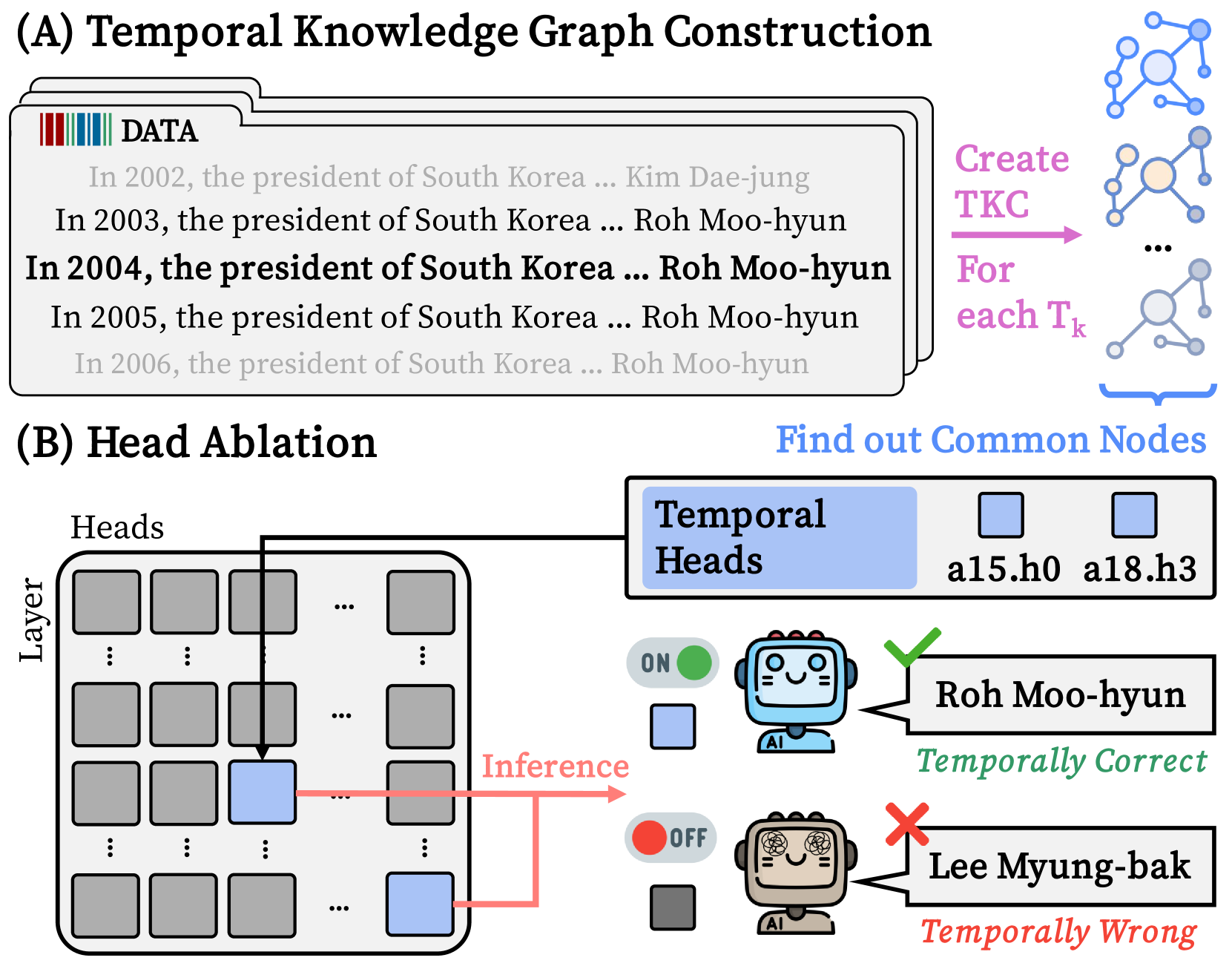
Conceptual diagram of Temporal Knowledge Circuits showing how specific heads (Temporal Heads) activate for time-specific queries versus time-invariant queries.
Evaluation Highlights
- Ablating Temporal Heads in Llama-2 significantly increases probability of non-target (wrong year) answers, while time-invariant knowledge remains stable
- Identified heads respond to both numeric years ('In 2004') and textual aliases ('In the year the Summer Olympics were held'), confirming semantic temporal encoding
- Ablation minimally impacts general QA performance (TriviaQA, Math), with F1 score drops of less than 0.6
Breakthrough Assessment
7/10
Strong mechanistic interpretability contribution identifying specific components for temporal processing. The finding that these heads are 'exclusive' to temporal tasks is significant, though the scope is limited to a few models and simple fact retrieval.