TapWeight automatically optimizes the importance weights of multiple pretraining objectives by minimizing downstream validation loss through a three-level optimization framework using implicit differentiation.
Core Problem
Existing task-adaptive pretraining methods use multiple objectives (e.g., MLM, contrastive loss) but determining their relative importance requires expensive manual tuning or suboptimal equal weighting.
Why it matters:
Domain discrepancies between general pretraining and downstream tasks lead to performance degradation if not adapted correctly
Manual hyperparameter search becomes computationally prohibitive as the number of pretraining objectives increases (e.g., 5 objectives in Imagemol)
Equal weighting disregards that certain objectives (like contrastive learning) may be far more beneficial for specific downstream tasks (like semantic similarity) than others
Concrete Example:When adapting BERT for semantic textual similarity, a contrastive learning objective is more important than masked language modeling. Standard approaches might weight them equally (suboptimal) or require exhaustive grid search to find that contrastive loss should have a higher weight.
Key Novelty
Three-Level Optimization for Pretraining Weights
Treats pretraining objective weights as learnable hyperparameters optimized against downstream validation performance
Uses a nested three-stage loop: (1) pretrain with fixed weights, (2) finetune a proximal model on task data, (3) update weights based on validation loss
Employes implicit differentiation to propagate gradients through the finetuning and pretraining steps back to the objective weights
Architecture
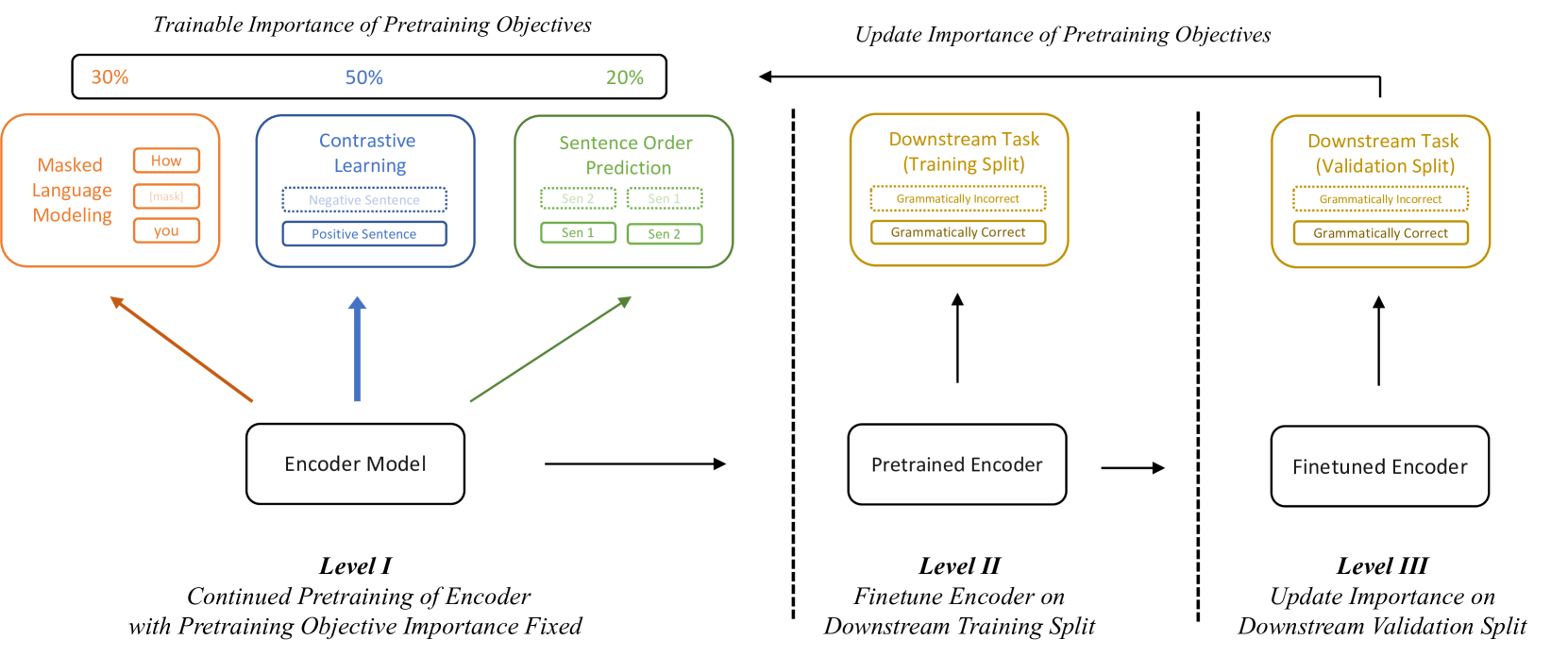
The complete framework of TapWeight showing the three-level optimization process
Breakthrough Assessment
7/10
Offers a mathematically rigorous solution to the 'magic number' problem in multi-objective pretraining. While the MLO technique is known, applying it to reweight pretraining objectives based on downstream feedback is a logical and useful advancement.
⚙️ Technical Details
Problem Definition
Setting: Multi-objective continued pretraining followed by downstream finetuning
Outputs: Optimized trade-off parameters λ for pretraining objectives
Pipeline Flow
Input Data (Text/Molecules)
Pretrained Model (Backbone)
Task-Specific Head
Output Prediction
System Modules
Backbone Model
Extract features from input data
Model or implementation: RoBERTa (for NLP) or Imagemol (for Molecules)
Novel Architectural Elements
The novelty is in the training optimization loop (TapWeight framework), not the inference architecture itself. The inference model uses standard architectures.
Modeling
Base Model: RoBERTa (NLP), Imagemol (Molecules)
Training Method: Multi-Level Optimization (MLO) with Implicit Differentiation
Code is publicly available at https://anonymous.4open.science/r/TapWeight-9A2E. The paper utilizes the Betty library for gradient computation. Specific hyperparameters for the baselines or training time are not detailed in the provided text.
📊 Experiments & Results
Evaluation Setup
Task-adaptive pretraining followed by finetuning on specific downstream tasks
Natural Language Understanding Tasks (NLU (likely GLUE or similar))
Metrics:
Validation Loss (used for optimization)
Downstream Task Performance (Metric not specified in text, likely Accuracy/F1/RMSE depending on task)
Statistical methodology: Not explicitly reported in the paper
Main Takeaways
TapWeight significantly outperforms baseline methods on both molecular property prediction (13 datasets) and natural language understanding (8 tasks).
The framework effectively generalizes across different modalities (text and molecules) and different pretrained models (RoBERTa and Imagemol).
Automating the tradeoff between pretraining objectives eliminates the need for manual hyperparameter search, addressing the issue of suboptimal outcomes from equal weighting.
Note: Specific numeric results were not included in the provided text snippet.
📚 Prerequisite Knowledge
Prerequisites
Task-Adaptive Pretraining (TAP)
Multi-Level Optimization (MLO)
Implicit Function Theorem (IFT)
Gradient Descent
Key Terms
TAP: Task-Adaptive Pretraining—an intermediate step between general pretraining and finetuning where the model is further pretrained on task-relevant unlabeled data
MLO: Multi-Level Optimization—a hierarchy of optimization problems where the solution to a lower-level problem serves as a constraint or input to a higher-level problem
IFT: Implicit Function Theorem—a mathematical tool used here to compute gradients of the optimal model parameters with respect to hyperparameters (like weights) without unrolling the entire training loop
proximal regularization: A penalty term encouraging the finetuned model weights to stay close to the pretrained model weights, enabling efficient gradient approximation
Imagemol: A molecular representation model used in the experiments that involves 5 distinct pretraining objectives
Betty: A software library for automatic differentiation in multilevel optimization problems, used to implement TapWeight