📝 Paper Summary
Mental Health Analysis
Chain-of-Thought Reasoning
Clinical NLP
A structured Chain-of-Thought prompting framework that guides Large Language Models through emotion analysis, binary classification, and causal reasoning to accurately estimate depression severity scores.
Core Problem
Standard LLM-based depression detection lacks interpretability and struggles to identify nuanced linguistic cues like anhedonia (e.g., negated positive affect), often conflating symptom identification with severity assessment.
Why it matters:
- Current end-to-end classification models fail to meet medical standards for auditability because they lack explicit reasoning steps.
- Holistic text processing overlooks subtle diagnostic markers, such as implied expectations in phrases like 'Family gatherings should be fun, yet they feel meaningless.'
- Clinical practice requires distinct processes for symptom detection (binary) and severity assessment (regression), which current models often merge.
Concrete Example:
A phrase like 'I try to enjoy hobbies but feel nothing' contains subtle anhedonia cues (implicit expectation of joy + contextual negation). A standard model might miss this or treat it generally negatively, whereas the proposed method explicitly dissects the negated positive affect before assigning a depression score.
Key Novelty
Emotion-to-Reasoning Chain-of-Thought (CoT) Framework
- Decomposes the diagnostic process into four clinical stages: Emotion Analysis, Binary Classification, Causal Reasoning, and Severity Assessment.
- Mimics the workflow of mental health professionals by first identifying symptoms and root causes before calculating quantitative severity scores (PHQ-8).
Architecture
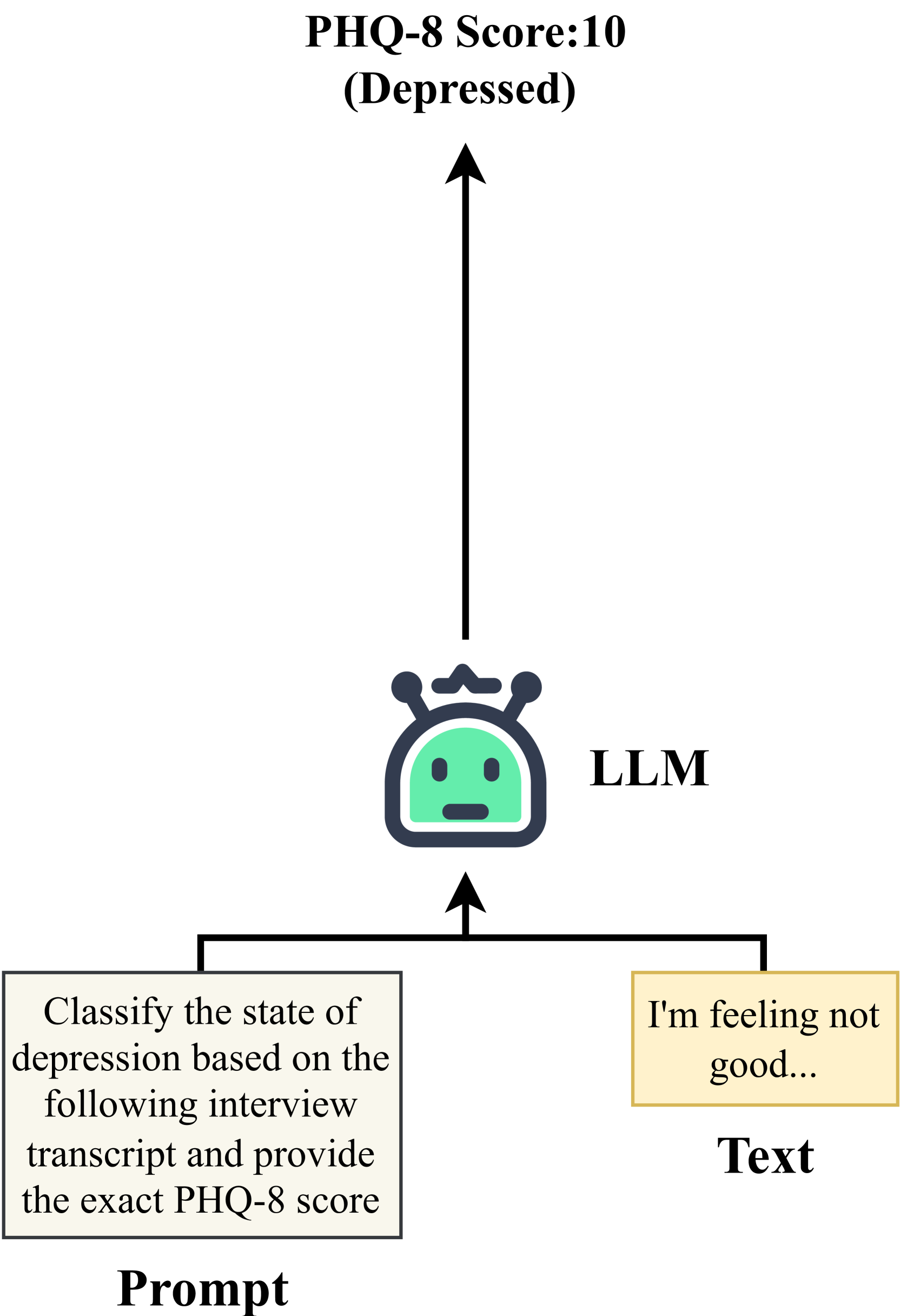
The four-stage Chain-of-Thought prompting framework pipeline.
Evaluation Highlights
- Achieves 0.732 CCC (Concordance Correlation Coefficient) with GPT-4o using the proposed CoT strategy, outperforming the standard GPT-4o baseline (0.696 CCC).
- Improves QwQ-32b-preview's performance significantly, raising CCC from 0.597 to 0.705 and reducing Mean Absolute Error (MAE) from 4.23 to 3.55.
- Surpasses traditional multimodal deep learning baselines like CubeMLP (0.583 CCC) using only text input.
Breakthrough Assessment
7/10
Significant improvement in interpretability and accuracy for mental health estimation by aligning LLM reasoning with clinical workflows. Demonstrates that structured prompting can unlock performance gains even in smaller models.