📊 Experiments & Results
Evaluation Setup
Survey of benchmarks used in literature
Benchmarks:
- GSM8K (Mathematical reasoning)
- CSQA (Commonsense reasoning)
- Last Letter Concatenation (Symbolic reasoning)
- ProofWriter (Logical reasoning)
- ScienceQA (Multi-modal reasoning)
Metrics:
- Accuracy
- Statistical methodology: Not explicitly reported in the paper
Experiment Figures
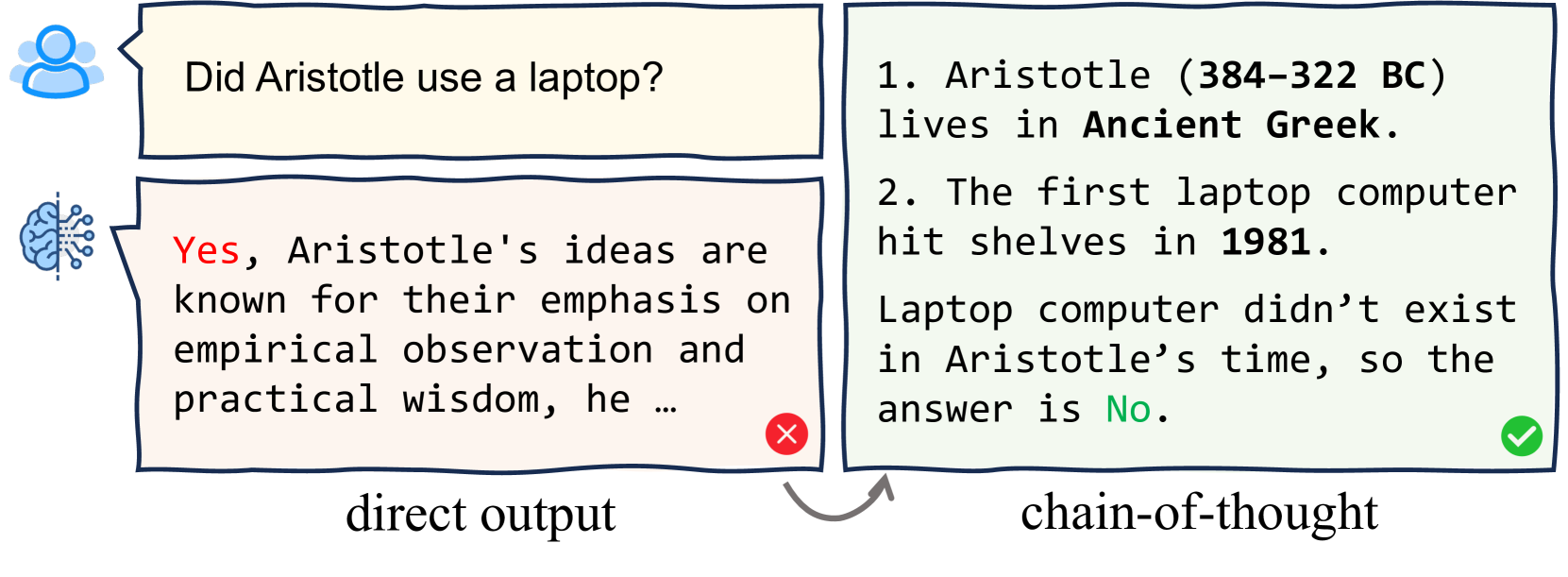
Comparison between Standard Prompting and Chain-of-Thought Prompting on a math word problem.
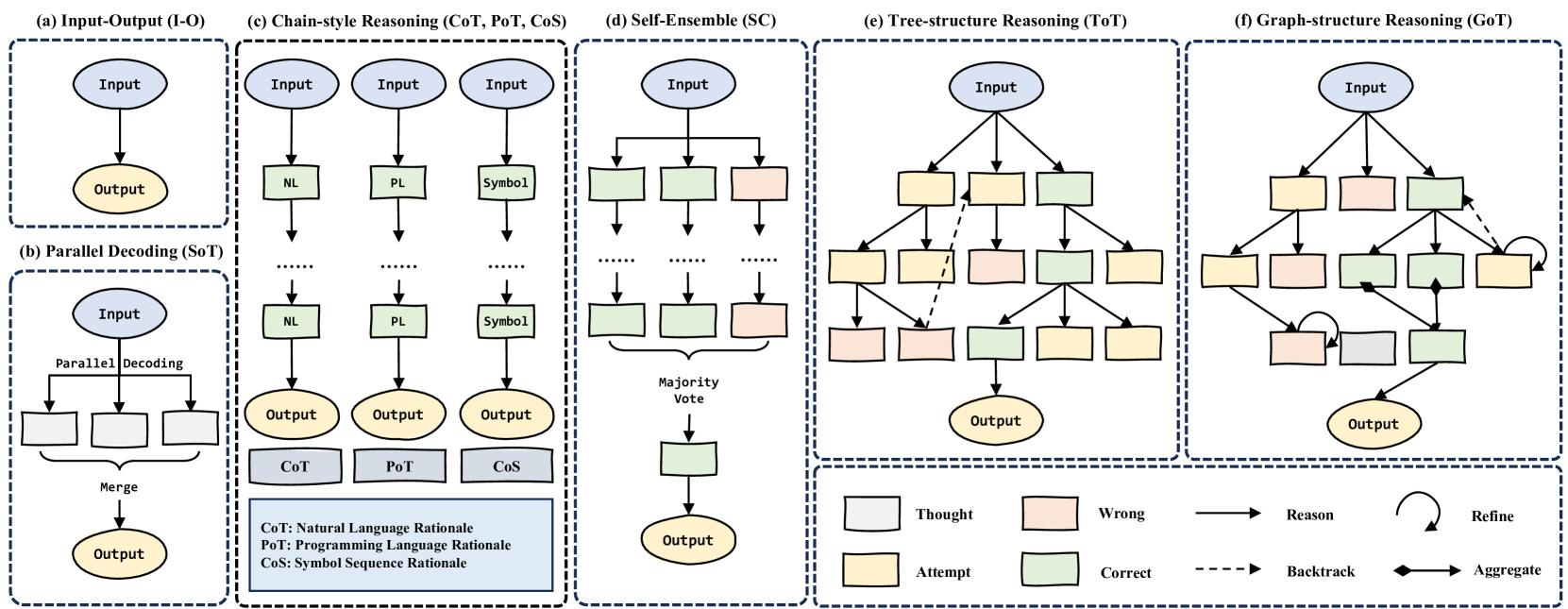
Visual comparison of topological variants: (a) Input-Output, (b) CoT (Chain), (c) CoT-SC (Multiple Chains), (d) ToT (Tree), (e) GoT (Graph).
Main Takeaways
- CoT prompting significantly boosts LLM reasoning, especially for complex tasks, by decomposing problems into manageable steps.
- Topological complexity improves performance but hurts generalization: Graph/Tree structures solve harder problems but require specific decomposition designs that may not apply generally.
- There is a trade-off between cost and performance: Manual prompting yields better results but is expensive; Automatic prompting is cheap but unstable.
- Faithfulness remains a challenge: LLMs hallucinate during reasoning, necessitating verification modules and knowledge enhancement.