Sijin Chen, Xin Chen, C. Zhang, Mingsheng Li, Gang Yu, Hao Fei, Hongyuan Zhu, Jiayuan Fan, Tao Chen
Fudan University,
Tencent PCG,
National University of Singapore,
Institute for Infocomm Research (I2R), A*STAR
Computer Vision and Pattern Recognition
(2023)
MMQAReasoningAgent
📝 Paper Summary
3D Vision-Language ModelingEmbodied AI Agents
LL3DA is a 3D-LLM that accepts point clouds and visual interactions (clicks, boxes) directly to resolve spatial ambiguity and perform reasoning without expensive multi-view image projections.
Core Problem
Existing 3D-LLMs rely on computationally heavy multi-view image projections or fail to handle ambiguity in cluttered scenes when relying solely on text instructions.
Why it matters:
Projecting 2D features to 3D space creates huge computational overhead and ignores essential geometric properties of the scene
Plain text instructions often lead to ambiguities in complex, cluttered 3D environments where multiple similar objects exist
Specialist models (built for one task like QA or Captioning) struggle to scale or generalize compared to LLM-based approaches
Concrete Example:In a cluttered room with multiple chairs, the text instruction 'describe the chair' is ambiguous. LL3DA allows a user to click on a specific chair (visual prompt) to precisely identify the target for the model to describe.
Key Novelty
Large Language 3D Assistant (LL3DA)
Integrates visual prompts (clicks, bounding boxes) alongside text instructions to create 'interaction-aware' 3D scene embeddings
Uses a Multi-Modal Transformer (similar to Q-Former) to bridge the gap between permutation-invariant point clouds and the ordered, causal embedding space of LLMs
Directly processes point clouds rather than relying on multi-view 2D image feature projection, preserving geometry and reducing compute
Architecture
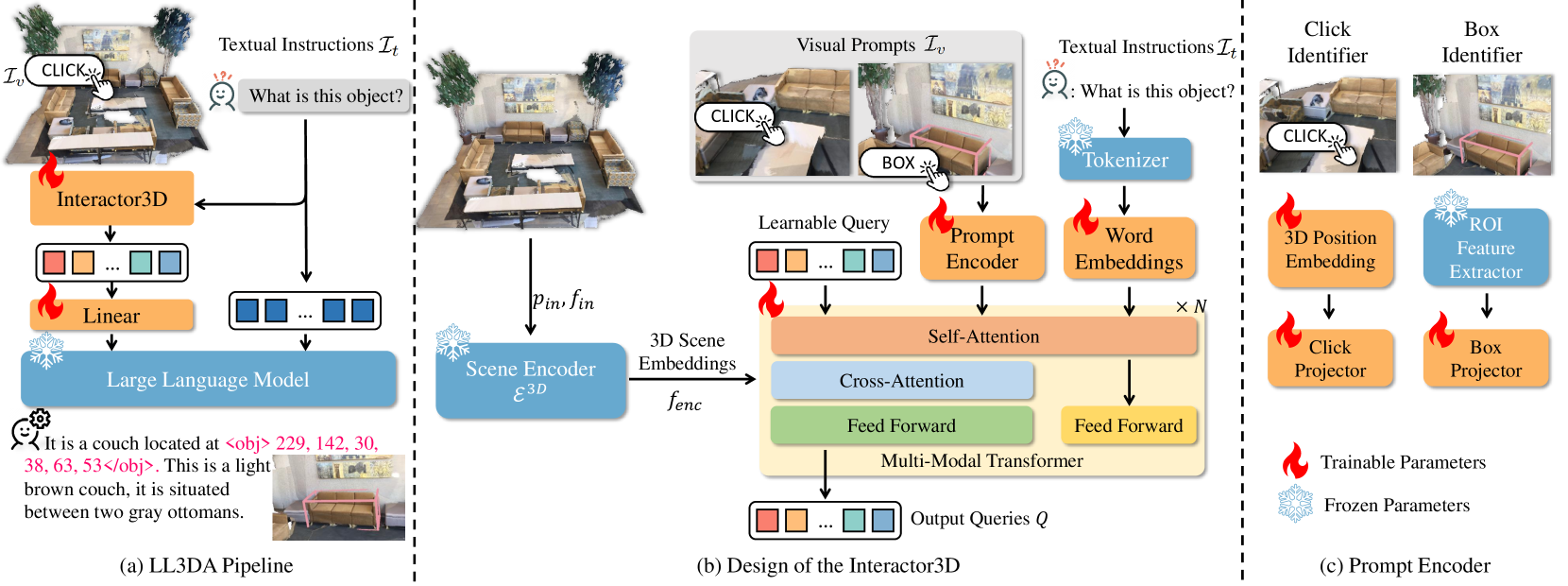
The overall architecture of LL3DA, detailing the Interactor3D module and its connection to the LLM.
Evaluation Highlights
Achieves state-of-the-art results on ScanRefer and Nr3D datasets for 3D Dense Captioning (quantitative values cut off in provided text)
Surpasses various 3D vision-language models on the ScanQA dataset for 3D Question Answering
Demonstrates capability to handle both 'describe' and 'describe and localize' tasks by leveraging visual prompts to remove ambiguity
Breakthrough Assessment
7/10
Strong conceptual contribution by integrating direct visual prompts (clicks) into 3D-LLMs to solve ambiguity. Moves away from heavy 2D-to-3D projection pipelines.
⚙️ Technical Details
Problem Definition
Setting: Auto-regressive generation of text responses given a 3D point cloud, textual instructions, and optional visual interactions
Inputs: Point cloud PC (coordinates + features), Textual Instruction I_t, Visual Interactions I_v (clicks or boxes)
Outputs: Natural language response (potentially containing discretized coordinate tokens)
Pipeline Flow
Input Processing (Point Cloud & Visual Prompts)
Feature Encoding (Scene Encoder & Prompt Encoder)
Feature Aggregation (Interactor3D/MMT)
Response Generation (LLM)
System Modules
Scene Encoder (Feature Encoding)
Extract features from the raw 3D point cloud
Model or implementation: Masked transformer encoder (pre-trained on ScanNet detection), frozen
Visual Prompt Encoder (Feature Encoding)
Encode user interactions (clicks or boxes) into embedding space
Model or implementation: Fourier positional embeddings (for clicks) or ROI feature extractor (for boxes)
Multi-Modal Transformer (MMT)
Aggregate scene and prompt information into fixed-length tokens compatible with LLM
Model or implementation: Transformer with self-attention (text+prompts) and cross-attention (scene features)
LLM
Generate final natural language response and coordinates
Model or implementation: OPT-1.3B (frozen)
Novel Architectural Elements
Interactor3D: A unified module that injects visual prompts (clicks/boxes) into the query initialization of a Q-Former style aggregator, making the 3D representation 'interaction-aware'
Modeling
Base Model: OPT-1.3B
Training Method: Instruction Tuning (Supervised Fine-Tuning)
Objective Functions:
Purpose: Maximize likelihood of target text given inputs.
Formally: Token-wise cross-entropy loss on the predicted tokens
Adaptation: Fine-tuning of the Projector and MMT (LLM and Scene Encoder are frozen)
Compute: 8 Nvidia RTX3090 (24G) GPUs, approx 1 day training time
Comparison to Prior Work
vs. 3D-LLM: LL3DA takes point clouds directly (no multi-view projection) and supports visual prompt interactions
vs. ScanQA specialists: LL3DA is a generalist LLM handling multiple tasks (QA, Captioning, Planning) in one model
Limitations
Relies on a frozen scene encoder, which may limit the adaptability of visual features to new domains
Performance depends on the quality of the point cloud input (e.g., sparsity, noise)
Snippet does not provide quantitative ablation on the impact of specific visual prompt types (clicks vs boxes) in isolation
Reproducibility
Code availability is not explicitly provided in the text snippet. Model relies on pre-trained ScanNet detection weights and OPT-1.3B weights. Training data (ScanRefer, Nr3D, ScanQA) is public.
📊 Experiments & Results
Evaluation Setup
Evaluated on standard 3D Vision-Language benchmarks for captioning and QA
Benchmarks:
ScanRefer (3D Dense Captioning)
Nr3D (3D Visual Grounding / Captioning)
ScanQA (3D Question Answering)
Metrics:
CiDEr (C)
BLEU-4 (B-4)
METEOR (M)
Rouge-L (R)
m@k IoU (for captioning localization)
Statistical methodology: Not explicitly reported in the paper
Main Takeaways
The paper claims state-of-the-art performance on 3D Dense Captioning (ScanRefer, Nr3D) and 3D Question Answering (ScanQA), surpassing previous 3D-LLMs and specialists.
The introduction of visual prompts (clicks/boxes) allows the model to resolve ambiguity in textual instructions, which is a key failure mode of previous text-only 3D-LLMs.
The architecture proves that direct point cloud processing with an interaction-aware transformer (Interactor3D) is a viable and efficient alternative to multi-view image projection methods like 3D-LLM.
📚 Prerequisite Knowledge
Prerequisites
Transformer architecture (Attention mechanisms)
3D Point Cloud processing (PointNet++ or Sparse Convolutions)
Vision-Language Alignment (Q-Former concepts)
Key Terms
Point Cloud: A set of data points in space representing a 3D shape or object, often containing coordinates (x, y, z) and features like color
LMM: Large Multimodal Model—an LLM extended to process non-text modalities like images or 3D data
FPS: Farthest Point Sampling—an algorithm to select a subset of points from a point cloud that are maximally distant from each other to cover the shape well
Q-Former: A transformer module used to bridge the gap between a frozen visual encoder and a frozen LLM by learning a fixed number of query vectors
IoU: Intersection over Union—a metric used to evaluate the accuracy of an object detector by comparing the overlap between the predicted box and the ground truth
OPT: Open Pre-trained Transformer—a family of open-source large language models