Ling Yang, Zhaochen Yu, Chenlin Meng, Minkai Xu, Stefano Ermon, Bin Cui
International Conference on Machine Learning
(2024)
MMAgentReasoning
📝 Paper Summary
Text-to-Image GenerationText-Guided Image Editing
RPG is a training-free framework that utilizes Multimodal LLMs to recaption prompts and plan spatial layouts, enabling diffusion models to generate complex compositional images via independent regional processing.
Core Problem
State-of-the-art diffusion models struggle with complex prompts involving multiple objects, attributes, and relationships, often failing to bind attributes correctly or respect spatial constraints.
Why it matters:
Current layout-based methods provide only rough spatial guidance and handle object overlaps poorly due to latent conflicts
Feedback-based refinement methods are computationally expensive and require collecting high-quality feedback data
Achieving precise compositionality (e.g., specific counts, distinct attribute binding) remains a major hurdle for models like DALL-E 3 and SDXL
Concrete Example:A prompt like 'A green hair twintail in red blouse, wearing blue skirt' requires distinct attribute binding. Standard models might bleed colors (e.g., making the skirt red). RPG decomposes this into specific subregions (green hair, red blouse, blue skirt) to prevent attribute leakage.
Key Novelty
Recaption, Plan, and Generate (RPG)
Utilizes MLLMs as a 'Global Planner' to break down complex prompts into detailed sub-prompts and assign them to specific spatial subregions via Chain-of-Thought reasoning
Introduces 'Complementary Regional Diffusion' which generates image latents for each subregion independently and merges them (resize-and-concatenate) at each step, preventing semantic conflict in overlapping areas
Architecture
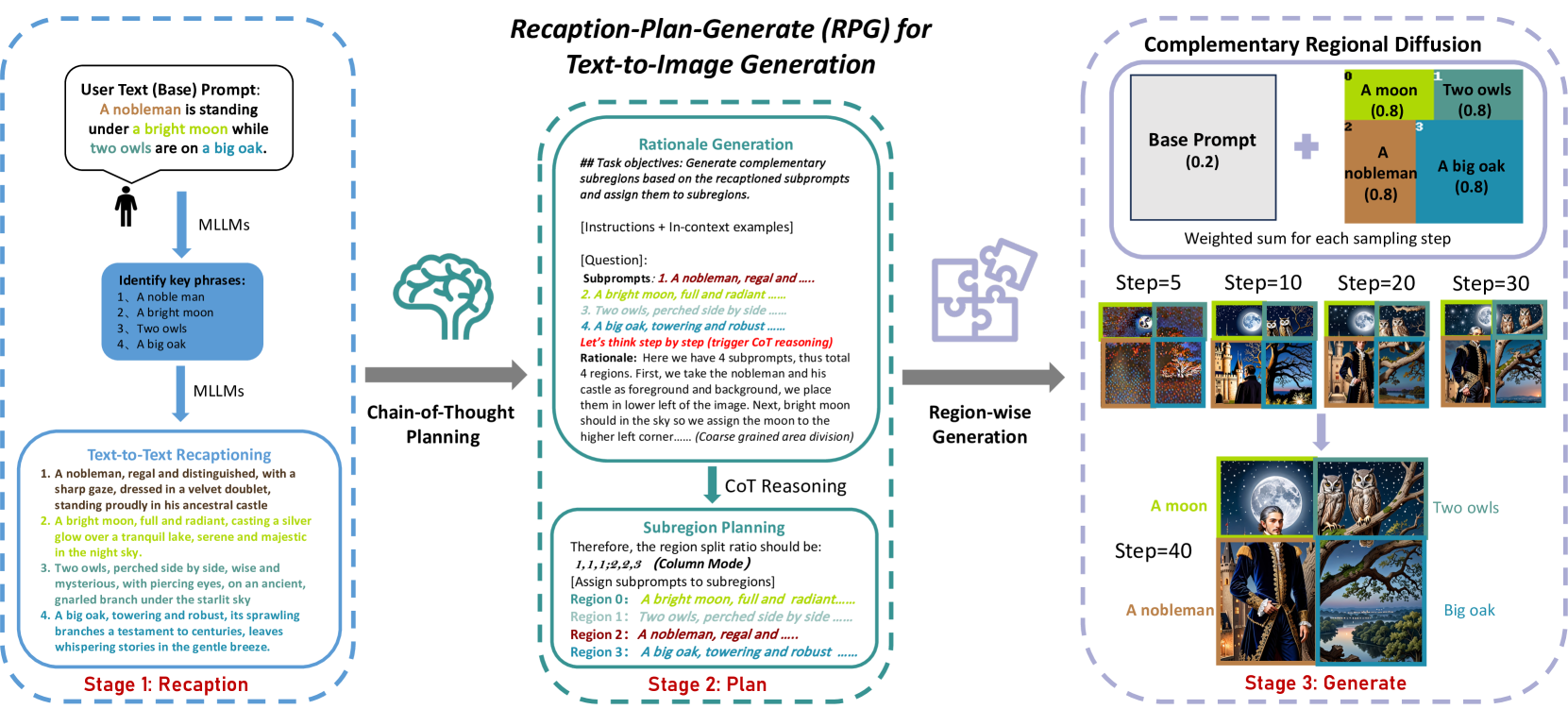
The overall RPG framework illustrating the three main stages: Multimodal Recaptioning, Chain-of-Thought Planning, and Complementary Regional Diffusion.
Breakthrough Assessment
8/10
Proposes a highly logical, training-free mechanism to solve a persistent flaw in diffusion models (compositionality). By effectively 'tiling' the generation process under LLM guidance, it addresses attribute bleeding and spatial neglect without retraining.
⚙️ Technical Details
Problem Definition
Setting: Text-to-Image Generation and Editing under complex compositional constraints
Inputs: Complex text prompt y^c containing multiple entities/attributes, or Source Image x + Target Prompt y_tar
Outputs: Generated or Edited Image adhering to compositional constraints
Planning: CoT Planner (Subprompts -> Region Division)
Generation: Complementary Regional Diffusion (Regions -> Final Image)
System Modules
Multimodal Recaptioner
Decompose complex prompts into detailed sub-prompts or analyze source images for semantic discrepancies
Model or implementation: LLM / MLLM (e.g., GPT-4, Gemini Pro)
CoT Planner
Partition image space into complementary regions and assign sub-prompts to them
Model or implementation: MLLM (with CoT prompting)
Regional Diffusion Generator
Generate image latents for each region and merge them
Model or implementation: Diffusion Backbone (e.g., SDXL, ControlNet)
Novel Architectural Elements
Complementary Regional Diffusion: A split-and-merge inference pipeline that generates latents for distinct rectangular regions in parallel and concatenates them spatially
Code is publicly available at https://github.com/YangLing0818/RPG-DiffusionMaster. The framework is training-free and relies on pre-trained MLLMs (like GPT-4/Gemini) and Diffusion models (SDXL). Prompts for CoT are described in the paper.
📊 Experiments & Results
Evaluation Setup
Text-to-Image Generation and Text-Guided Image Editing
Benchmarks:
Comparisons against DALL-E 3 (Text-to-Image Generation)
Comparisons against SDXL (Text-to-Image Generation)
Comparisons against InstructPix2Pix (Text-Guided Image Editing)
Metrics:
Text-Image Semantic Alignment
Multi-category Object Composition
Statistical methodology: Not explicitly reported in the paper
Main Takeaways
The paper claims RPG outperforms state-of-the-art models (DALL-E 3, SDXL) in multi-category object composition and semantic alignment.
The framework unifies generation and editing in a closed-loop fashion, allowing MLLMs to diagnose discrepancies and refine the image iteratively.
Complementary Regional Diffusion addresses the issue of conflicting latent representations in overlapping regions, a common failure point in previous attention-based methods.
📚 Prerequisite Knowledge
Prerequisites
Diffusion Models (Latent Diffusion)
Multimodal Large Language Models (MLLMs)
Chain-of-Thought (CoT) Reasoning
Cross-Attention Mechanisms
Key Terms
RPG: Recaption, Plan and Generate—the proposed training-free framework for compositional generation
MLLM: Multimodal Large Language Model—an AI model capable of processing and reasoning over both text and image inputs (e.g., GPT-4, Gemini Pro)
CoT: Chain-of-Thought—a prompting strategy where the model generates intermediate reasoning steps before the final answer
Complementary Regional Diffusion: A technique where the image space is divided into non-overlapping regions; latents are generated for each region independently using sub-prompts and then concatenated
Attribute Binding: The ability of a model to correctly associate an attribute (e.g., 'red') with the correct object (e.g., 'cube') without leaking to other objects
Inpainting: The process of reconstructing missing or masked parts of an image