📝 Paper Summary
Humanoid Robotics
Loco-manipulation
Sim-to-Real Transfer
Whole-body Control
This survey synthesizes 30 years of humanoid research, highlighting the convergence of model-based control and learning-based methods to achieve unified whole-body loco-manipulation rather than separate locomotion and manipulation.
Core Problem
Humanoid robots have historically treated locomotion (balancing/walking) and manipulation (hand tasks) as separate problems, failing to leverage the whole body for complex, contact-rich real-world tasks.
Why it matters:
- Separate control schemes limit robots to static bases or simple walking, preventing human-level tasks like carrying heavy loads up stairs or pushing large objects
- Current robots lack the efficiency of humans (Cost of Transport > 0.7 vs. 0.2), partly due to rigid control rather than compliant whole-body dynamics
- Real-world deployment requires handling unstructured environments and safe physical collaboration with humans, which pure trajectory tracking cannot accommodate
Concrete Example:
Humans use elbows or hips to hold a door open while carrying a box (whole-body manipulation). In contrast, most traditional humanoid controllers strictly limit interaction to feet and fingertips, treating any other body contact as a disturbance to be rejected rather than a useful leverage point.
Key Novelty
Comprehensive Survey of Humanoid Loco-Manipulation (HLM)
- Reviews the evolution from distinct Model-Based methods (MPC, WBC) to integrated Learning-Based approaches (Sim-to-Real RL, Imitation Learning)
- Identifies 'Loco-Manipulation' as the critical capability gap, defined as the simultaneous coordination of locomotion and manipulation using the whole body
- Proposes that Foundation Models (FMs) and whole-body tactile sensing are the emerging pillars needed to solve high-level planning and contact-rich interaction
Architecture
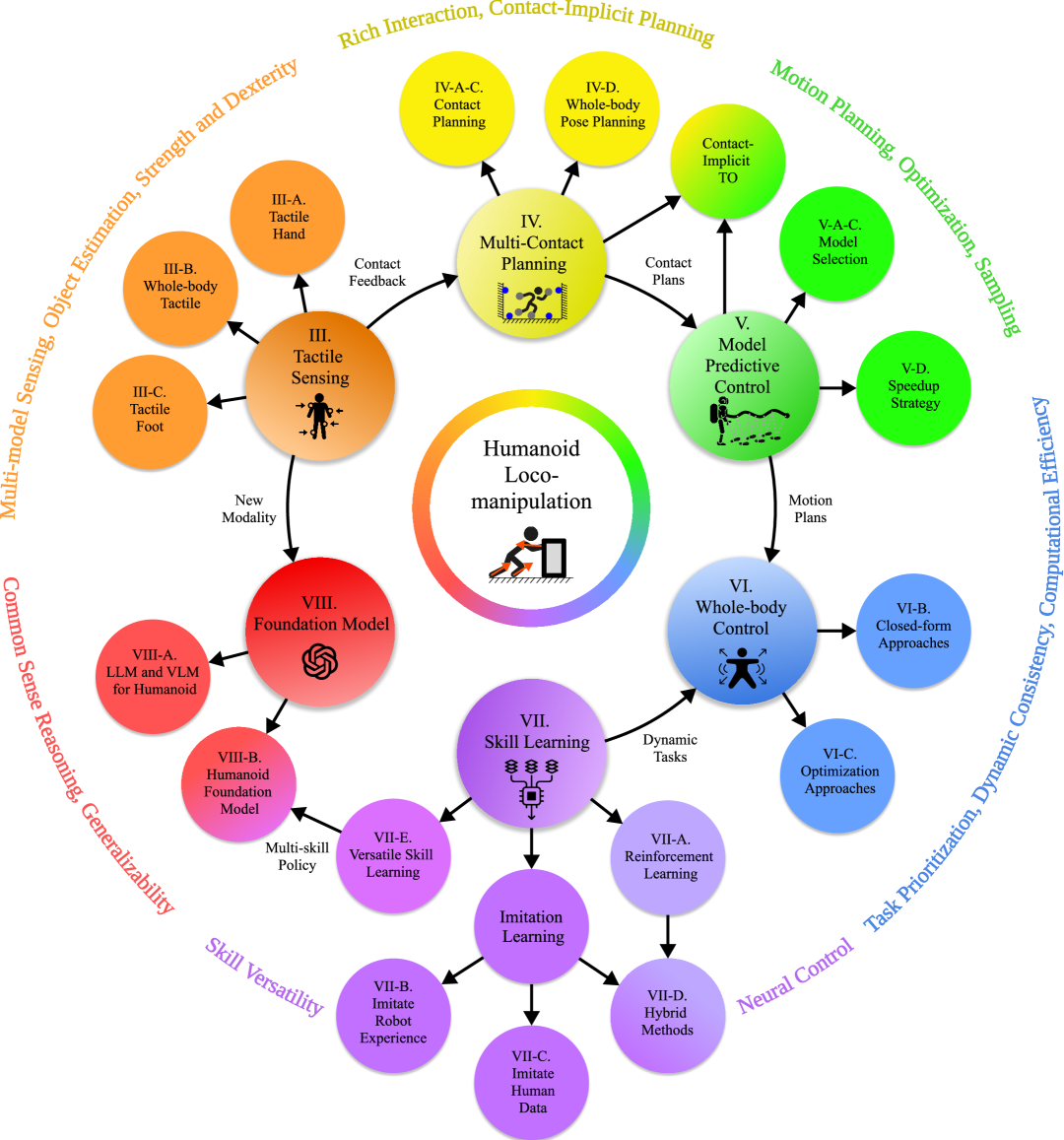
A roadmap of the humanoid robotics field, organizing sub-disciplines into a hierarchy from Hardware/Design up to Planning/Decision Making.
Breakthrough Assessment
8/10
An extensive, timely survey that bridges the gap between classical control theory and modern AI in robotics. Essential reading for understanding the current 'humanoid race' involving companies like Tesla and Figure.