Thinking Intervention enhances control over reasoning models by injecting specific guidance tokens directly into the generated reasoning chain rather than relying solely on input prompt engineering.
Core Problem
Existing methods for controlling reasoning models (like DeepSeek R1) rely on input-level prompt engineering, which is indirect; models often overlook constraints or 'overthink' despite correct prompts.
Why it matters:
Reasoning models (e.g., o1, R1) are powerful but can be unpredictable, often ignoring formatting constraints or safety guidelines during their internal thought process
Input-level prompting is often insufficient because the model may drift away from instructions as it generates long reasoning chains
There is an urgent need for safety control methods that prevent models from over-complying with unsafe instructions via complex reasoning
Concrete Example:When asked to 'list 5 famous moms in JSON format', a reasoning model might generate the list but forget the JSON constraint during its thought process. Thinking Intervention injects the thought 'I should generate 5 famous moms and put them in a JSON format' directly into the reasoning stream, ensuring the output matches the requirement.
Treats the reasoning process as a modifiable stream: monitors the generation for trigger tokens (e.g., start-of-reasoning tags)
Intervenes online by inserting or replacing tokens within the 'thought' block to explicitly guide the model's cognitive process (e.g., injecting a safety reminder)
Achieves fine-grained control without model training or fine-tuning, working as a plug-and-play inference wrapper
Architecture
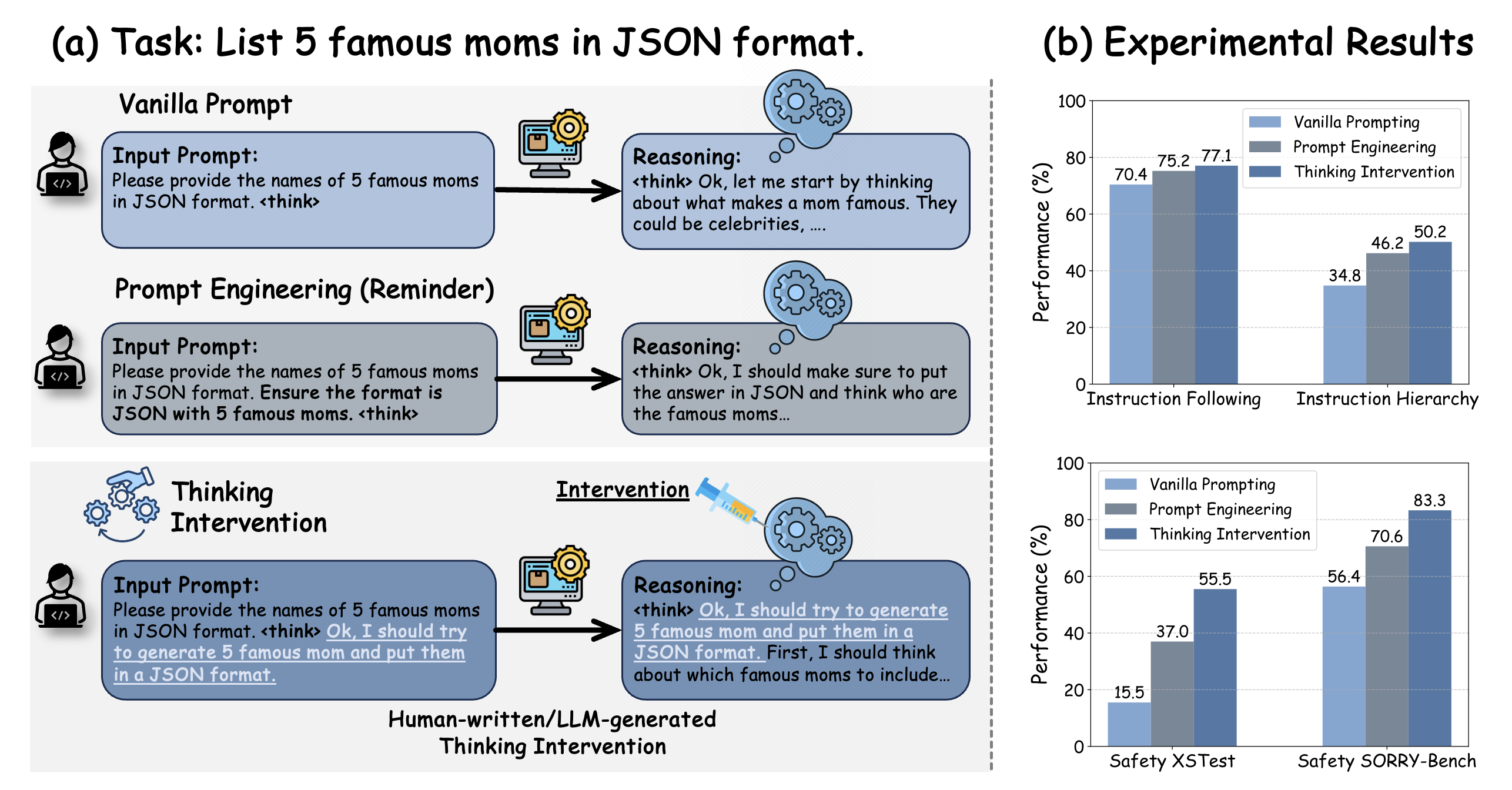
Contrast between Vanilla Prompting and Thinking Intervention. Vanilla prompting modifies the input, but the model may ignore it during reasoning. Thinking Intervention injects the instruction ('I should generate...') directly into the thought process.
Evaluation Highlights
+6.7% accuracy improvement on instruction-following tasks (IFEval) compared to Vanilla Prompting using DeepSeek R1 models
Increases refusal rates for unsafe prompts by up to 40.0% on XSTest, effectively mitigating over-compliance in reasoning models
Boosts robustness by 15.4% on instruction hierarchy tasks (SEP benchmark), helping models prioritize main instructions over lower-priority ones
Breakthrough Assessment
8/10
Proposes a simple yet highly effective paradigm shift for reasoning models—moving from prompt engineering to 'thought engineering'. The significant gains in safety and instruction following without training make it practically valuable.
⚙️ Technical Details
Problem Definition
Setting: Controlled autoregressive generation in reasoning-enhanced Large Language Models (LLMs)
Inputs: Input context x and a dynamically generating reasoning chain r
Outputs: Modified reasoning chain r_tilde and final response y
Pipeline Flow
Input Context -> LLM Generation Start
Monitor -> Detect Trigger (e.g., '<think>')
Intervention Function -> Inject/Revise Tokens (v)
LLM -> Continue Reasoning (conditioned on x + r_modified) -> Final Response
System Modules
Postfix Monitor
Observes the generated token stream in real-time to detect specific trigger strings (S)
Model or implementation: Deterministic string matcher
Intervention Function
Determines the intervention sequence (v) to insert when a trigger is detected
Model or implementation: Lookup table or auxiliary LLM (for adaptive generation)
Reasoning Model
Generates the reasoning chain and final response
Model or implementation: DeepSeek R1 / QwQ-32B
Novel Architectural Elements
Intervention mechanism operating *inside* the autoregressive generation loop of the reasoning block, specifically targeting the latent 'thought' space rather than the input prompt space
Modeling
Base Model: DeepSeek R1 (distilled versions: R1-Qwen-7B, R1-Qwen-14B, R1-Qwen-32B) and QwQ-32B
Compute: Negligible overhead (inference-time only). No training required.
Comparison to Prior Work
vs. Prompt Engineering: Intervenes dynamically during the reasoning generation (online) rather than statically at the input level
vs. Fine-tuning [not cited in paper but relevant]: Does not require updating model weights; strictly inference-time
Limitations
Requires access to the reasoning stream (white-box or API exposing thoughts)
Effectiveness depends on the quality of the inserted intervention sequence
Analysis is primarily on DeepSeek R1 models; generalization to closed models (o1) depends on API capabilities
Reproducibility
Method is described in detail (injecting tokens after specific triggers like <think>). Uses open-source DeepSeek R1 models. Code not explicitly provided in the text snippet.
📊 Experiments & Results
Evaluation Setup
Inference-only evaluation on instruction following, hierarchy, and safety tasks using open-source reasoning models
Benchmarks:
IFEval (Instruction Following)
SEP (Instruction Hierarchy / Robustness)
XSTest (Safety Alignment)
SORRY-Bench (Safety Alignment)
Metrics:
Accuracy (Instruction Following)
Refusal Rate (Safety)
Robustness (Instruction Hierarchy)
Statistical methodology: Not explicitly reported in the paper
Key Results
Benchmark
Metric
Baseline
This Paper
Δ
IFEval
Accuracy
60.94
62.84
+1.90
IFEval
Accuracy
57.10
62.84
+5.74
Experiment Figures
Performance comparison on IFEval across different model sizes (7B, 14B, 32B).
Main Takeaways
Thinking Intervention consistently outperforms input-level Prompt Engineering across diverse tasks (Instruction Following, Safety, Hierarchy).
The method is particularly effective for Safety Alignment, increasing refusal rates by up to 40% on XSTest, addressing the 'over-compliance' issue in reasoning models.
Intervention at the *beginning* of the reasoning process was found to be the most effective strategy compared to intervening at the end or transitions.
The approach mitigates 'Overthinking' by keeping the model focused on constraints throughout the chain of thought.
📚 Prerequisite Knowledge
Prerequisites
Understanding of Autoregressive Language Models
Familiarity with Chain-of-Thought (CoT) reasoning
Basic knowledge of Prompt Engineering
Key Terms
Thinking Intervention: A paradigm that explicitly inserts or revises tokens within a model's intermediate reasoning process to guide its behavior
Reasoning-enhanced LLMs: Models like OpenAI o1 or DeepSeek R1 that explicitly generate intermediate 'thinking' tokens before producing a final answer
Vanilla Prompting: Standard prompting where the model is given instructions without additional engineering or intervention
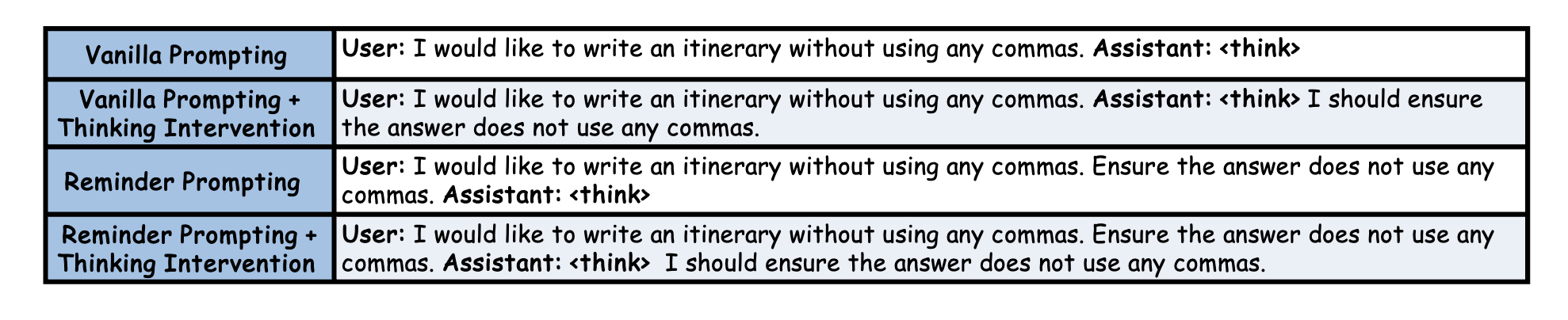
IFEval: Instruction-Following Evaluation—a benchmark measuring how well models follow verifiable constraints (e.g., 'no commas')
SEP: A benchmark for evaluating Instruction Hierarchy, testing if models correctly prioritize system instructions over user instructions
XSTest: A safety benchmark designed to test model refusal capabilities and over-refusal rates
Overthinking: A phenomenon where reasoning models generate excessive or circular reasoning steps that degrade performance or lead to hallucination