Financial Large Language ModelsReasoning ModelsReinforcement Learning for LLMs
Fin-R1 is a 7-billion parameter financial LLM trained via supervised fine-tuning and Group Relative Policy Optimization on a distilled high-quality reasoning dataset, achieving strong performance with low deployment costs.
Core Problem
General-purpose reasoning models struggle in finance due to fragmented data sources, lack of transparency (black box nature) required for compliance, and weak transferability to specific business scenarios.
Why it matters:
Financial tasks require integrating heterogeneous knowledge (legal, economic, quantitative) which general models often fail to do coherently
Regulatory environments demand traceability and explainability, but most models output answers without transparent reasoning paths
Existing financial models typically rely on pre-training or simple fine-tuning, lacking the deep reasoning capabilities needed for complex tasks like risk pricing
Concrete Example:Financial data often contains contradictory signals across dispersed sources (e.g., contractual terms vs. market signals). A standard model might memorize training examples, failing to generalize when these signals conflict in new scenarios, whereas a reasoning model needs to explicitly weigh the evidence.
Key Novelty
Two-stage Financial Reasoning Post-Training
Constructs a specialized reasoning dataset (Fin-R1-Data) by distilling reasoning traces from DeepSeek-R1 and filtering them with Qwen2.5-72B-Instruct
Applies Supervised Fine-Tuning (SFT) followed by Group Relative Policy Optimization (GRPO) to enforce both correctness and structured, interpretable reasoning chains in a small 7B model
Architecture
The overall two-stage framework pipeline: Data Construction (Distillation & Filtering) and Model Training (SFT + RL).
Evaluation Highlights
Achieved an average score of 75.2 on established financial reasoning benchmarks
Outperformed existing state-of-the-art models of the same 7B scale by more than 17 points
Ranked second overall among tested models, surpassing many larger general-purpose models
Breakthrough Assessment
8/10
Successfully adapts the 'reasoning model' paradigm (like o1/DeepSeek-R1) to a specific vertical (finance) using a 7B model, demonstrating that smaller domain-specific models can achieve high reasoning performance via specialized RL.
⚙️ Technical Details
Problem Definition
Setting: Financial Question Answering and Reasoning
Code is publicly available at https://github.com/SUFE-AIFLM-Lab/Fin-R1. The Fin-R1-Data dataset construction process is detailed (Source -> Distillation -> Filtering). FinPEE dataset constructed from proprietary exam questions.
📊 Experiments & Results
Evaluation Setup
Evaluation on established financial benchmarks and practical application scenarios
Benchmarks:
FinQA (Financial Question Answering with numerical reasoning)
Statistical methodology: Not explicitly reported in the paper
Key Results
Benchmark
Metric
Baseline
This Paper
Δ
Financial Reasoning Benchmarks (Average)
Average Score
Not reported in the paper
75.2
Not reported in the paper
Experiment Figures
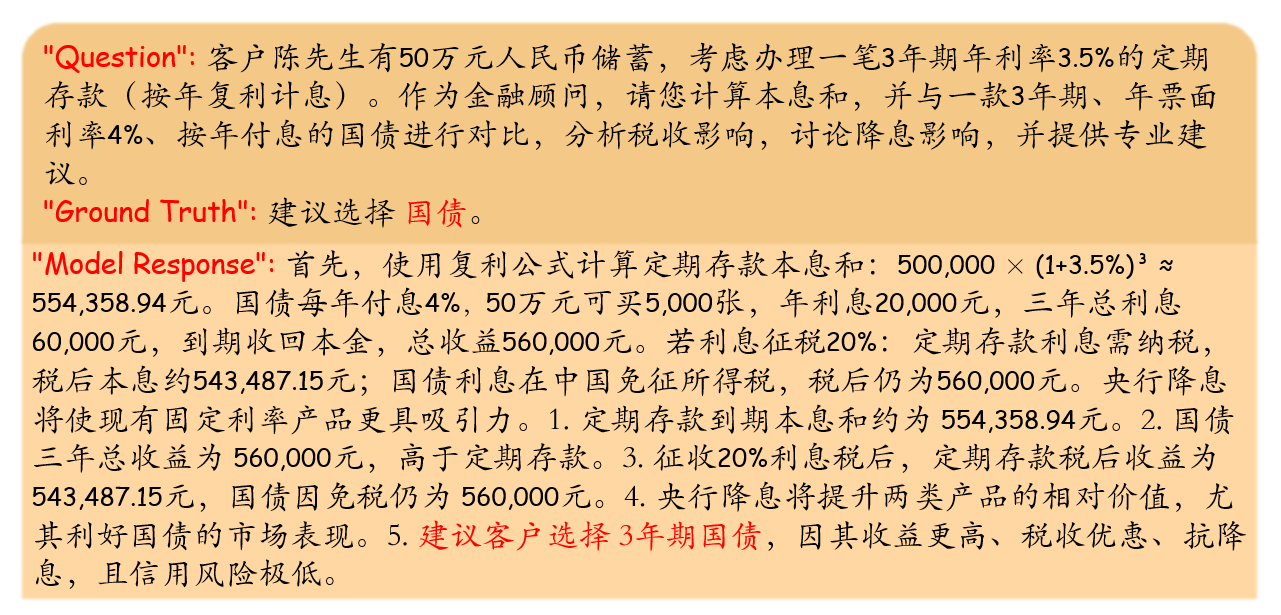
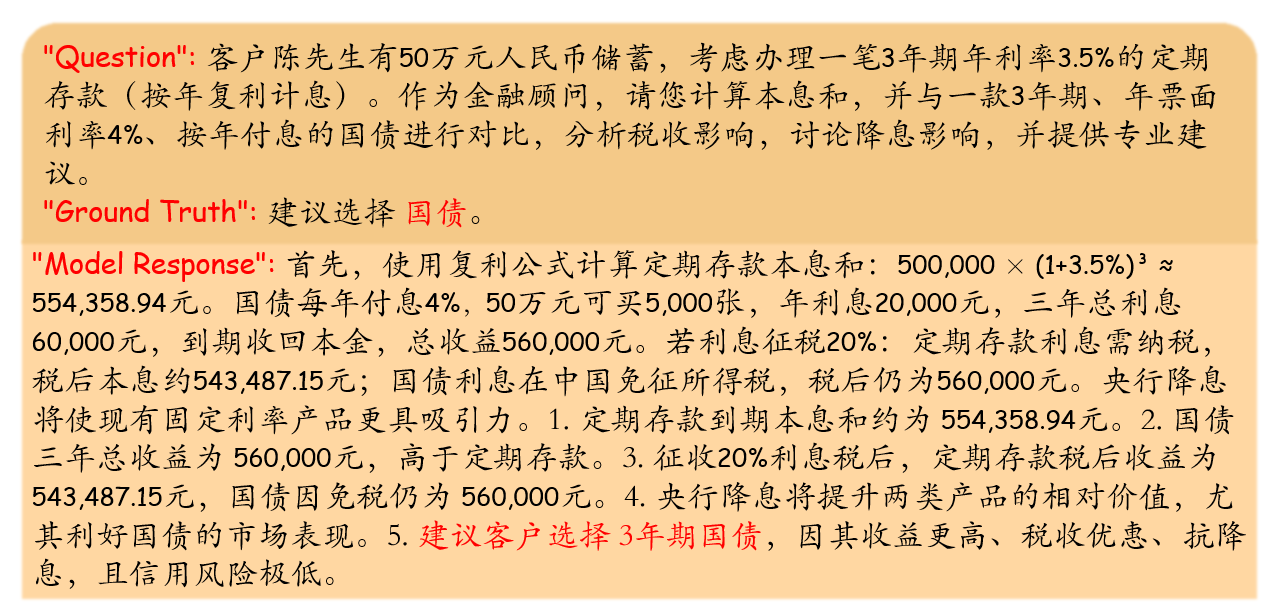
Sample outputs of Fin-R1 in Chinese and English, demonstrating explicit reasoning paths.
Main Takeaways
Fin-R1 achieves an average score of 75.2 on financial reasoning benchmarks, ranking second overall.
Outperforms peer 7B models by a margin of over 17 points, demonstrating the efficacy of the RL-based reasoning pipeline.
The two-stage training (SFT + GRPO) effectively enables a small model to perform complex reasoning tasks previously reserved for much larger models.
Data quality is critical: filtering distilled data with a strong judge (Qwen2.5-72B) ensures high-quality reasoning traces for training.
📚 Prerequisite Knowledge
Prerequisites
Basics of Large Language Model training (SFT, RLHF)
Understanding of Chain-of-Thought (CoT) reasoning
Familiarity with Reinforcement Learning algorithms (PPO, GRPO)
Key Terms
GRPO: Group Relative Policy Optimization—an RL algorithm that improves reasoning by generating multiple outputs for a prompt and optimizing based on their relative performance within the group, avoiding the need for a separate value network
CoT: Chain-of-Thought—a prompting or training technique where the model generates intermediate reasoning steps before the final answer
SFT: Supervised Fine-Tuning—training a model on labeled input-output pairs to teach it specific behaviors or knowledge
PPO: Proximal Policy Optimization—a standard reinforcement learning algorithm for LLMs that constrains policy updates to ensure stability
Distillation: The process of training a smaller 'student' model to mimic the outputs or reasoning of a larger, more capable 'teacher' model
LLM-as-a-Judge: Using a strong LLM to evaluate the quality or correctness of outputs from another model