📝 Paper Summary
Visual Mathematical Reasoning
Large Multimodal Models (LMMs) Evaluation
We-Math evaluates LMMs by decomposing complex visual math problems into sub-problems based on hierarchical knowledge concepts, revealing that models often rely on rote memorization rather than true reasoning.
Core Problem
Existing visual math benchmarks rely on result-oriented evaluation (final answer correctness), failing to reveal whether LMMs truly understand the underlying principles or merely exploit shortcuts.
Why it matters:
- High end-to-end accuracy can mask deep reasoning flaws, such as 'Rote Memorization' where models answer complex problems correctly but fail the prerequisite sub-problems
- Current benchmarks overlook the hierarchical nature of mathematical knowledge, where mastering a complex concept requires mastering its dependencies
- Identifying specific failure modes (e.g., lack of knowledge vs. lack of generalization) is crucial for progressing toward human-like reasoning
Concrete Example:
A model might correctly solve a multi-step geometry problem asking for a shaded area (Composite Problem) but fail to correctly calculate the area of the constituent triangle or circle (Sub-problems) when asked individually. This contradiction suggests the model guessed or memorized the final answer rather than reasoning through the steps.
Key Novelty
Knowledge-based Hierarchical Decomposition and Process Evaluation
- Deconstructs 6.5K visual math problems into a tree of 67 knowledge concepts and 5 granularity layers, mimicking human learning paths
- Decomposes composite problems into atomic sub-problems to test if the model masters the necessary prerequisites before solving the complex task
- Introduces a four-dimensional metric (Insufficient Knowledge, Inadequate Generalization, Complete Mastery, Rote Memorization) to diagnose *why* a model fails or succeeds
Architecture
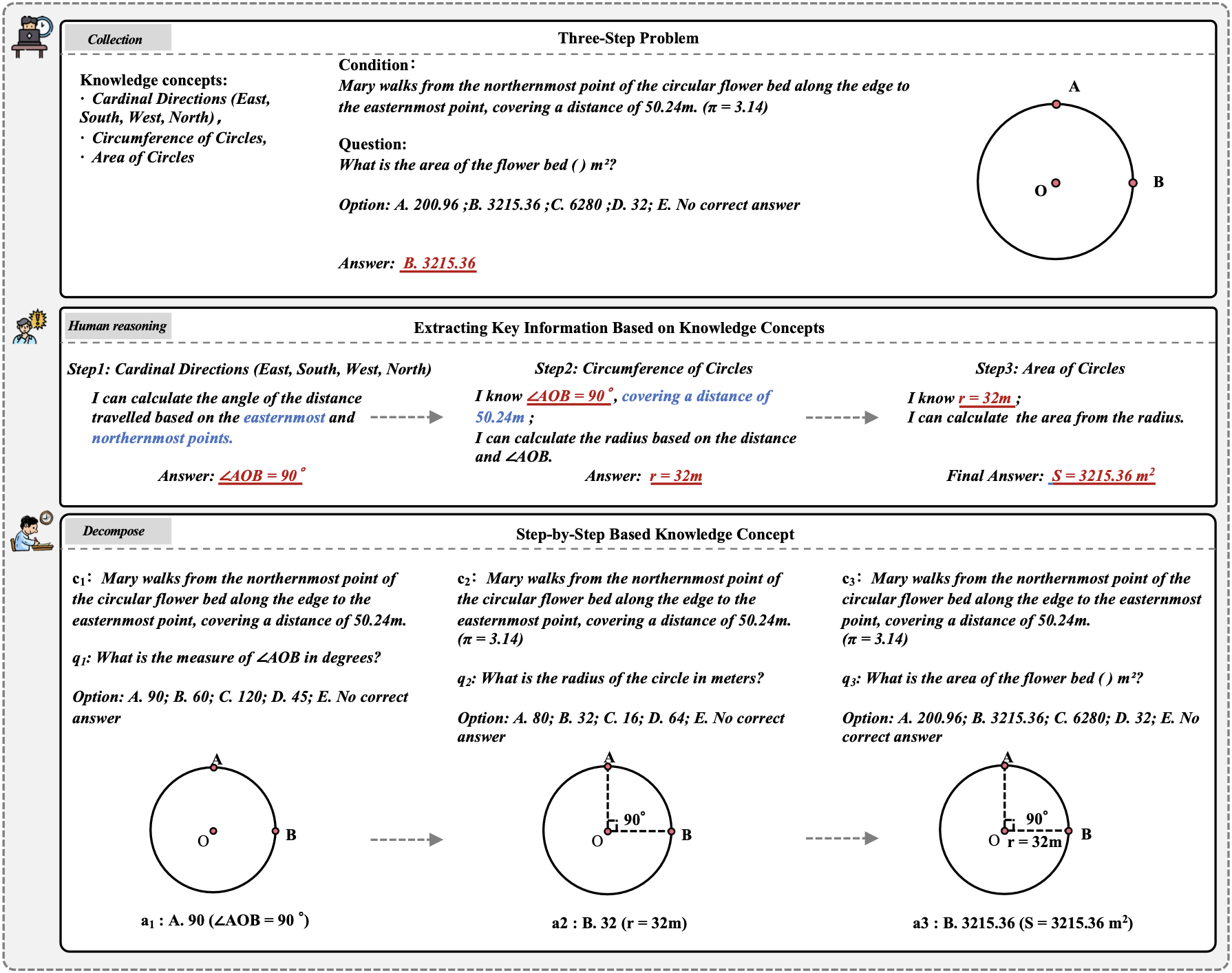
The pipeline for Knowledge-based Data Decomposition and the decision logic for the four-dimensional metric (IK, IG, CM, RM)
Evaluation Highlights
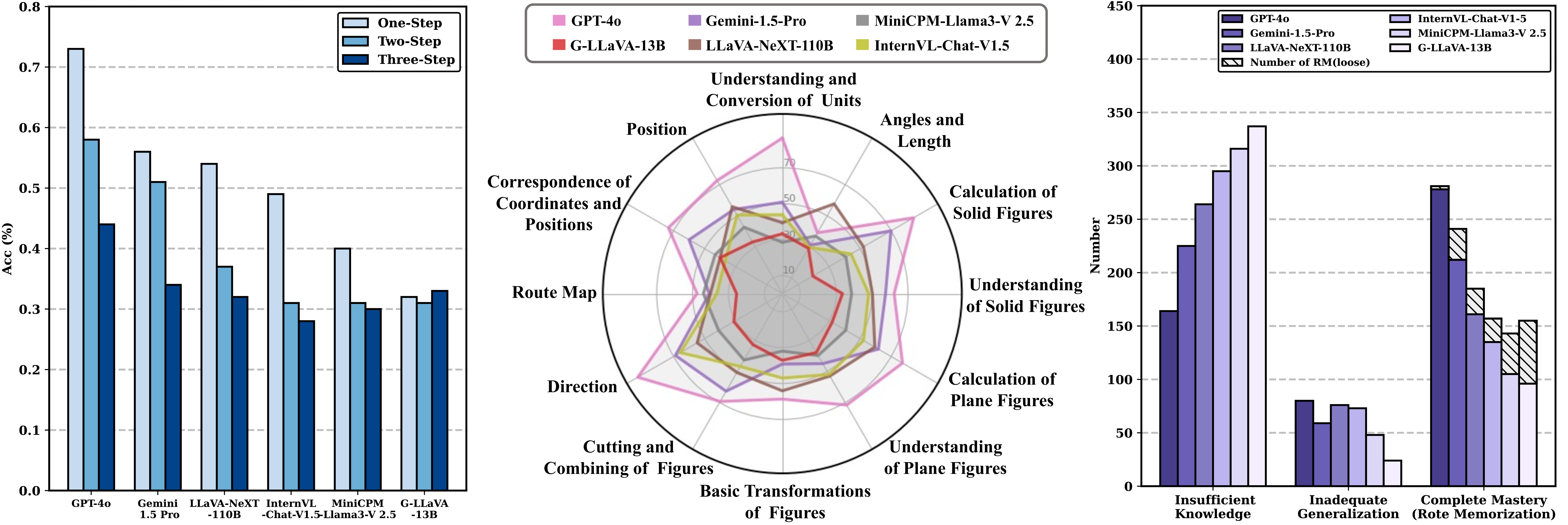
- GPT-4o achieves the highest 'Complete Mastery' but still struggles with generalization; its primary challenge has shifted from 'Insufficient Knowledge' to 'Inadequate Generalization'
- Many LMMs exhibit high 'Rote Memorization' rates (e.g., G-LLaVA-13B has ~36% loose Rote Memorization), solving complex problems while failing their sub-steps
- Knowledge Concept Augmentation (providing concept definitions) reduces 'Insufficient Knowledge' errors, confirming that lack of domain definitions is a bottleneck for smaller models
Breakthrough Assessment
8/10
Significant shift from outcome-based to process-based evaluation in visual math. The 'Rote Memorization' metric exposes a critical flaw in current LMM reasoning that standard accuracy metrics miss.