📝 Paper Summary
Prompting Strategies
Reasoning in LLMs
Multimodal Reasoning
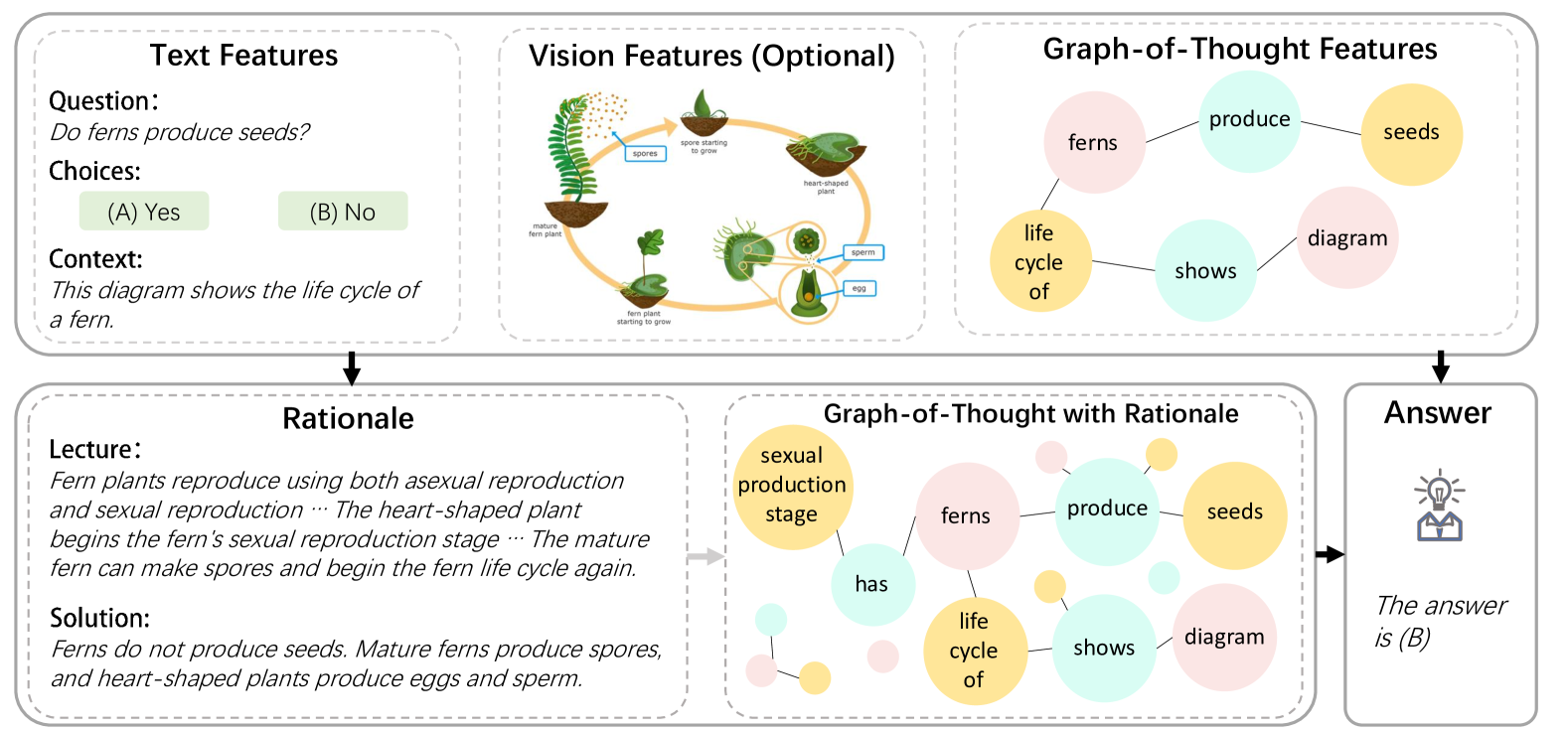
Graph-of-Thought models reasoning as a non-linear graph of connected ideas rather than a linear chain, fusing graph-encoded structural information with text and visual features for improved question answering.
Core Problem
Human thought is non-linear and jumping, but current Chain-of-Thought (CoT) approaches force LLMs into strict sequential reasoning, losing complex structural connections between ideas.
Why it matters:
- Sequential chains fail to capture 'leaps of thought' where seemingly unrelated ideas connect to form solutions
- Existing methods neglect the complex structural information inherent in reasoning (e.g., multiple premises leading to one conclusion)
- Current multimodal approaches often treat reasoning linearly, missing the graph-like nature of human cognition
Concrete Example:
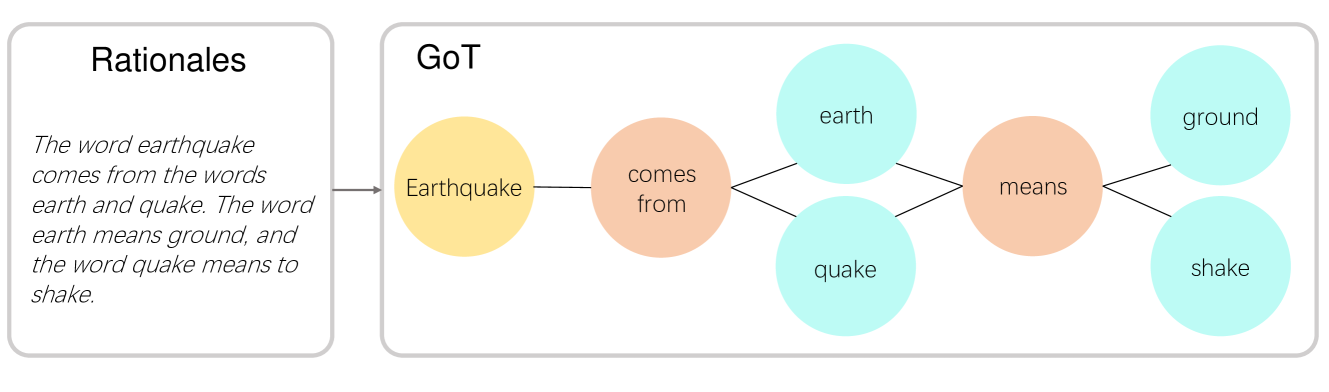
In reasoning about an earthquake, a linear chain might say 'Earthquake -> shaking -> ground moves'. A graph approach captures that 'Earthquake' links to 'earth' and 'quake', which implies 'ground' and 'shake' respectively, and these converge to the final concept, modeling the deductive leap.
Key Novelty
Graph-of-Thought (GoT) Framework
- Models thoughts as nodes in a graph (extracted via OpenIE) and connections as edges, rather than a linear sequence
- Uses a specialized graph attention network to encode this 'thought graph' alongside standard text and vision encoders
- Fuses the graph, text, and visual representations via a gated fusion mechanism to generate rationales and answers
Architecture
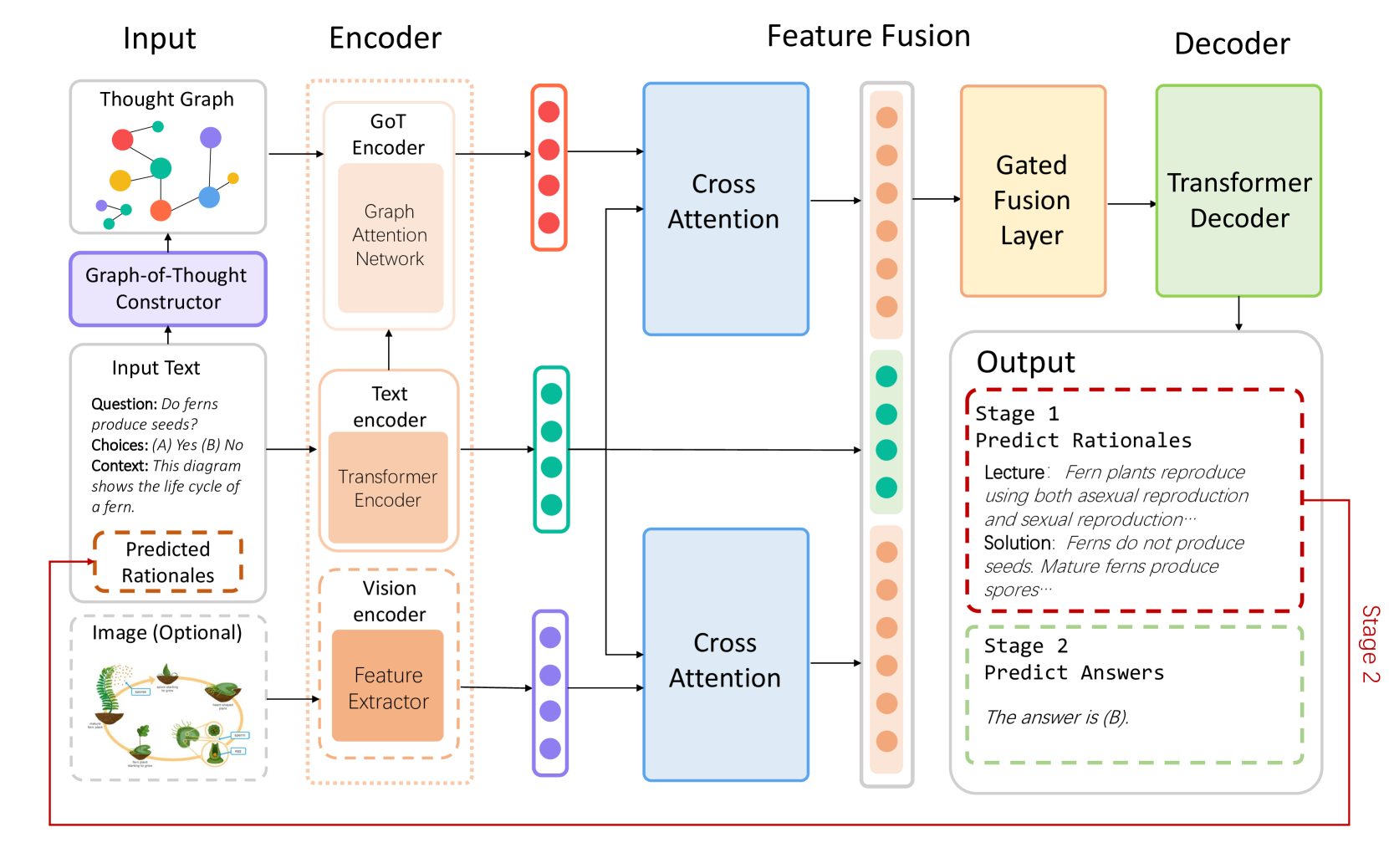
The overview of the Graph-of-Thought framework, detailing the two-stage process (Rationale Generation and Answer Generation) and the specific encoding modules.
Evaluation Highlights
- +2.40% accuracy improvement over the strong Multimodal-CoT baseline on the ScienceQA test set using T5-base
- Achieves 87.59% accuracy on ScienceQA (T5-base), surpassing the prior state-of-the-art
- Outperforms ChatGPT by 9.28% on the ScienceQA benchmark
Breakthrough Assessment
7/10
Significant architectural innovation by explicitly encoding reasoning structure as a graph and fusing it with other modalities. Strong empirical results on ScienceQA, though primarily evaluated on T5-based models rather than the largest modern LLMs.