📝 Paper Summary
Certifying Algorithms
Automated Planning
Formal Verification
Proposes a framework for certifying the optimality of classical planning solutions using pseudo-Boolean cutting planes proofs, enabling independent verification that no cheaper plan exists.
Core Problem
Classical planning algorithms claim to find optimal (cheapest) plans, but these claims are hard to verify without re-running the solver, and solvers may have bugs.
Why it matters:
- Plan correctness is easy to verify (using tools like VAL), but verifying *optimality* (that no better plan exists) is currently unsolved for general cases.
- Existing optimality certification methods are either inefficient (requiring exponential task reformulation) or too specific (limited to certain forward-search heuristics).
- Blindly accepting solver outputs is risky in safety-critical applications; 'certifying algorithms' that produce proofs are standard in SAT but nascent in Planning.
Concrete Example:
A planner outputs a plan $\pi$ with cost 10. A validator can check if $\pi$ works and costs 10. However, the validator cannot easily check if a hidden plan $\pi'$ with cost 9 exists. This paper generates a proof that cost < 10 leads to a contradiction.
Key Novelty
Pseudo-Boolean (PB) Cutting Planes with Reification for Planning
- Encodes the planning task and heuristic estimates into pseudo-Boolean constraints (linear inequalities over boolean variables), which naturally handle arithmetic costs.
- Uses a cutting planes proof system (supported by the VeriPB checker) to derive a contradiction for any goal state having a cost lower than the optimal plan.
- Introduces 'heuristic certificates' that translate admissible heuristic values (like Pattern Databases) into PB constraints, allowing the proof to leverage heuristic information efficiently.
Architecture
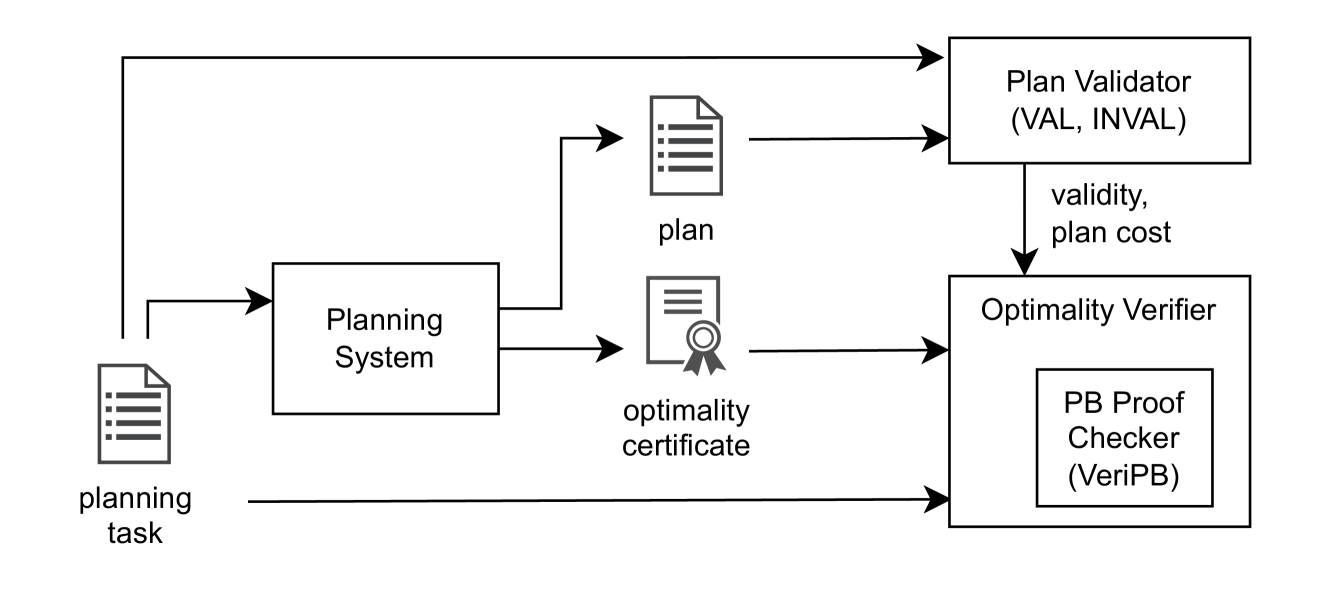
The workflow of the certifying planning system
Breakthrough Assessment
8/10
Fills a major gap in reliable AI planning. While SAT certification is mature, general optimality certification for planning was missing. The move to Pseudo-Boolean (vs. CNF) is mathematically well-motivated for cost reasoning.