📝 Paper Summary
Neurosymbolic AI
Cognitive Modeling
Spatial Reasoning
Embodied-LM operationalizes cognitive image schemas by using LLMs to translate natural language problems into Answer Set Programs grounded in spatial primitives like PATH and CONTAINER for executable reasoning.
Core Problem
LLMs lack robust mental representations for logical reasoning, often failing to maintain consistency in described situations or reason soundly on problems with many premises.
Why it matters:
- Current LLMs purely process text statistics, missing the sensorimotor 'image schemas' (like containment or paths) that humans use to structure understanding of abstract concepts
- Purely neural approaches struggle with maintaining state consistency in multi-step deductive reasoning tasks
Concrete Example:
In a problem like 'Alice is older than Bill, and Charles is younger than Bill', an LLM might hallucinate relationships. Embodied-LM maps this to a spatial 'timeline' (PATH schema), where geometric constraints force 'Alice > Charles' to be true automatically (a 'free ride' inference).
Key Novelty
Neurosymbolic Reasoning Grounded in Image Schemas
- Translates abstract logical problems into spatial geometry problems by identifying the underlying 'image schema' (e.g., mapping time to a spatial line)
- Uses an LLM to generate Answer Set Programming (ASP) code that defines these spatial relationships, then solves them using a Declarative Spatial Reasoning solver
Architecture
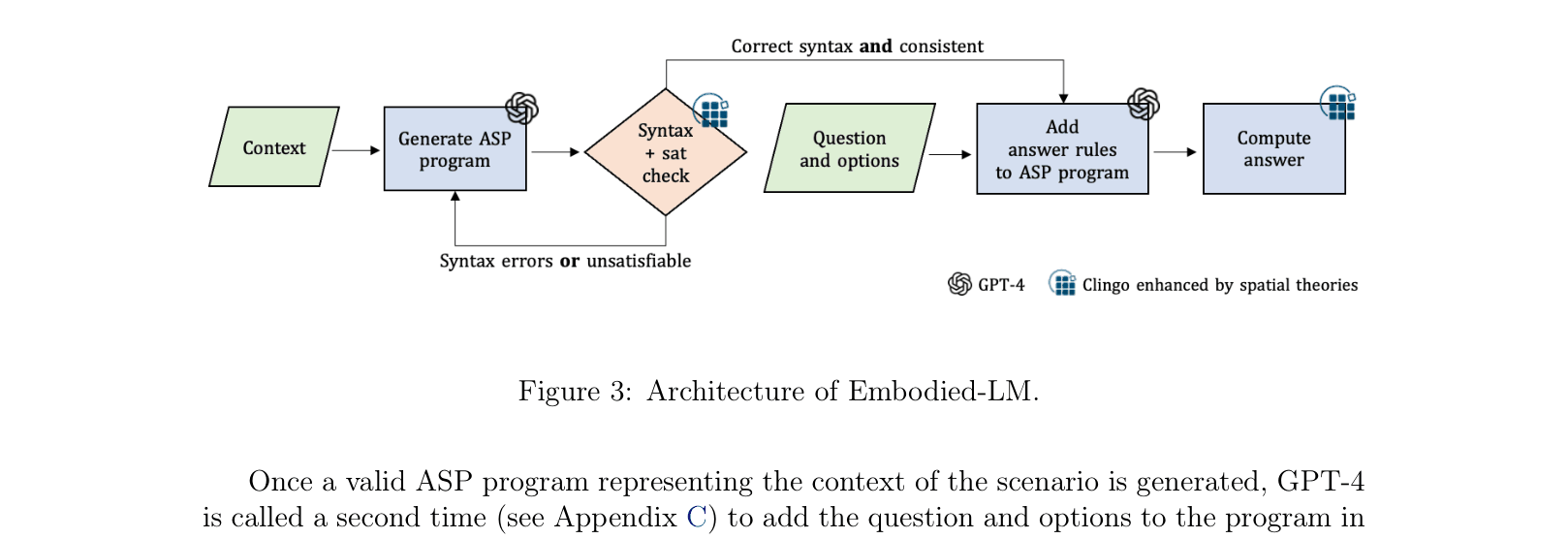
The Embodied-LM pipeline transforming natural language into executable spatial logic
Evaluation Highlights
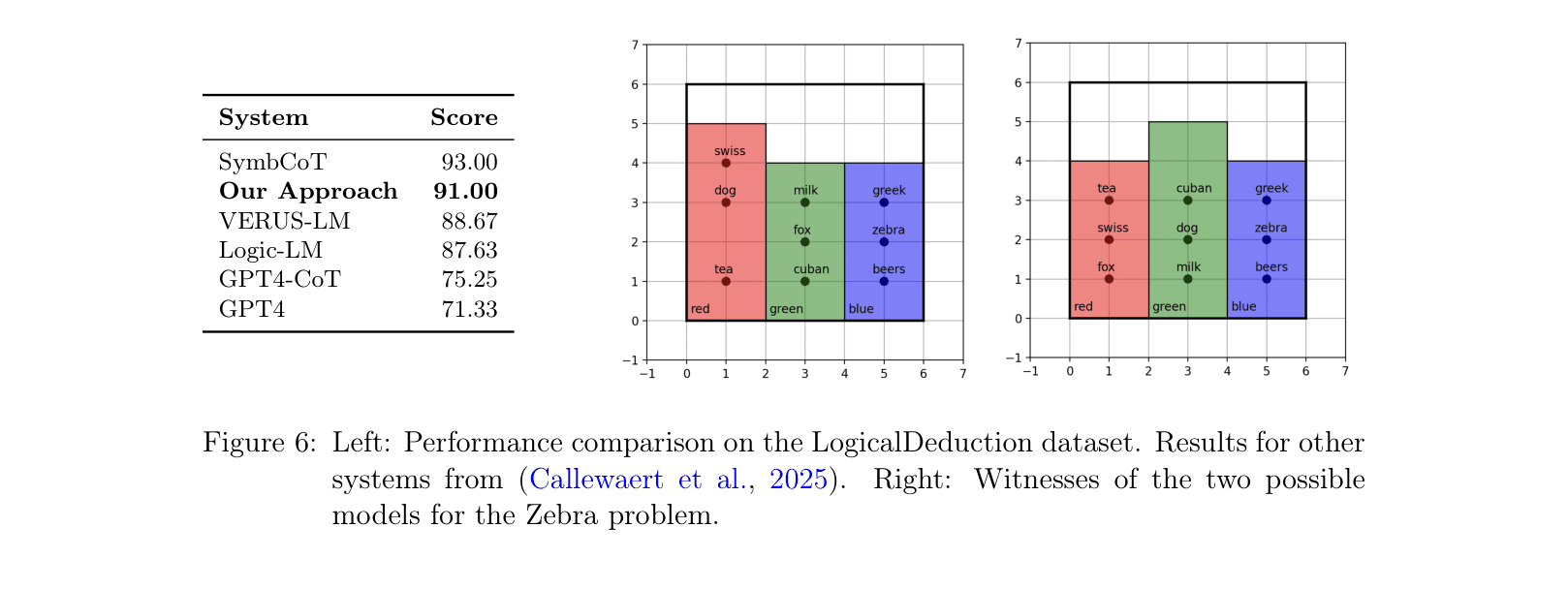
- 91.00% accuracy on the LogicalDeduction dataset, outperforming GPT-4 Chain-of-Thought (75.25%) and Logic-LM (87.63%)
- Demonstrates capability to solve complex constraints (Zebra Puzzles) by mapping diverse relationships (ownership, attributes) to the CONTAINER image schema
- Provides executable witnesses (visualizations of spatial configurations) for answers, enhancing interpretability compared to black-box LLMs
Breakthrough Assessment
7/10
Strong proof-of-concept connecting cognitive science (image schemas) with neurosymbolic execution. Achieves competitive performance with high interpretability, though currently limited to specific spatial primitives.