📝 Paper Summary
Mechanistic Interpretability
Reasoning Dynamics
Representation Geometry
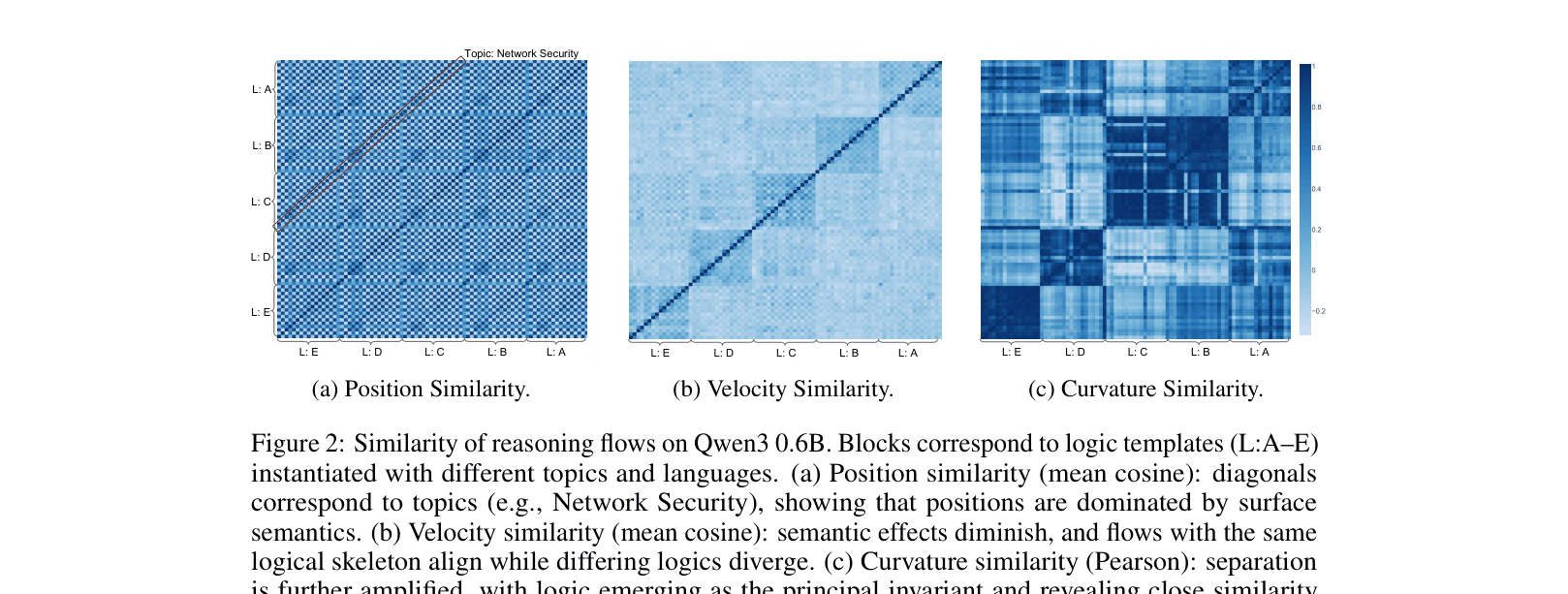
The paper models LLM reasoning as continuous geometric flows where logical structure acts as a differential controller governing the velocity and curvature of semantic trajectories, independent of surface content.
Core Problem
Current interpretations of LLMs often view reasoning as discrete token generation or random graph walks, failing to explain how models internalize deep logical structure independent of surface semantics.
Why it matters:
- Challenging the 'stochastic parrot' view is essential to determine if LLMs genuinely understand logic or merely mimic surface forms
- Lack of rigorous geometric frameworks limits our ability to quantify, steer, and ensure the safety of reasoning processes in latent space
- Understanding the distinction between semantic content (position) and logical structure (velocity/curvature) is critical for robust interpretability
Concrete Example:
A logical deduction (e.g., Modus Ponens) applied to 'weather' vs. 'sports' produces completely different raw embeddings. Using only position similarity suggests they are unrelated, missing the shared underlying logical 'movement' that a geometric flow analysis reveals.
Key Novelty
Reasoning Flow Framework
- Models reasoning as a cumulative trajectory (flow) on a concept manifold, where local velocity and curvature are dictated by logical rules rather than semantic topics
- Proposes that logic functions as a 'steering wheel' (differential constraint) that determines the turning and speed of the reasoning path, while semantic content determines the location
Architecture
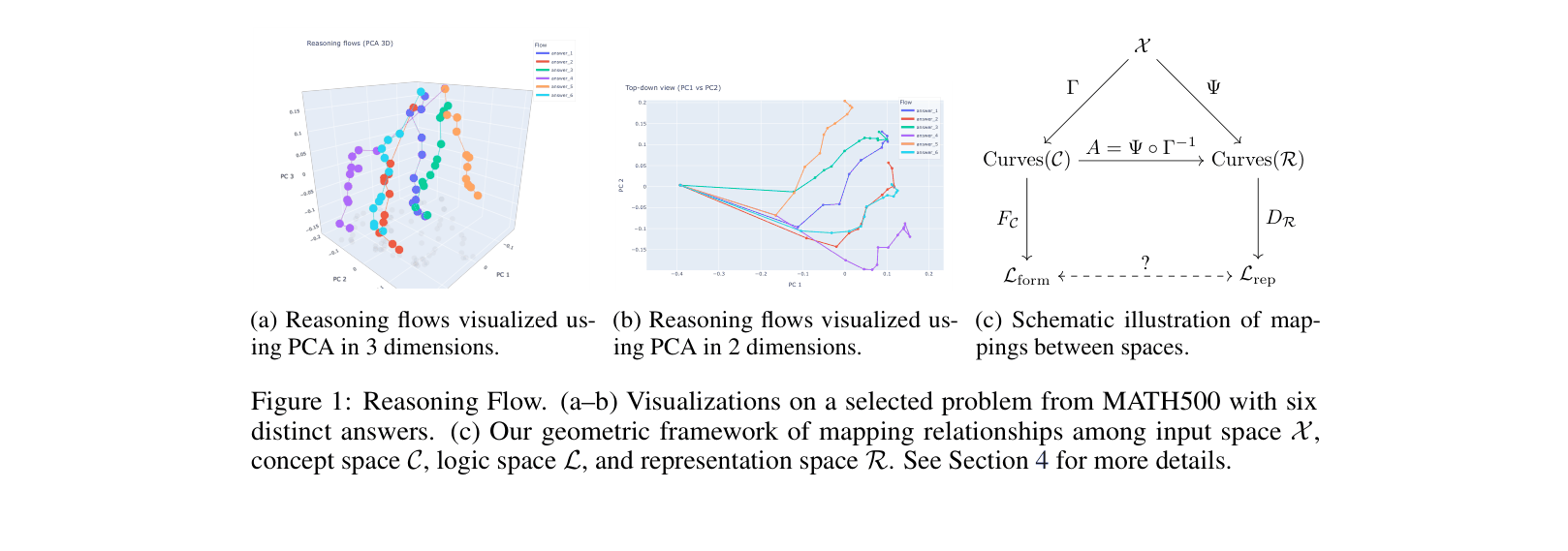
Schematic of the mapping relationships between Input Space X, Concept Space C, Logic Space L, and Representation Space R.
Evaluation Highlights
- Logic similarity in Qwen3-0.6B increases from 0.26 (position) to 0.53 (curvature), showing logic is encoded in higher-order geometry
- Random shuffling of logical steps collapses curvature similarity to 0.02, proving the trajectory's order is structurally significant
- Consistent geometric patterns observed across model families (Qwen, LLaMA) and scales (0.5B to 8B), suggesting a universal representational law
Breakthrough Assessment
8/10
Offers a strong theoretical formalization of reasoning as geometry, backed by empirical evidence that successfully disentangles logic from semantics. Provides a new lens for interpretability beyond static features.