📝 Paper Summary
Multi-Agent Systems (MAS)
Agent Collaboration Topology
OFA-MAS is a universal graph generative framework that designs adaptive Multi-Agent System topologies for any task domain using a single model, replacing domain-specific specialized designers.
Core Problem
Existing MAS topology design methods follow a 'one-for-one' paradigm, training specialized models for specific domains, which fails to generalize to unseen cross-domain queries and cannot leverage shared structural patterns.
Why it matters:
- Real-world web services (e.g., search engines) face queries from unpredictable domains, making domain-specific models impractical to deploy
- Training separate models for every new task creates an intractable maintenance burden and prohibitive scalability costs
- Isolated models fail to learn abstract, reusable collaboration patterns (e.g., 'Analyst → Solver' flows) that exist across different disciplines like math and coding
Concrete Example:
A mathematical theorem proving task and a software debugging task often share a similar collaboration pattern (e.g., 'Analyst → Inspector → Solver'). A specialized model trained only on math cannot transfer this structural knowledge to debugging, while separate models for each require redundant training.
Key Novelty
Universal 'One-for-All' MAS Topology Designer
- Reframes topology design as an autoregressive graph generation problem where a single model constructs agent roles and connections step-by-step based on task semantics
- Uses a Mixture-of-Experts (MoE) architecture to dynamically route generation decisions to specialized sub-networks, allowing one model to adapt its 'design strategy' for diverse task types
- Employs a three-stage training curriculum (unconditional priors → LLM-synthesized mapping → empirical fine-tuning) to build cross-domain capability without catastrophic forgetting
Architecture
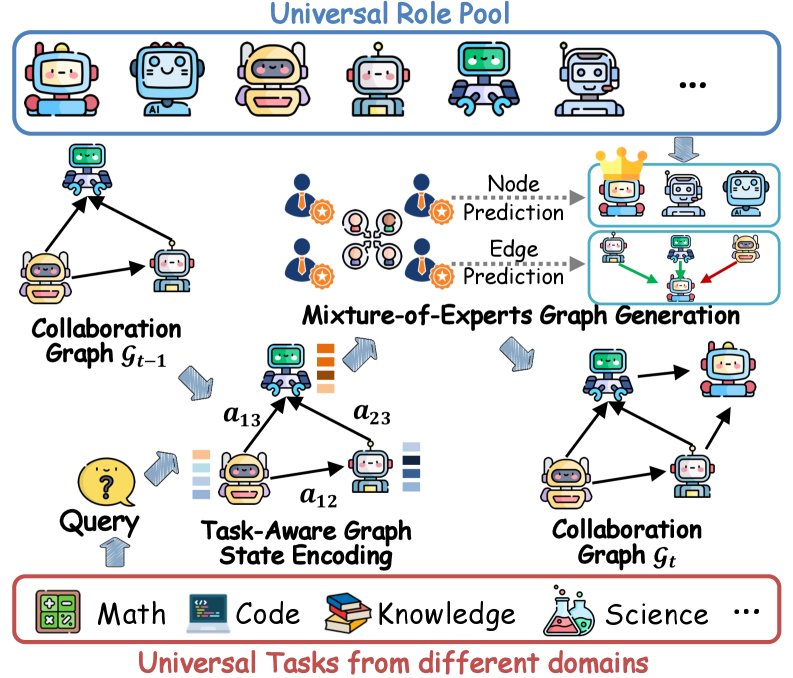
The architecture of the OFA-MAS framework, highlighting the Task-Aware Graph State Encoder (TAGSE) and the Mixture-of-Experts (MoE) generation module.
Breakthrough Assessment
8/10
Pioneers the shift from 'one-for-one' to 'one-for-all' in MAS design. The combination of MoE for structural adaptability and a synthesized training curriculum addresses key scalability hurdles in agentic systems.