📊 Experiments & Results
Evaluation Setup
Predicting user responses to multiple-choice opinion questions
Benchmarks:
- OpinionQA (Opinion Prediction / Alignmnent)
Metrics:
- Prediction Accuracy (Macro average of individual prediction accuracy)
- Statistical methodology: Not explicitly reported in the paper
Key Results
| Benchmark | Metric | Baseline | This Paper | Δ |
|---|---|---|---|---|
| Cluster Analysis demonstrates that data-driven personas capture strong, distinct viewpoints that diverge from the general population. | ||||
| OpinionQA | Disagreement with population (Question: Democratic party representation) | 18.21 | 88.05 | +69.84 |
| OpinionQA | Disagreement with population (Question: Government benefits vs Inequality) | 25.00 | 100.00 | +75.00 |
| OpinionQA | Disagreement with population (Question: Guns vs Gun Violence) | 46.00 | 0.00 | -46.00 |
Experiment Figures
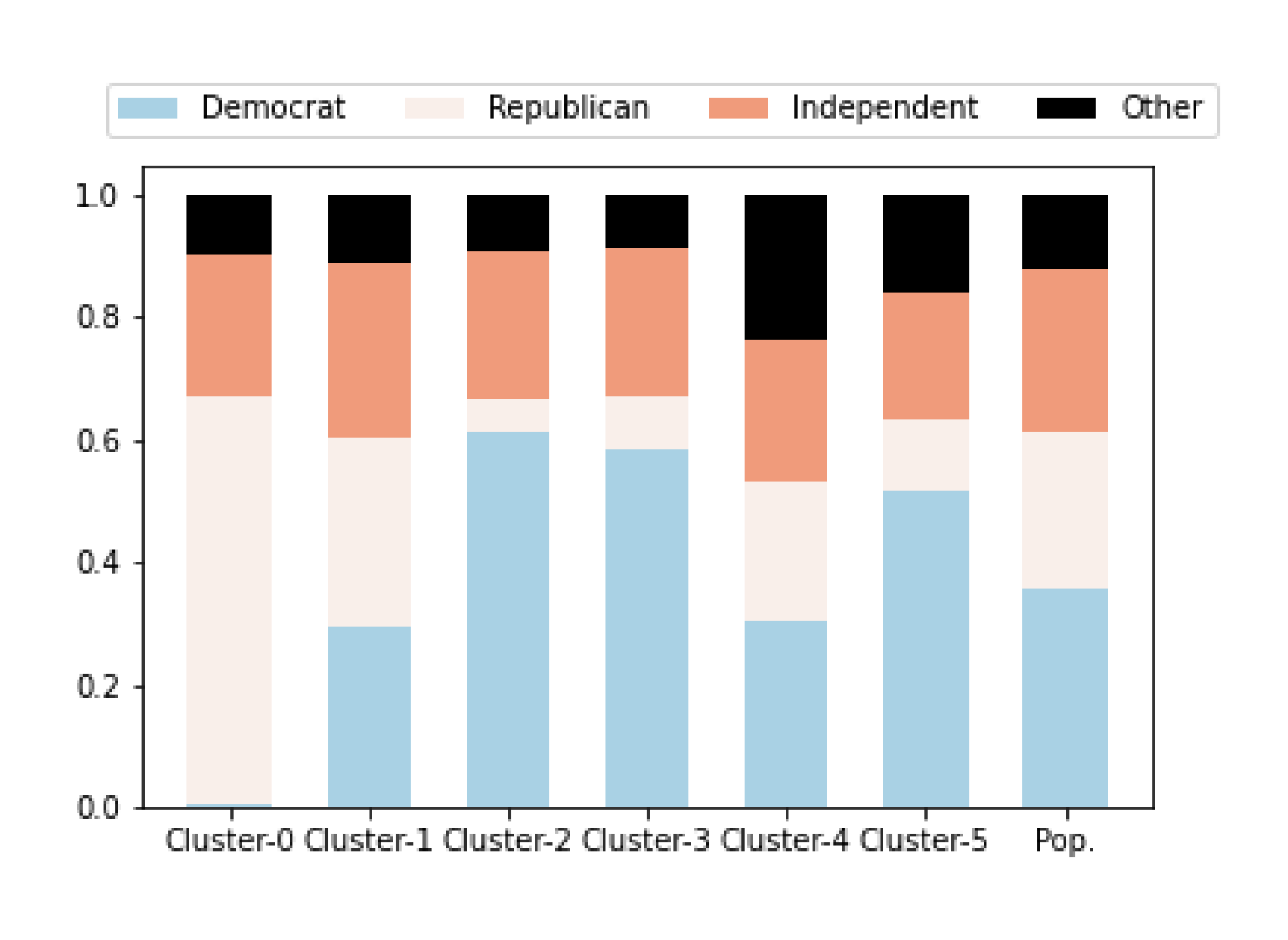
Demographic composition (Party, Race, Education) of the 6 identified cluster personas.
Main Takeaways
- Data-driven personas outperform demographic-based and context-based baselines by 57%-77% in prediction accuracy, showing that latent embeddings capture opinion capability better than explicit traits.
- The method discovers 'cluster personas' that are demographically mixed (e.g., Republicans with different education levels) but opinion-aligned, validating the need for data-driven grouping over demographic buckets.
- The approach is efficient: a single Soft-Prompting Model (SPM) is trained to handle all personas, rather than fine-tuning separate models for each group.