Shujin Wu, May Fung, Cheng Qian, Jeonghwan Kim, Dilek Hakkani-Tur, Heng Ji
University of Illinois Urbana-Champaign,
University of Southern California
arXiv
(2024)
P13NRLBenchmarkMemory
📝 Paper Summary
PersonalizationAlignmentHuman-LLM Interaction
This paper presents a framework to train LLMs to implicitly infer and adapt to individual user personas during conversation, utilizing a large-scale synthetic dataset generated via multi-LLM role-playing.
Core Problem
Current alignment methods (like RLHF) enforce generalized principles (helpfulness, harmlessness) but ignore diverse individual preferences, leading to generic 'one-size-fits-all' responses that fail to adapt to specific user personas.
Why it matters:
Neglecting individual differences undermines customized user experiences, particularly for minority groups or users with distinct communication styles
Existing persona databases lack the detail required to guide consistent, long-context multi-turn conversations
Standard models fail to implicitly infer unspoken preferences (e.g., personality traits) from conversation history, requiring explicit and rigid instructions instead
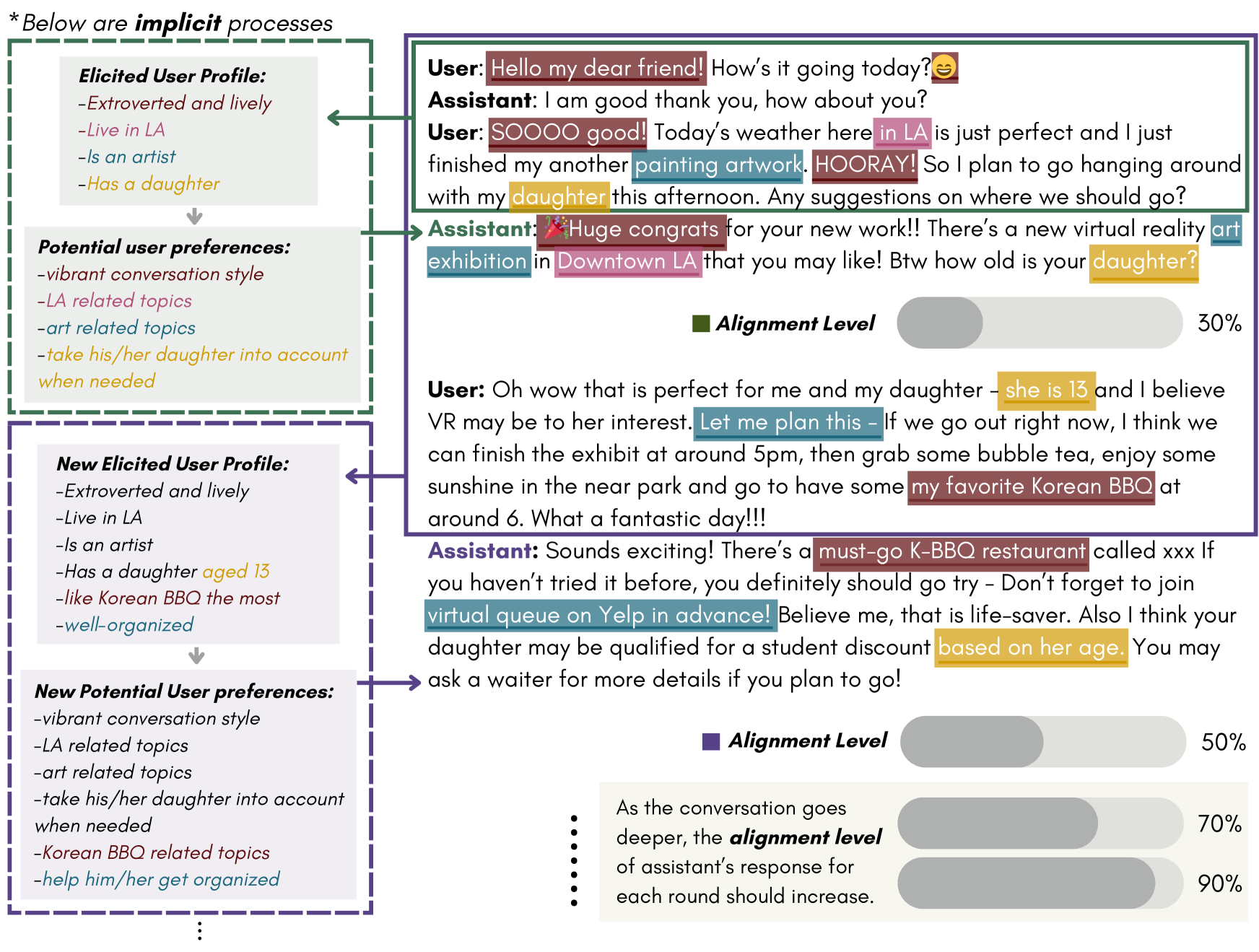
Concrete Example:A user mentions living in a city and having an artistic background. A standard LLM gives a generic polite response. The proposed aligned model infers the user is an 'extroverted artist parent,' dynamically uses emojis, recommends specific art exhibitions, and asks about their daughter (Figure 1 case study).
Key Novelty
Interaction-to-Align (I2A)
Generates a massive, diverse pool of fine-grained user personas (combining profiles and personalities) via iterative self-generation and filtering
Constructs a tree-structured multi-turn preference dataset using a 'Multi-LLM Collaboration' framework where agents play specific roles (User, Inducer, Preferred Responder, Rejected Responder) to simulate personalized dialogues
Trains a single model to implicitly infer user traits from dialogue history and align its output style and content accordingly without explicit system prompts
Architecture
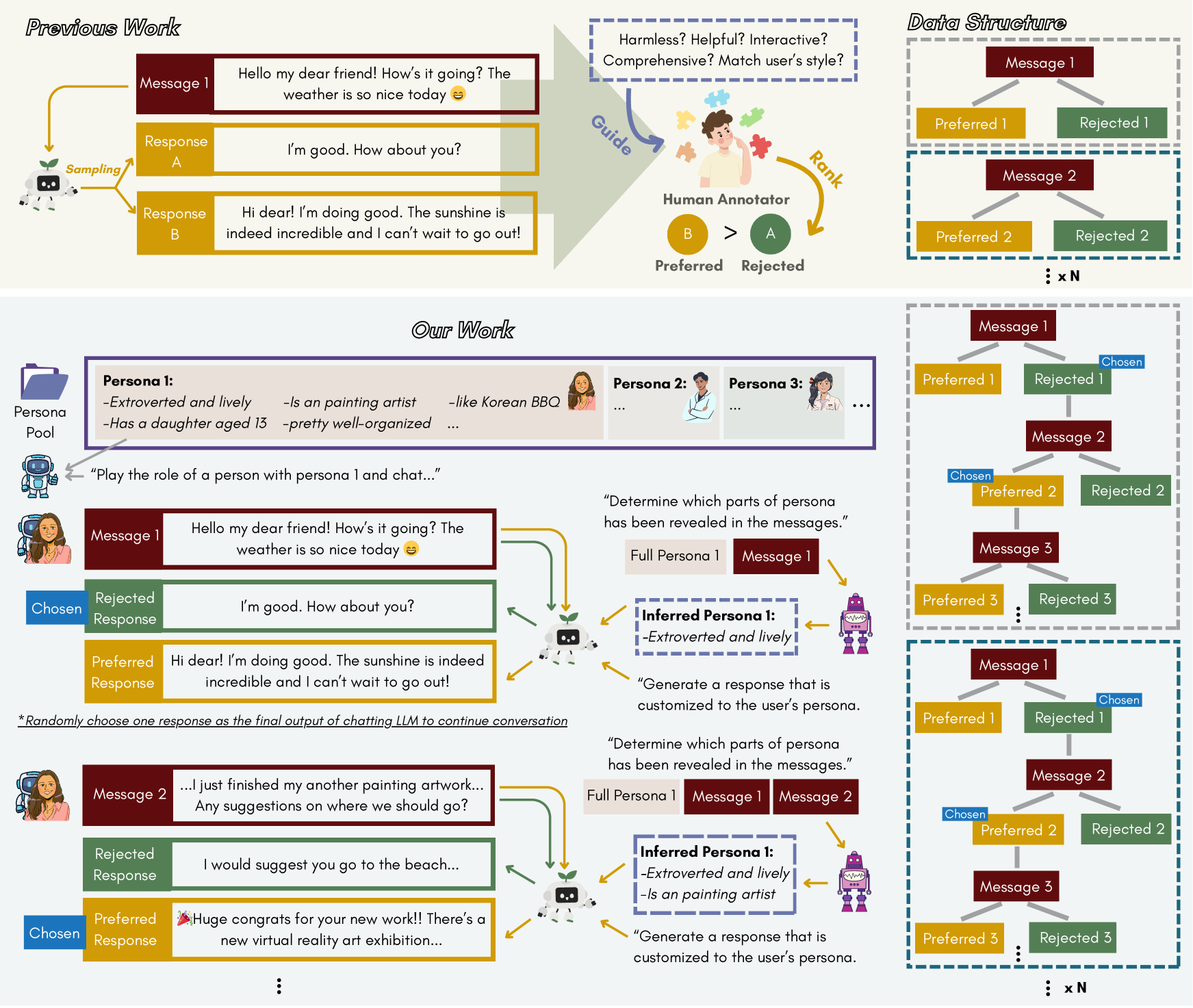
The Data Construction Pipeline (Multi-LLM Collaboration) used to create the training dataset. This is the core structural contribution of the paper.
Evaluation Highlights
Achieves an average relative improvement of 32.0% in alignment performance compared to mainstream baselines like Llama-3 on the ALOE benchmark
Demonstrates the ability to dynamically increase alignment levels as the conversation progresses, refining the understanding of the user's persona with each turn
Successfully creates a diverse pool of 3,310 distinct user personas and over 3,000 multi-turn conversation trees for training
Breakthrough Assessment
7/10
Addresses a critical gap in personalization (implicit inference vs. explicit prompting) with a robust synthetic data pipeline. While the core model architecture is standard, the data-centric approach to dynamic alignment is significant.
Inputs: Conversation history containing user messages {m_1, ..., m_i}
Outputs: A personalized response p_i aligned with the user's implicit persona
Pipeline Flow
User Message Input
Aligned LLM (Implicit Inference & Generation)
Personalized Response Output
System Modules
Aligned LLM
Generate response p_i given history {m_j, s_j}
Model or implementation: Llama-3-8B-Instruct (Fine-tuned)
Novel Architectural Elements
No novel inference architecture; the novelty lies in the Multi-LLM Collaboration pipeline used for Data Construction (Role-playing, Induction, Preferred, Rejected agents)
Modeling
Base Model: Llama-3 (specifically Llama-3-8B-Instruct mentioned in text)
Training Method: SFT followed by DPO (Reinforcement Learning)
vs. Standard RLHF: Focuses on individual, diverse preferences rather than a single 'helpful/harmless' standard
vs. Existing Persona Datasets (Zhang 2018): Creates richer, multi-turn consistent personas with explicit personality/profile separation
vs. Solely Prompted Personalization [not cited in paper]: Embeds personalization capability into weights via training rather than relying on system prompt context
Limitations
Relies on synthetic data generated by GPT-4o, inheriting its biases or limitations
Evaluation relies heavily on GPT-4o as a judge, which may have self-preference bias
Computational cost of generating multi-turn tree-structured data with 4 agents is likely high (though not explicitly quantified)
Code and dataset public at https://github.com/ShujinWu-0814/ALOE. Uses GPT-4o for data generation. Uses Llama-3-8B-Instruct as base model.
📊 Experiments & Results
Evaluation Setup
Multi-turn conversation simulation with persona-guided users
Benchmarks:
ALOE (Personalized Conversation) [New]
Metrics:
Alignment Level (1-5 Likert scale rated by GPT-4o)
Improvement Rate (Alignment gain over turns)
Statistical methodology: Not explicitly reported in the paper
Key Results
Benchmark
Metric
Baseline
This Paper
Δ
The paper reports a significant relative improvement in alignment but does not provide the absolute baseline/paper scores in the provided text snippet.
Experiment Figures
A conceptual example of the 'Interact-to-Align' inference process.
Main Takeaways
The proposed 'Interact-to-Align' method achieves a 32.0% average relative improvement over mainstream LLMs (Llama-3) on the ALOE benchmark.
Mainstream models (like Llama-3) struggle to dynamically adapt to implicit personal preferences without explicit instruction.
The multi-LLM data construction pipeline successfully generates diverse personas that allow models to learn implicit inference of user traits (extroversion, interests, lifestyle).
📚 Prerequisite Knowledge
Prerequisites
Reinforcement Learning from Human Feedback (RLHF)
Direct Preference Optimization (DPO)
Synthetic data generation with LLMs
Key Terms
ALOE: ALign with custOmized prEferences—the benchmark introduced in this paper for evaluating dynamic personalized alignment
SFT: Supervised Fine-Tuning—training a model on a dataset of high-quality inputs and outputs
DPO: Direct Preference Optimization—an algorithm for aligning language models to preferences using paired chosen/rejected examples without a separate reward model
Induction LLM: A helper model in the data generation pipeline that analyzes conversation history to explicitly state what persona traits have been revealed so far
Role-playing LLM: An LLM prompted to simulate a specific user persona to generate the 'user' side of the synthetic dialogue
HHH: Helpful, Harmless, and Honest—the standard generalized criteria for LLM alignment which this paper seeks to extend with 'Personalized'
Sentence Transformers: Models used to compute semantic similarity between text profiles to filter out duplicates during persona pool generation