📝 Paper Summary
Agentic Recommender Systems
LLM-based User Simulation
Collaborative Filtering with LLMs
AgentCF treats both users and items as autonomous agents that collaboratively refine their text-based memories through interaction and reflection to capture collaborative filtering patterns.
Core Problem
LLMs rely on semantic knowledge and struggle to capture behavioral collaborative filtering patterns (e.g., users who buy X also buy Y) when used directly for recommendation.
Why it matters:
- Existing LLM-based agents focus primarily on user simulation, ignoring the crucial role of item-side modeling in recommender systems
- The gap between universal language modeling and personalized behavior modeling limits the effectiveness of LLMs in capturing user-item relational data
Concrete Example:
Shoppers who buy diapers often buy beer. While this is a strong behavioral pattern captured by collaborative filtering, it confuses LLMs because diapers and beer are semantically unrelated.
Key Novelty
Agent-based Collaborative Filtering
- Models items as active agents with memory alongside user agents, enabling the simulation of two-sided interactions rather than just user behavior
- Introduces 'Collaborative Reflection' where agents update their text memories based on the discrepancy between their autonomous choices and real-world ground truth
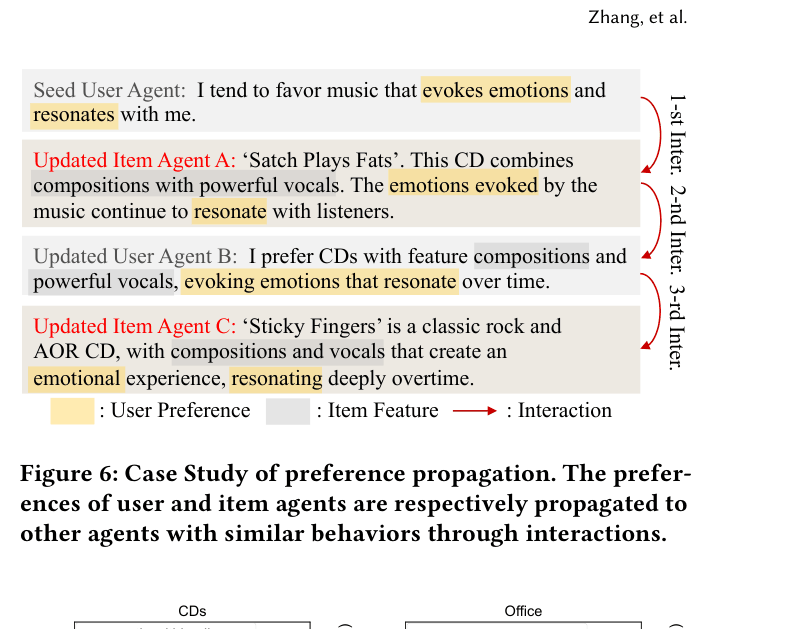
- Establishes preference propagation: item agents store adopter preferences in memory and pass this information to future users during interactions
Architecture
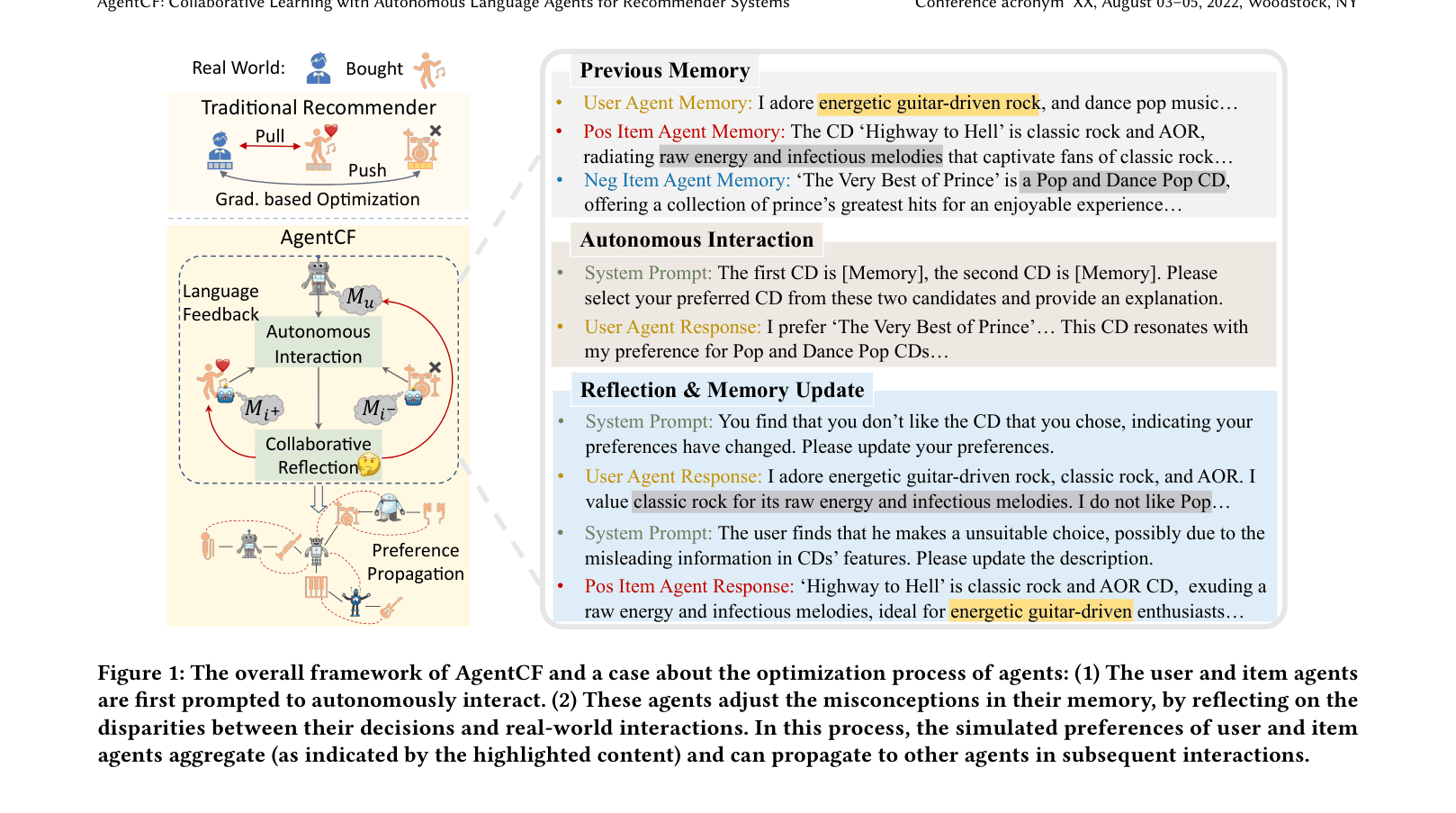
The overall AgentCF framework showing the cycle of autonomous interaction, collaborative reflection, and memory update.
Evaluation Highlights
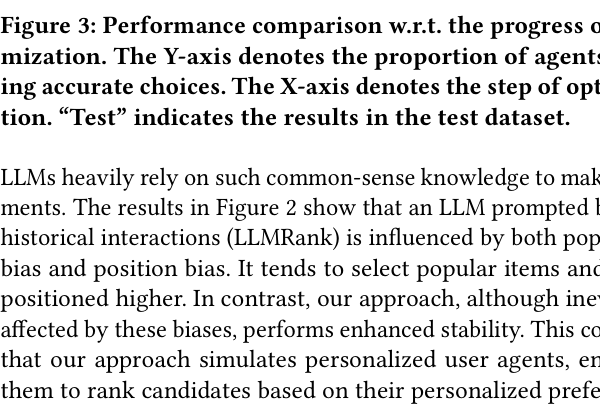
- Outperforms LLMRank (zero-shot LLM recommender) by +7.7% on CDs Dense dataset (NDCG@10), showing the benefit of memory optimization
- Achieves parity with or exceeds traditional supervised models (BPR, SASRec) trained on sampled datasets (e.g., +13.9% vs SASRec sample on CDs Dense NDCG@10)
- Ablation studies confirm removing Item Agents degrades performance by ~3.7% on CDs Dense, validating the importance of item-side modeling
Breakthrough Assessment
7/10
Novel conceptualization of items as active agents with memory to bridge the gap between LLM semantics and collaborative filtering. Strong performance against zero-shot baselines, though dependent on small sampled datasets due to API costs.