📝 Paper Summary
Multi-Agent Systems
Agent Coordination
DRF improves multi-agent task performance by using an interactive rating network and a reputation scoring mechanism to dynamically select high-quality agents and filter out malicious or underperforming ones.
Core Problem
Existing multi-agent systems rely on static, predefined roles and lack mechanisms to assess agent credibility, making them vulnerable to malicious interference (e.g., prompt injection) and performance variability.
Why it matters:
- Predefined role allocation (e.g., 'software engineer') relies heavily on human expertise and cannot adapt to unknown task requirements.
- Blind trust in agents enables malicious or compromised agents to derail tasks, as current frameworks lack capability differentiation.
- Without reputation tracking, systems cannot distinguish between a temporarily unlucky agent and a consistently incompetent or adversarial one.
Concrete Example:
A team might assign a critical coding task to an agent designated as a 'software engineer'. If this agent is compromised by a malicious prompt injection, it will output harmful code. A static framework continues to trust it based on its role, whereas a reputation-based system would detect the low-quality output and stop selecting it.
Key Novelty
Reputation-Aware Dynamic Agent Selection
- Constructs an interactive rating network where agents act as peer reviewers, scoring each other's solutions during task execution to quantify performance dynamically.
- Implements a 'credit score' system (reputation) that persists across rounds; good performance increases reputation, while bad performance causes it to decay.
- Uses an Upper Confidence Bound (UCB) algorithm to select agents, balancing the exploitation of known high-performers with the exploration of potentially better, untested agents.
Architecture
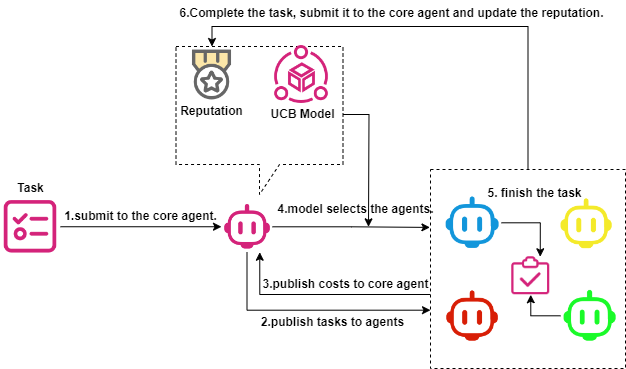
System model of the DRF framework.
Breakthrough Assessment
7/10
Addresses a critical reliability gap in multi-agent systems by introducing formal reputation modeling and bandit-based selection, moving beyond static role assignments.