MixLM accelerates LLM-based ranking by compressing long item descriptions into compact embeddings that are cached and mixed with query text, reducing inference costs while maintaining relevance.
Core Problem
Cross-encoder LLM rankers require processing long prompts containing both user queries and full item descriptions, leading to high computational costs and latency due to quadratic attention and prefill bottlenecks.
Why it matters:
Industrial search systems have strict latency and throughput constraints that often prevent the deployment of powerful full-text LLM rankers.
Existing solutions either sacrifice semantic depth by using smaller models or lose information by truncating inputs.
High prefill costs limit the number of candidates that can be reranked in real-time.
Concrete Example:A standard ranker prompt might contain thousands of tokens for a job description. For every query, the LLM must re-process these tokens, causing massive redundant computation. MixLM replaces the 2000+ token description with a single embedding token, drastically shortening the input.
Key Novelty
Text-Embedding Mix-Interaction
Decouples the ranker's input into dynamic text (query) and static embeddings (items).
Compresses item text into a few learned embedding tokens offline using an encoder LLM, then stores them in a cache.
At inference, the ranker LLM processes a mixed prompt containing the natural language query and the retrieved item embeddings, bypassing the need to process the full item text.
Architecture
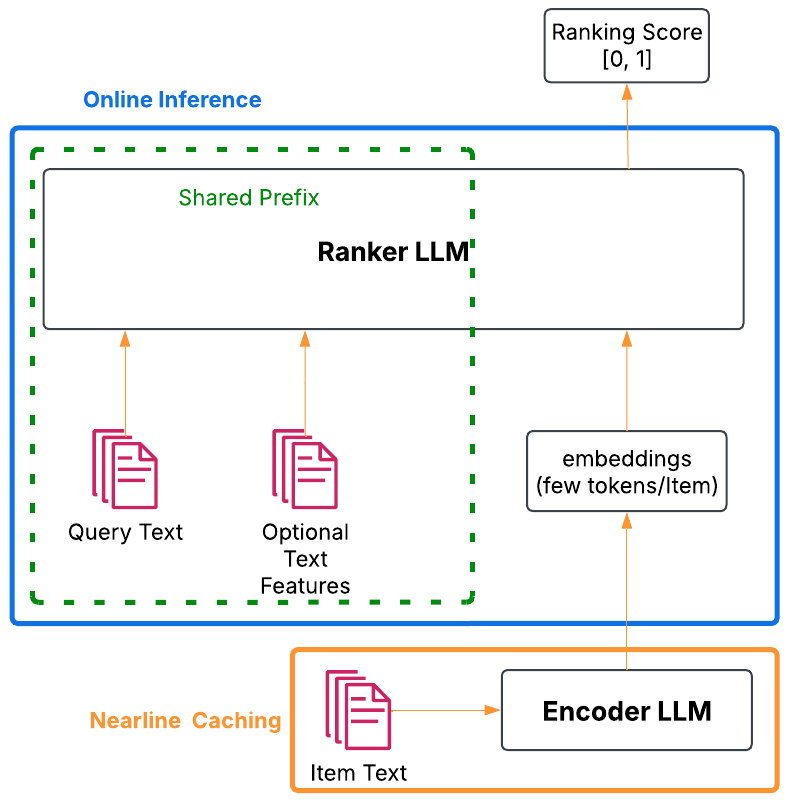
Overview of the MixLM architecture showing the split between offline encoding and online ranking.
Evaluation Highlights
Improves serving throughput by 75.9× compared to a full-text LLM ranker baseline under a fixed latency budget.
Achieves 10.0× higher throughput compared to a summarized-text LLM ranking baseline.
Deployment in LinkedIn's Job Search resulted in a +0.47% increase in Daily Active Users (DAU) in online A/B testing.
Breakthrough Assessment
8/10
Significant practical breakthrough for industrial LLM deployment. It successfully bridges the gap between the semantic power of cross-encoders and the efficiency of representation-based methods, proven by large-scale production gains.
⚙️ Technical Details
Problem Definition
Setting: Pointwise relevance ranking where a model predicts a relevance score given a query q and candidate item j.
Inputs: User query q (text) and candidate item j (text)
Outputs: Relevance probability p_yes
Pipeline Flow
Encoder LLM (Offline): Item Text -> Item Embeddings
Model or implementation: 0.6B parameter model (initialized from GTE)
Nearline Cache
Stores precomputed item embeddings to avoid online re-encoding.
Model or implementation: Key-Value Store
Ranker LLM
Predicts relevance by attending to both query text and item embeddings.
Model or implementation: 0.6B parameter model (custom architecture accepting mixed inputs)
Novel Architectural Elements
Mixed-input interface allowing the Ranker LLM to ingest raw embeddings directly into its transformer layers alongside text embeddings.
End-to-end differentiable pipeline connecting a frozen/cached encoder output to a trainable ranker input.
Modeling
Base Model: 0.6B pretrained model (for both Ranker and Encoder)
Training Method: Three-stage training pipeline: (1) Domain SFT, (2) Teacher Training, (3) Joint Ranker-Encoder Training with Distillation.
Objective Functions:
Purpose: Ensure predicted probabilities match ground truth labels.
Formally: KL divergence between MixLM output and ground truth p*.
Purpose: Distill knowledge from the full-text teacher model.
Formally: KL divergence between MixLM output and Teacher output p^.
Purpose: Align encoder embeddings with ranker's expected input space.
Formally: Cosine similarity between ranker hidden states given full text vs. given embeddings.
Purpose: Align prediction distribution between mixed-input and full-text passes.
Formally: KL divergence between MixLM(embeddings) and MixLM(full_text).
Trainable Parameters: Full joint training of Encoder and Ranker parameters (Theta_R, Theta_E)
Training Data:
180K samples for Stage 1 (Domain Reasoning)
10.9M examples for Stage 2 & 3 (Ranking)
Labels generated by 7B internal relevance judge
Key Hyperparameters:
encoder_sampling_strategy: Last token (T_S=1) used in production
item_text_length_p99: 2100 tokens
Compute: Not reported in the paper
Comparison to Prior Work
vs. Full-text LLM: MixLM moves item encoding offline, reducing online cost by ~76x.
vs. Summarized-text: MixLM uses learned embeddings which retain more semantic signal than discrete text summaries, achieving higher throughput.
vs. ColBERT: ColBERT uses late interaction with multi-vector storage; MixLM integrates compression into the LLM space directly [not cited in paper].
Limitations
Relies on a proprietary 7B teacher model for label generation.
Requires consistent hidden dimensions between Encoder and Ranker (or a projection layer).
Offline encoding means item updates require re-encoding (though cheaper than re-training).
Reproducibility
No code or model weights provided. The system is deployed at LinkedIn. Training data is proprietary user logs. Replication requires implementing the architecture and training pipeline from descriptions.
📊 Experiments & Results
Evaluation Setup
Online A/B testing in LinkedIn Job Search and offline throughput analysis.
Benchmarks:
LinkedIn Job Search (Online) (Relevance Ranking)
Metrics:
Throughput (QPS)
Latency
Daily Active Users (DAU)
Job Applications (Qualified Apply)
Statistical methodology: Not explicitly reported in the paper
Key Results
Benchmark
Metric
Baseline
This Paper
Δ
Serving Infrastructure
Throughput Improvement (vs Full-Text)
1.0
75.9
74.9
Serving Infrastructure
Throughput Improvement (vs Summarized)
1.0
10.0
9.0
LinkedIn Job Search
DAU Lift
0.0
0.47
+0.47
Main Takeaways
Massive throughput gains enable full-traffic deployment of LLM ranking where it was previously cost-prohibitive.
Compression to a single embedding token (T_S=1) is sufficient to preserve relevance signals in this domain.
Distillation from a full-text teacher is crucial for the mixed-modality student to learn effective interactions.
The approach scales efficiently, allowing pre-computation of millions of item embeddings.
📚 Prerequisite Knowledge
Prerequisites
Transformer architecture (Embeddings, Attention)
Cross-encoder vs. Bi-encoder ranking
Knowledge Distillation
LLM Inference (Prefill vs. Decode)
Key Terms
Cross-encoder: A ranking model that processes query and document simultaneously in a single transformer pass, allowing full attention interaction but incurring high cost.
Prefill: The initial phase of LLM inference where the prompt is processed to generate KV cache; often the bottleneck for long inputs.
GTE: General Text Embedding—a family of models trained to generate dense vector representations of text.
NDCG@10: Normalized Discounted Cumulative Gain at rank 10—a measure of ranking quality that accounts for the position of relevant items.
Distillation: Training a smaller or more efficient 'student' model to mimic the outputs or internal states of a larger 'teacher' model.
DAU: Daily Active Users—a key metric for user engagement in online services.