📝 Paper Summary
Cross-Domain Sequential Recommendation (CDSR)
LLM-based Recommendation
URLLM improves cross-domain recommendations by aligning collaborative graph data with semantic text and retrieving similar users to guide a Large Language Model, reducing out-of-domain hallucinations.
Core Problem
Existing methods fail to simultaneously capture collaborative structure and semantic item information, while LLMs often hallucinate items outside the target domain due to a lack of domain constraints.
Why it matters:
- Traditional CDSR models suffer from cold-start issues by overlooking valuable semantic text buried in item features
- LLMs applied to recommendation struggle to integrate structured collaborative history seamlessly
- Uncontrollable LLM generation leads to 2% to 20% of recommendations belonging to the wrong domain, undermining system reliability
Concrete Example:
In a movie-to-game recommendation scenario, a standard LLM might suggest a movie sequel instead of a game, or a game that doesn't exist, because it relies on common knowledge rather than specific domain constraints and user interaction history.
Key Novelty
User Retrieval and Domain Grounding on LLM (URLLM)
- Dual-Graph modeling that aligns item-attribute graphs (semantic) with item-item sequence graphs (collaborative) to feed structured info into the LLM
- A user retrieval paradigm that fetches similar users (via KNN) to serve as in-context demonstrations for the LLM, bridging collaborative filtering with language generation
- Domain-specific refinement strategies to force the LLM to generate items strictly within the target domain
Architecture
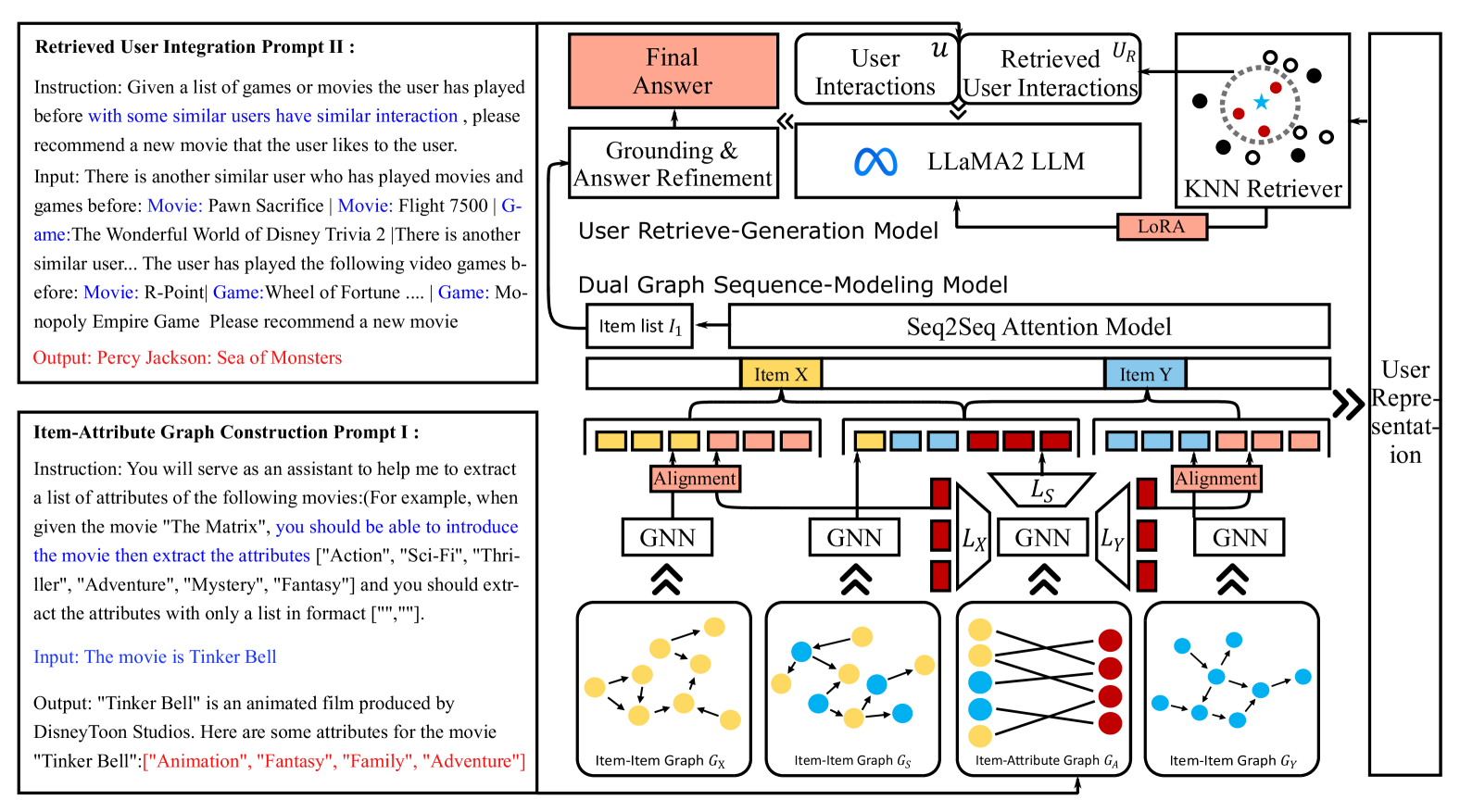
The URLLM framework architecture, detailing the Dual Graph Sequence-Modeling Model and the User Retrieve-Generation Model.
Evaluation Highlights
- Demonstrates effective information integration on Amazon datasets (Movie-Game and Art-Office)
- Identifies positive correlation between the hit rate of retrieved users and overall model performance
- Mitigates the issue where 2% to 20% of generated content belongs to other domains [baseline failure rate reported in motivation]
Breakthrough Assessment
7/10
Novel integration of retrieval-augmented generation specifically for the cross-domain recommendation cold-start problem, addressing the specific hallucination issues of LLMs in this context.