📝 Paper Summary
Conversational Recommender Systems (CRS)
Dialogue Management
LLM-based User Simulation
RecLLM is a roadmap and architecture for building a large-scale conversational recommender system using LLMs for unified dialogue management, tractable retrieval, and joint ranking-explanation, validated on the YouTube corpus.
Core Problem
Traditional recommender systems rely on implicit signals (clicks) and lack transparency/control, while existing conversational recommenders often struggle with large-scale corpora, groundedness, and lack of training data.
Why it matters:
- Current large-scale recommenders often surface clickbait or bias due to reliance on implicit signals rather than explicit user intent
- LLMs hallucinate and struggle to interface efficiently with industrial-scale item corpora (millions of items) without massive memorization
- The lack of production CRS products creates a 'cold start' data problem: there are no logs to train sophisticated models
Concrete Example:
A user asks for 'videos about fish recipes'. A standard chatbot might hallucinate non-existent video titles. A direct-prediction LLM cannot memorize millions of changing YouTube videos. RecLLM solves this by having the LLM generate a search query (API call) to a retrieval engine, then explaining the results.
Key Novelty
RecLLM (End-to-End LLM-based CRS Architecture)
- Replaces modular dialogue state tracking with a unified LLM that outputs both natural language and API calls (e.g., 'Request: <query>') as a single language modeling task
- Proposes a joint ranking/explanation module where an LLM scores items based on metadata summaries and context, generating natural language justifications via chain-of-thought
- Introduces a controllable user simulator conditioned on session-level variables (profiles) or turn-level variables (intents) to generate synthetic training data for the CRS
Architecture
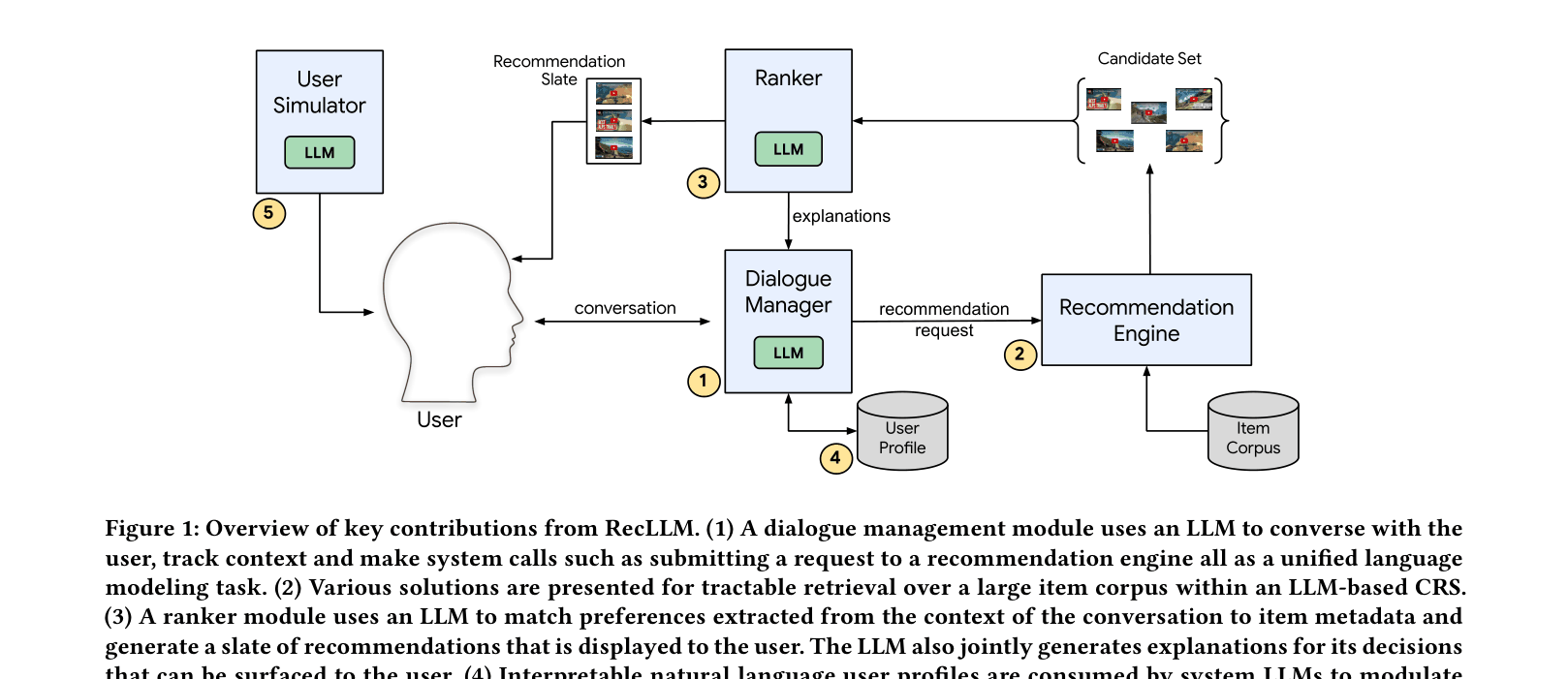
Overview of the RecLLM system components and their interaction
Evaluation Highlights
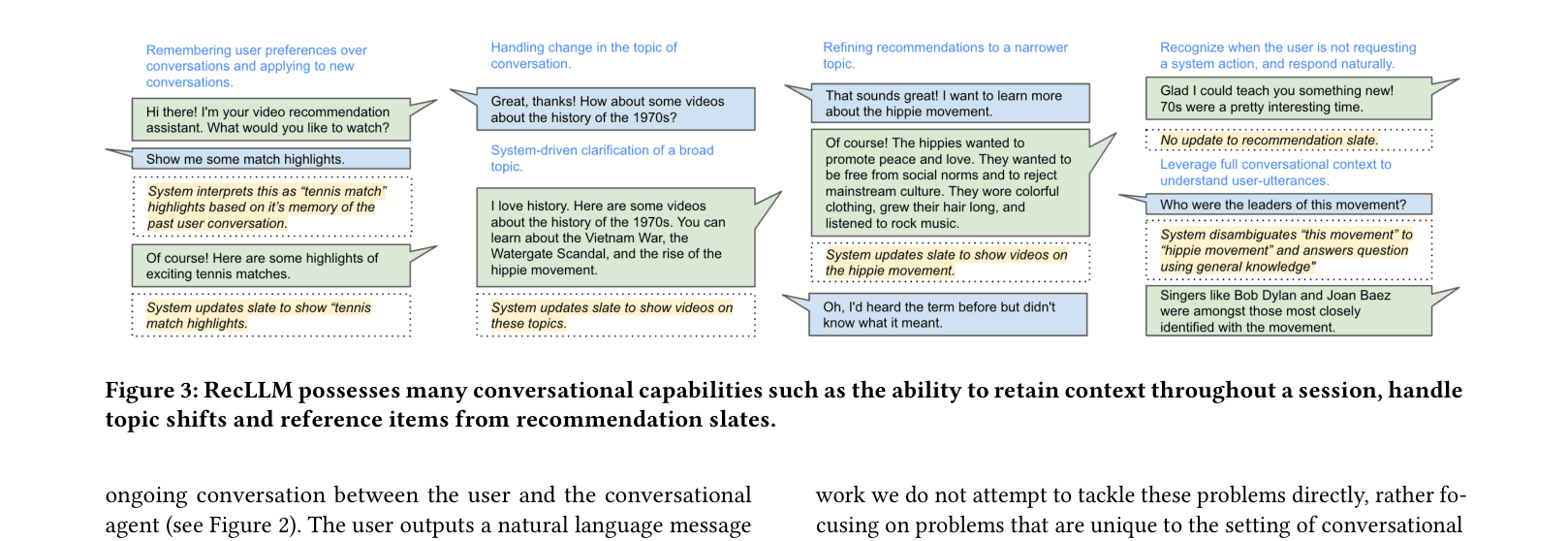
- Demonstrates qualitative fluency in maintaining context across topic shifts (e.g., switching from 90s hip hop to 80s rock) in mock conversations
- Proof-of-concept implementation on the full public YouTube video corpus using LaMDA-based models
- Proposes a Reinforcement Learning from Human Feedback (RLHF) strategy for tuning the dialogue manager using simulated sessions
Breakthrough Assessment
5/10
This is primarily a position paper and roadmap ('proof of concept') rather than a rigorous empirical study. It proposes an architecture and demonstrates feasibility but lacks quantitative benchmarking against SOTA baselines.