Explainable RecommendationLLM-based User Simulation
HF4Rec replaces sparse human feedback with LLM-simulated rewards to optimize recommendation explanations via reinforcement learning, using Pareto optimization to balance conflicting qualities like informativeness and persuasiveness.
Core Problem
Traditional explainable recommendation relies on supervised learning that blindly mimics ground truth reviews, failing to identify potentially superior generated explanations due to data sparsity and lack of human feedback.
Real-time human feedback for training is prohibitively expensive and slow
Evaluation criteria for explanations are multi-faceted (e.g., persuasiveness vs. informativeness) and often contradictory, making simple optimization difficult
Concrete Example:A user buys a skincare product ($v_2$). The ground truth review is generic: 'It feels nice on my skin'. If the model generates a more detailed explanation like 'My skin feels softer and smooth as it absorbs quickly', supervised learning penalizes it for not matching the target text, even though it is more informative and persuasive.
Key Novelty
Human-Like Feedback-Driven Optimization (HF4Rec)
Uses Large Language Models as 'Human Simulators' to generate reward scores for explanations, effectively creating synthetic feedback for unobserved user-item pairs
Employs a retrieval-augmented prompting strategy to extract user interests from noisy history and induce personalized scoring criteria
Transforms the multi-perspective quality enhancement (balancing informativeness vs. persuasiveness) into a dynamic Pareto optimization problem to improve all objectives simultaneously
Architecture
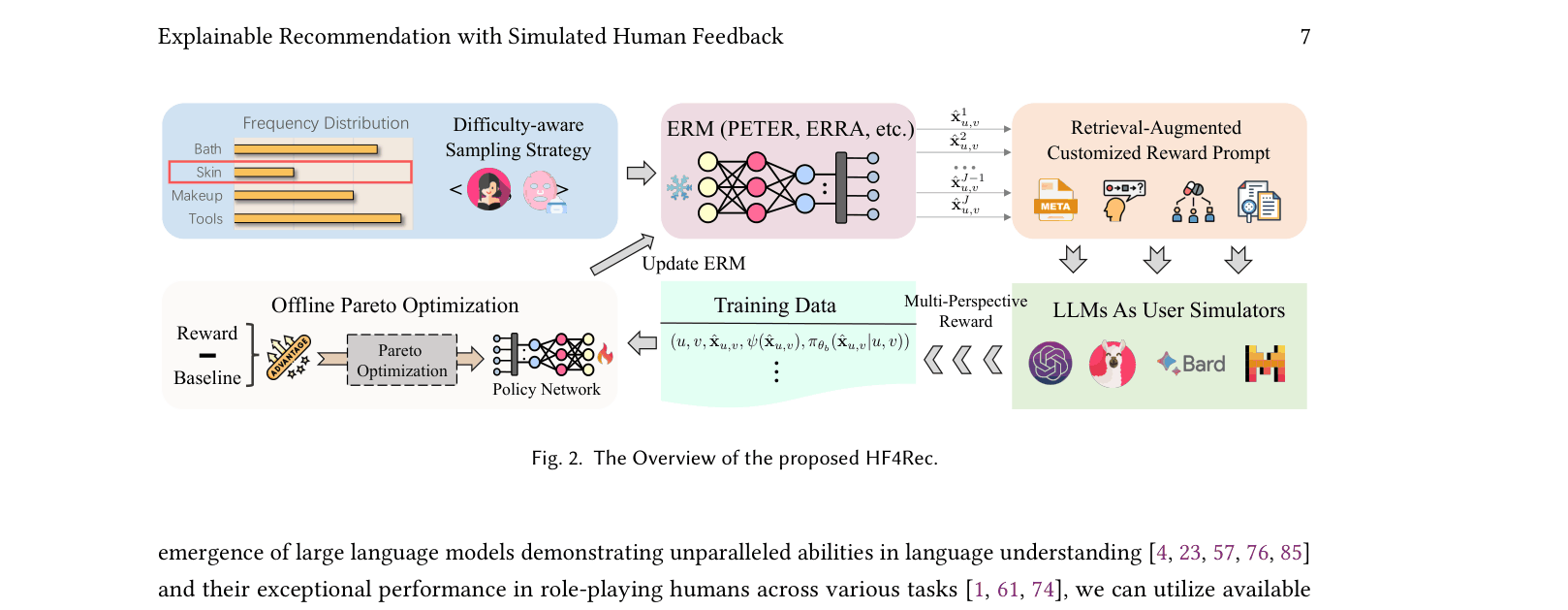
Overview of the HF4Rec framework showing the interaction between the Explainable Recommendation Model (ERM), the LLM User Simulator, and the Pareto Optimization loop.
Evaluation Highlights
No quantitative results reported in the provided text
Qualitative superiority claimed over baselines in generating human-aligned explanations
Pareto optimization theoretically guarantees finding a gradient direction that improves all objectives simultaneously
Breakthrough Assessment
7/10
Novel application of RLAIF to the specific domain of explainable recommendation, addressing the critical 'ground truth' problem in text generation. The theoretical integration of Pareto optimization is strong.
⚙️ Technical Details
Problem Definition
Setting: Explainable Recommendation Task
Inputs: User ID u and Item ID v
Outputs: Predicted rating $\hat{r}_{u,v}$ and textual explanation $\hat{x}_{u,v}$
Pipeline Flow
Input (User/Item) -> Encoder -> Rating/Explanation Decoder -> Output Text
System Modules
Base Recommender (M)
Generate rating prediction and explanation text
Model or implementation: PETER, ERRA, or similar Att2Seq models (backbone agnostic)
Novel Architectural Elements
Training loop utilizes a Human Simulator (LLM) decoupled from the inference model
Dynamic Pareto weighting mechanism integrated into the loss function
Modeling
Base Model: Backbone agnostic (Experiments use PETER, ERRA, etc.)
Training Method: Off-Policy Reinforcement Learning with Pareto Optimization
Objective Functions:
Purpose: Optimize policy to maximize human-simulated rewards while staying close to behavior policy.
Formally: PPO-style clipped surrogate objective maximizing expected Advantage A.
clip_epsilon: Not explicitly reported in the paper
learning_rate: Not explicitly reported in the paper
Compute: Not reported in the paper
Comparison to Prior Work
vs. PETER/ERRA: HF4Rec optimizes via RL using simulated feedback rather than supervised NLL loss
vs. Standard RL: Uses Pareto optimization to handle multi-perspective rewards dynamically instead of fixed scalar weights
vs. Human-in-the-loop: Replaces expensive human annotators with LLM simulators
Limitations
Relies on the capability of the LLM simulator to accurately reflect human preferences (simulator bias)
Inference latency during training is high due to LLM interaction (mitigated by off-policy replay buffer)
Requires unobserved data sampling which may introduce noise if not handled carefully
Reproducibility
Prompt templates (3.1, 3.2, 3.3) are fully provided in the text. Algorithm 1 is provided. Code URL is not provided.
📊 Experiments & Results
Evaluation Setup
Explanation generation and rating prediction on e-commerce datasets
Benchmarks:
Amazon Beauty (Product Review Generation)
Amazon Sports and Outdoors (Product Review Generation)
Amazon Video Games (Product Review Generation)
Yelp (Business Review Generation)
Metrics:
RMSE (Rating Prediction)
BLEU
ROUGE
METEOR
Informativeness (LLM/Human Eval)
Persuasiveness (LLM/Human Eval)
Statistical methodology: Not explicitly reported in the paper
Main Takeaways
The paper proposes addressing data sparsity in explainable recommendation by using LLMs to simulate human feedback on unobserved items.
A difficulty-aware sampling strategy is used to improve robustness for niche items/users.
Quantitative results were not included in the provided source text, preventing extraction of specific performance metrics.
📚 Prerequisite Knowledge
Prerequisites
Reinforcement Learning (Policy Gradient)
Multi-Objective Optimization
Large Language Models (Prompting)
Key Terms
Pareto Optimality: A state where no objective can be improved without degrading another; in this context, balancing explanation qualities like informativeness and persuasiveness
Off-policy RL: A reinforcement learning method where the agent learns from data collected by an older or different policy (stored in a replay buffer) rather than only the current policy
PPO: Proximal Policy Optimization—an RL algorithm that uses a clipped surrogate objective to prevent the model from changing too drastically in a single update
Advantage Function: A value estimating how much better a specific action is compared to the average action in that state
Teacher Forcing: A training method where the model is fed the actual ground truth tokens from the previous step rather than its own generated predictions